


This week’s power rankings include the major update of the methodology from a earlier this season, plus a few tweaks each subsequent week. You’ll see that many of the visuals have changed, and I’m also directly comparing the implied Week 9 win probabilities and point spreads from my power rankings to what prediction markets and sportsbooks are projecting.
The major additions to the methodology are as follows:
Better adjustments for non-quarterback injury clusters
Better decay weighting on older results to improve predictive power
Adjusting dropback efficiencies for PFF grading inconsistencies
Using the Bayesian Quarterback Rankings to estimate quarterback change effects
Daily updating of the paid subscriber Google sheet for injuries and other relevant news items
For more info, you can find the archive of previous Power Rankings posts here, which detail the previous methodology.
TEAM OFFENSIVE AND DEFENSIVE STRENGTH
This plot shows the SOS-adjusted performance for every team in their 2026 games. At the risk of confusing things further, I added arrows next to the team logos to show how they have moved week-over-week. The diagonals represent a 55/45 mix for offense/defense strength, so teams along the same diagonal are roughly equal in total strength.
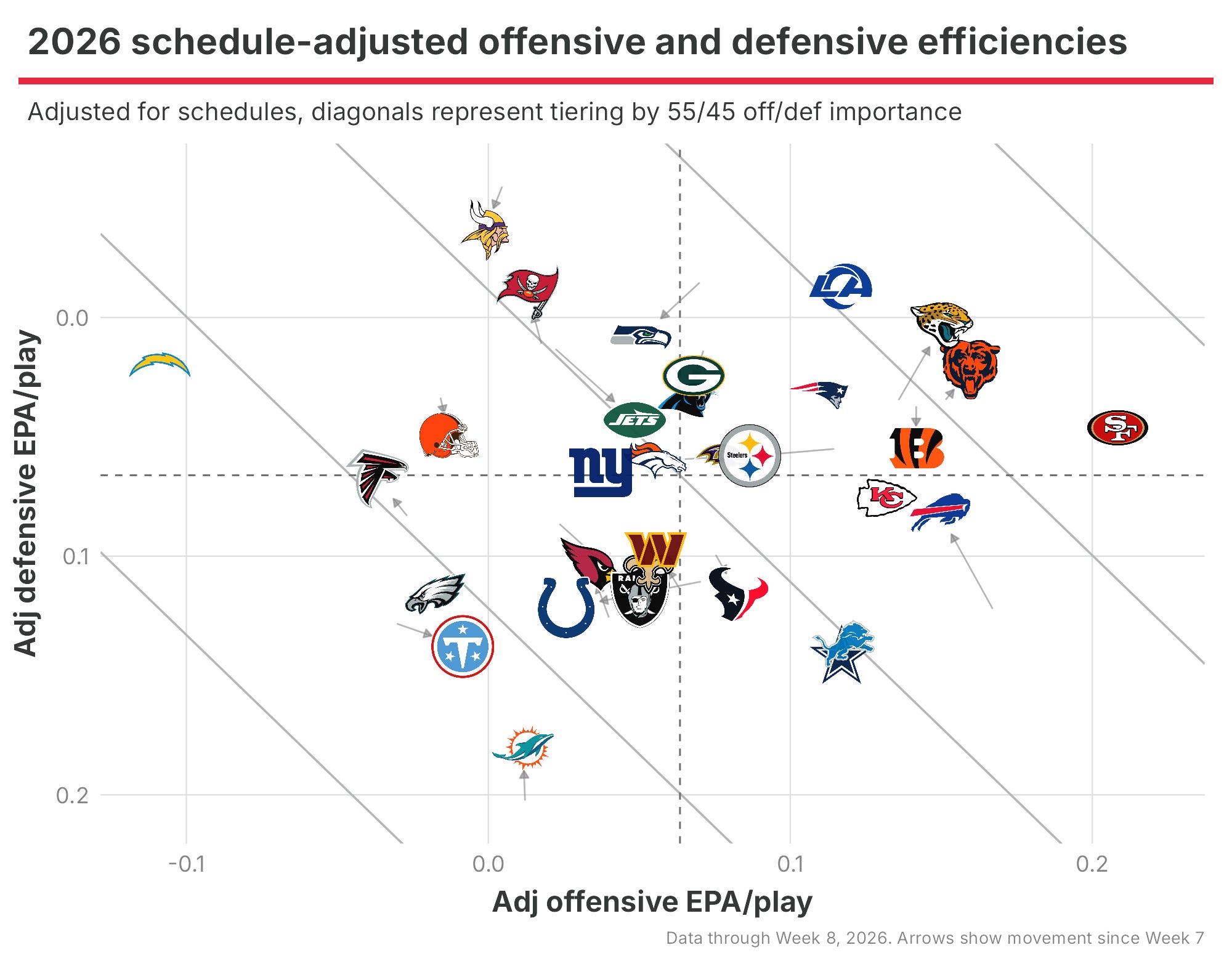
We have a couple teams moving up to approach the San Francisco 49ers in 2026 season-to-date performance, most notably the Jacksonville Jaguars and Chicago Bears.
It’s possible the Week 8 throttling of the Indianapolis Colts wasn’t as impressive as the model would believe for the Jaguars, with the Colts in the middle of a fire sale and, perhaps, folding at the first sign of adversity each week. I think that angle is largely overplayed and that NFL players don’t quit, especially this early in the NFL season. Either way, the Jags have been one of the most complete teams this year, ranking third in adjusted offensive EPA efficiency, and fourth on the defensive side.
I thought the Bears might get a bigger boost off the back of their impressive win at the Seattle Seahawks, but they were already very highly rated, and their offensive success rate in the game was more in the “really good” category than elite. That said, the Bears are moving on up the power rankings, as you’ll see below.
The Buffalo Bills had huge defensive concerns after being one of the worst units in the NFL through their first six games, but then laid the smack down on the injury-riddled Baltimore Ravens. The model is giving them too much credit for that performance, not fully incorporating the strength-of-schedule factor, which I adjust for in the power rankings and Week 9 projections below.
The slop-fest in Florida probably means that the movements up for the Tampa Bay Buccaneers defense and down for the Atlanta Falcons offense weren’t as significant as they seem. The Bucs are now approaching the Minnesota Vikings in 2026 defensive performance, but not quite there.
Speaking of the Vikings, they didn’t move much after their first loss, with the defense and offense looking okay by success rate. The market appears to still be lower on the Vikings than my power rankings.
The movements, or lack thereof, of the Denver Broncos and Kansas City Chiefs are difficult to reconcile with the former’s victory over the latter in Week 8. But the adjusted scores had the Chiefs as the better team (5-point differential better versus actual of four points worse).
POWER RANKINGS VERSUS THE BETTING MARKETS
Let’s start with the power rankings (exact numbers updated daily for injury news on the subscriber Google sheet) before heading to the markets.
*Power rankings and “Model to Market” analysis updated as of 11/3, 10:30AM ET. I send out daily (at least) updates of the numbers in a paid subscriber chat.
