


THE CLAIM
The question is forming on whether the Buffalo Bills can win a Super Bowl with one of the worst defenses in the NFL. Analysts have the Bills ranked from 29th to 32nd in EPA per play allowed, with the second-lowest pressure rate. That doesn’t sound like a Super Bowl contender, but the Bills do have a fantastic offense.

We have a few questions to answer: Has the Bills defense actually been that bad when adjusting for opponent and reducing high variance plays? Has any historical team won (or even gone to) the Super Bowl with a similarly poor defense? How much does the Bills’ offensive success mitigate their poor defense?
THE VERDICT: PARTIALLY TRUE
No team has been as bad defensively as the Bills through six games and won the Super Bowl. But that doesn’t account for how good their offense has been, and using my adjusted-scores-based metric - discounting high-variance plays - makes them look a whole lot better.
The Bills wouldn’t be among the best teams in overall strength to win the Super Bowl, but there have been ones with nearly as bad of defenses, supported by their strong offenses.
THE EVIDENCE
If you measure defensive efficiency by EPA per play, adjusted for opponent-average in other games, the Buffalo Bills have a truly awful defense, ranking in the bottom-3 of the NFL.
If we compare that to past Super Bowl champions since 1999 (data availability), the Bills are ranked lower than any champion, and there is a strong correlation between defensive ranking through six games and the full-season mark.
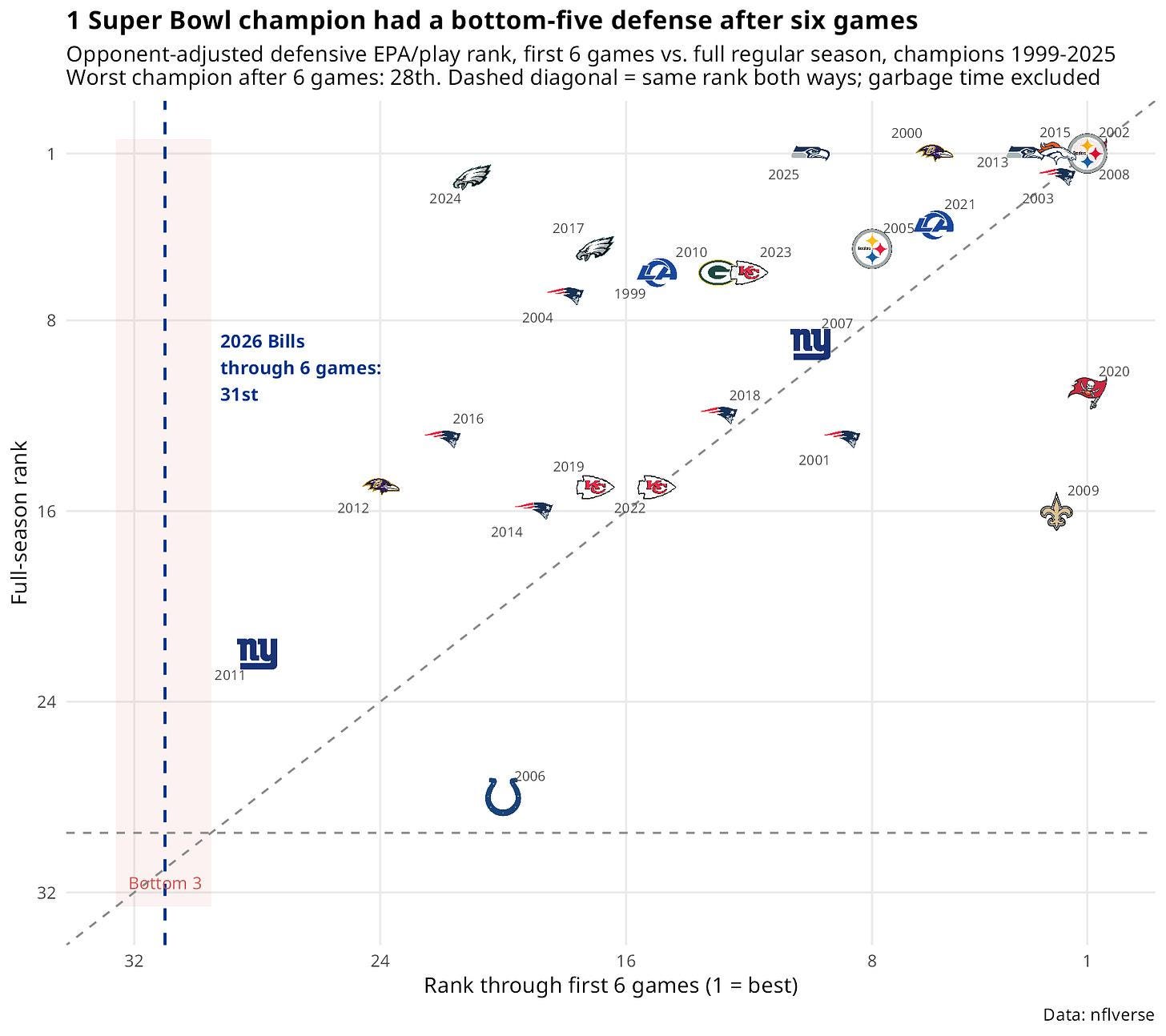
One champion did have a bottom-five defense this early: the 2011 New York Giants, who were 28th after six games. The next worst were the 2012 Baltimore Ravens (24th) and 2024 Philadelphia Eagles (21st). The median champion was a slightly better than average ranking of 12th. The Bills would still be the worst start for any champion since 1999, and that’s from a significant but not overwhelming sample of 27 teams.
The Bills’ offense mitigates a lot of their bad defense, enabling them to start 5-1 this season, with a top-10 previous schedule in terms of difficulty. They have the No. 1 opponent-adjusted offense (+0.21 EPA per play) by the same method as we ranked their defense (31st-ranked defense +0.16 allowed). That nets out to +0.05, which ranks 13th in the NFL this season.
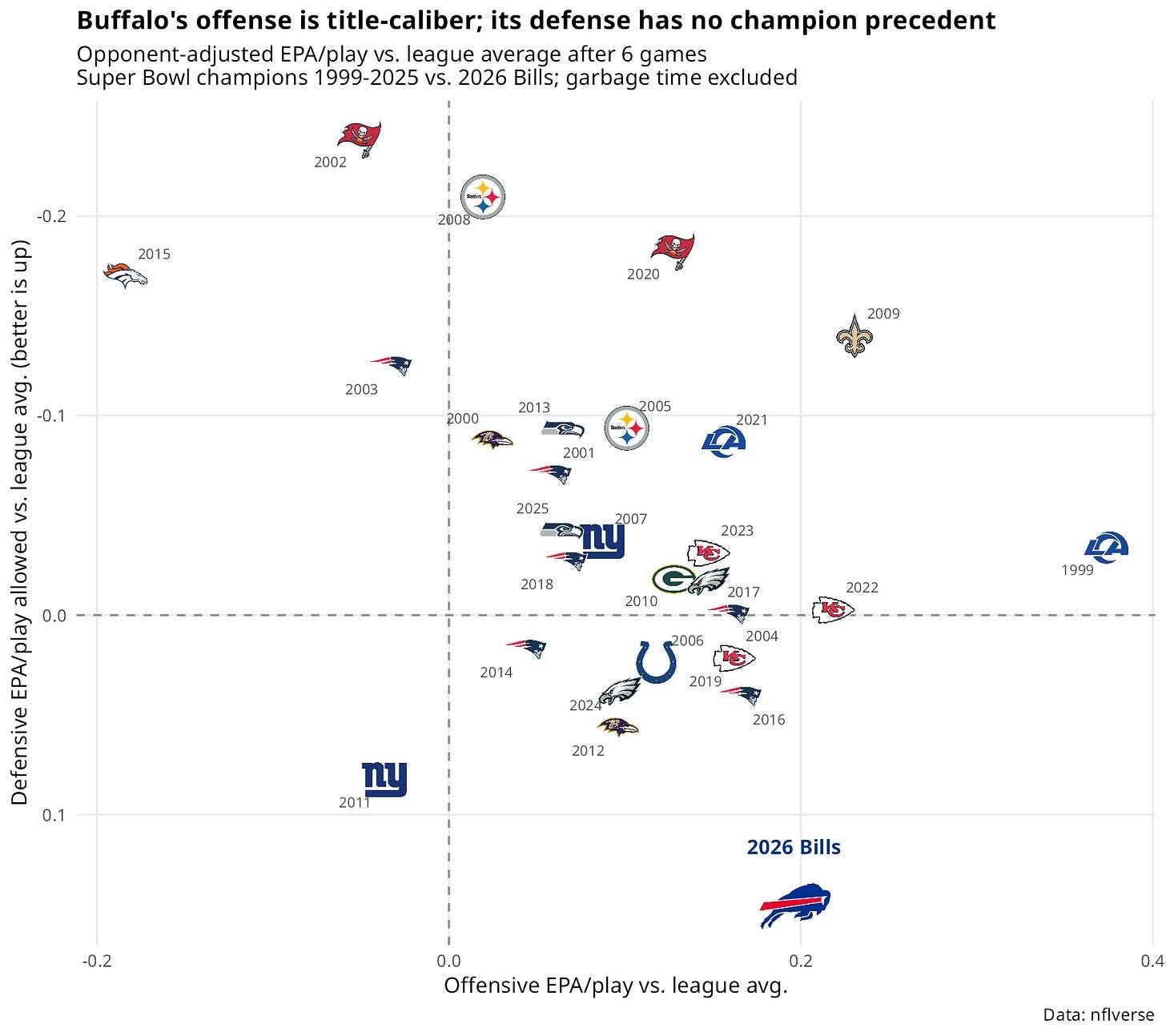
Historically, the gap between a team’s offense and defense has been a good predictor of titles. After six games, the median champion was sixth by net opponent-adjusted EPA efficiency, and 22 of 27 Super Bowl winners were top 10. The only champion as low as Buffalo was, again, the 2011 Giants (26th). Seven champions had below-average defenses, but the Bills are in their own bottom tier in comparison.
A small positive for the Bills is that offensive efficiency has historically been the more reliable half when projecting out over the rest of the season, but, perhaps, not as relatively strong as you’d think. From six games to the full season, offensive EPA has a correlation of 0.80 vs. 0.72 on defense. The Bills defense could improve some, but I wouldn’t count on a big jump.
Things get a bit rosier for the Bills when we switch to my fully adjusted efficiency metrics, that not only account for opponent strength, but are built off of the adjusted scores, which discount high-variance plays and rely more on fundamental metrics, like success rate.
