


The adjusted scores quantify team play quality, with emphasis on stable metrics (success rate) and downplaying higher variance events (turnovers, special team, penalties, fumble luck, etc). Adjusted expected points added (EPA), in conjunction with opportunity-based metrics like total plays and drives, projects adjusted points. Adjusted scores have been tested against actual scores and offer slightly better predictive ability, though their primary benefit is explanatory.
All 2022-2026 and historical Adjusted Scores and other site metrics are available in a downloadable format to paid subscribers via Google Sheet.
Find previous advanced reviews here
Unexpected Points is a reader-supported publication. To receive new posts and support my work, consider becoming a free or paid subscriber.
** Adjusted Scores table:
“Pass” - Pass rate over expectation (based on context of each play and historical averages
“Success” - Success rate on offense, a key metric in adjusted score vs actual
“H & A” - Home or away team
Seahawks (-3, 61%) vs Bears

This was a very strong win for the Chicago Bears on the road against a stout Seattle Seahawks defense. The Bears were up to fifth in my prior-week power rankings and with a slightly better projected win probability in this game than the market, but this performance exceeded all expectations. The Bears had offensive and defensive units working, hitting explosive plays with consistent success while limiting their opponents to very little outside of one big touchdown.
The Bears were penalized 10 times for 85 yards, but the Seahawks’ +4.6 penalty EPA advantage was more than offset by the Bears’ special teams getting +5.0 EPA back, mostly from the blocked field goal (+3.4).
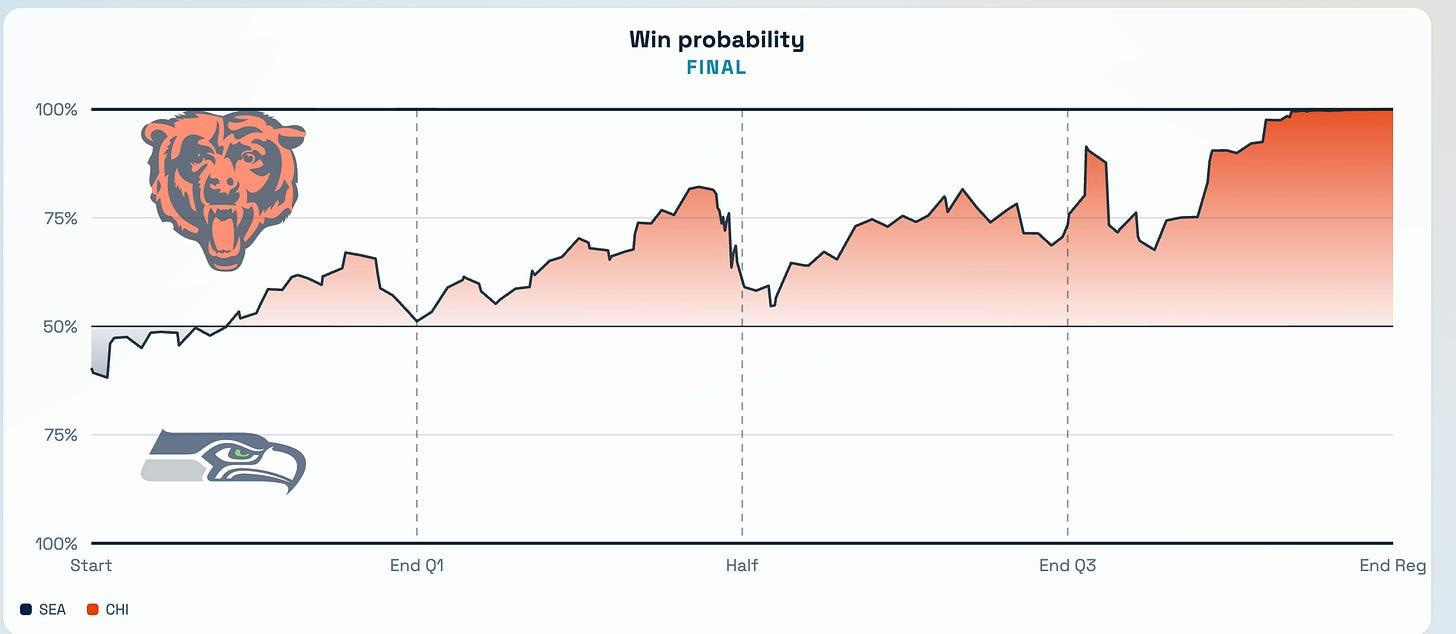
The Seahawks cut the Bears’ lead to within a touchdown at a few of points beyond the first quarter, but the Bears always maintained a 50%+ win probability from the mid-first quarter, then dropping the hammer in the middle of the fourth quarter.
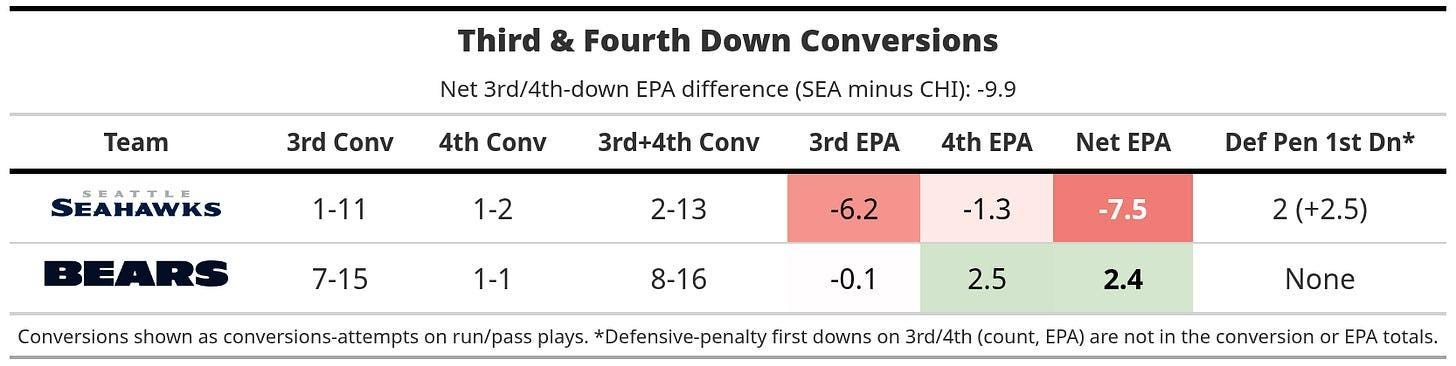
Seattle went 1-of-11 on third down for −6.2 EPA, while the Bears went 7-of-15. The Seahawks lost the late-down EPA margin by -9.9, a huge factor that allowed the Bears defense to end Seahawks drives and stay off the field.

While the Bears were highly successful for positive EPA on a play-by-play basis (49.3%), their yardage efficiency was more moderate at 5.3 per play, held down by only gaining 3.8 YPC.
However, their EPA efficiency was strong, with designed runs gaining more per play than on dropbacks (+0.21 to +0.14). D’Andre Swift converted a massive 4th-and-1 on their own 44-yard line on their first drive of the game, which ended up going for a total of 17 plays, taking 8:32 off of the clock and resulting in a touchdown. In total, the Bears gained +1.2 EPA per play on late downs, with five of six runs resulting in conversions (83%).
An important piece of context is that one of those “rushing” conversions came on what was really a wide receiver screen pass to Kalif Raymond on 3rd-and-9 gaining 39 yards (+4.0 EPA). The pass was slightly backwards, making it technically a running play.
