


This week’s power rankings include the major update of the methodology from earlier this season, plus a few tweaks each subsequent week. You’ll see that many of the visuals have changed, and I’m also directly comparing the implied Week 10 win probabilities and point spreads from my power rankings to what prediction markets and sportsbooks are projecting.
The major additions to the methodology are as follows:
Better adjustments for non-quarterback injury clusters
Better decay weighting on older results to improve predictive power
Adjusting dropback efficiencies for PFF grading inconsistencies
Using the Bayesian Quarterback Rankings to estimate quarterback change effects
Daily updating of the paid subscriber Google sheet for injuries and other relevant news items
For more info, you can find the archive of previous Power Rankings posts here, which detail the previous methodology.
TEAM OFFENSIVE AND DEFENSIVE STRENGTH
This plot shows the SOS-adjusted performance for every team in their 2026 games. At the risk of confusing things further, I added arrows next to the team logos to show how they have moved week-over-week. The diagonals represent a 55/45 mix for offense/defense strength, so teams along the same diagonal are roughly equal in total strength.
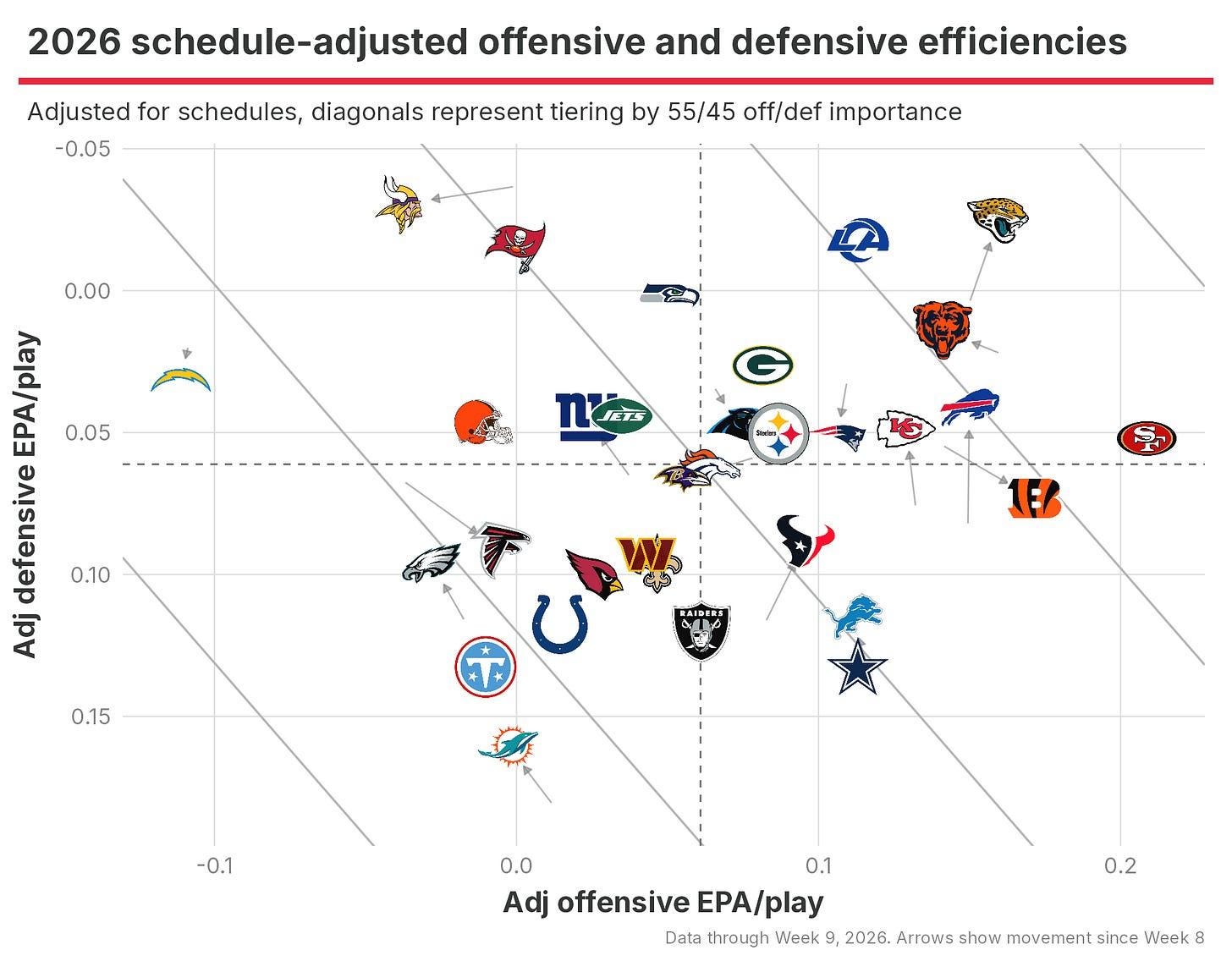
The biggest move in the top tier was for the Jacksonville Jaguars, with their defense jumping to near the Minnesota Vikings’ in 2026 adjusted efficiency, while their offense is now in the top-3. If you look along the diagonal representing the 55/45 split of offensive and defensive performance, the Jaguars are now above the San Francisco 49ers, who didn’t move after beating the Las Vegas Raiders in Week 9.
The Chicago Bears won again on Sunday night against a stingy Tampa Bay Buccaneers defense, but their efficiencies slightly weakened rather than improving. As injury updates came in during the week for the Los Angeles Rams, the Bears had already moved into the top power ranking spot before Sunday kickoffs.
The Cincinnati Bengals’ offense played well enough in Madrid to become No. 2 so far this season, but their defense wasn’t as fundamentally strong as the final score indicated. The Buffalo Bills have suddenly shifted from one of the worst defenses in the NFL a couple weeks ago to above average. That unit completely shut down the Minnesota Vikings’ offense on Monday night, and was good enough against an injury-riddled Baltimore Ravens attack in Week 8.
The Houston Texans are only 3-5 this year, but their fundamentals look more like a top-half NFL team, laying the smack down on a tumbling Los Angeles Chargers squad last week.
By adjusted offensive efficiency, the Vikings are now the second worst team in the NFL, though nowhere close to the Chargers, who reside in a tier of shame all by themselves.
Surprisingly, the Green Bay Packers didn’t improve much, nor the New England Patriots fall (much) when the former crushed the latter on Sunday, as turnovers played an outsized role in the win and the model discounts their effects somewhat.
POWER RANKINGS VERSUS THE BETTING MARKETS
Let’s start with the power rankings (exact numbers updated daily for injury news on the subscriber Google sheet) before heading to the markets.
*Power rankings and “Model to Market” analysis updated as of 11/10, 11:30AM ET. I’ll update that table at least daily in this dedicated post. I might need a major update early Tuesday evening if the trade deadline includes important deals.

