


The adjusted scores quantify team play quality, with emphasis on stable metrics (success rate) and downplaying higher variance events (turnovers, special team, penalties, fumble luck, etc). Adjusted expected points added (EPA), in conjunction with opportunity-based metrics like total plays and drives, projects adjusted points. Adjusted scores have been tested against actual scores and offer slightly better predictive ability, though their primary benefit is explanatory.
All 2025-2022 and historical Adjusted Scores and other site metrics are available in a downloadable format to paid subscribers via Google Sheet.
Find previous advanced reviews here
** Adjusted Scores table:
“Pass” - Pass rate over expectation (based on context of each play and historical averages
“Success” - Success rate on offense, a key metric in adjusted score vs actual
“H & A” - Home or away team
TB (-6) vs ATL

This was a significant loss for the Tampa Bay Buccaneers in their drive to the NFC South title, though not the knockout blow you might think. The Bucs still have both matchups against their only divisional rival Carolina Panthers left to play, making the results of those two contests most critical. The Bucs now need at least a split of those results to have a chance to win the division, and could lock in the title with two wins, no matter what happens in their last remaining game against the Miami Dolphins.
Before getting into how the Bucs could have been slightly unlucky to lose the game, I’ll start with the nerd sh!t up top: Going for two down eight can still work even if you fail in two straight conversion attempts. To clarify the theory that the Atlanta Falcons attempted to use in as brief an explanation as possible: If you’re down 14 points late in the game, you should go for two after the first touchdown, then the knowledge of that result can be used to decide if you go for two again (fail the first time) or simply kick the extra point (succeed the first time). If you do the traditional thing and kick two extra points, the likely best case scenario is a tied game and overtime, which is on average a 50/50 proposition. Creating an outcome of potentially winning the game by one and avoiding overtime has a lot of value (you can still go to overtime with a 2-point failure and subsequent success), though you open up the possibility of failing on both and being down one point.

The Falcons got the worse-case 2-point scenario that occurs roughly 25% of the time (assuming 50% 2-point conversion probability), but still won the game. This hints at an additional benefit of playing to win in regulation and not overtime. A deficit late forces your offense to take risks that it wouldn’t have in a tie game. In their final game-winning drive, the Falcons converted a 4th & 14 at their own 43 yard-line with 49 seconds remaining that they never would have tried in a tie game, putting them in position for the field goal. The underplayed downside of the go-for-2-down-8 strategy is the inverse of this scenario: If you do covert the first 2-pointer and eventually lead by one, you motivate your opponent to take more risks that they wouldn’t if the game was tied.
As you can see after all this theorizing on my part, this is all very complicated with more scenarios that you’d think in play. As a general rule, the underdog team should like the strategy because it introduces the likelihood of a few extremely high-leverage plays and overall variance, either with 2-point conversions or 4th down tries.
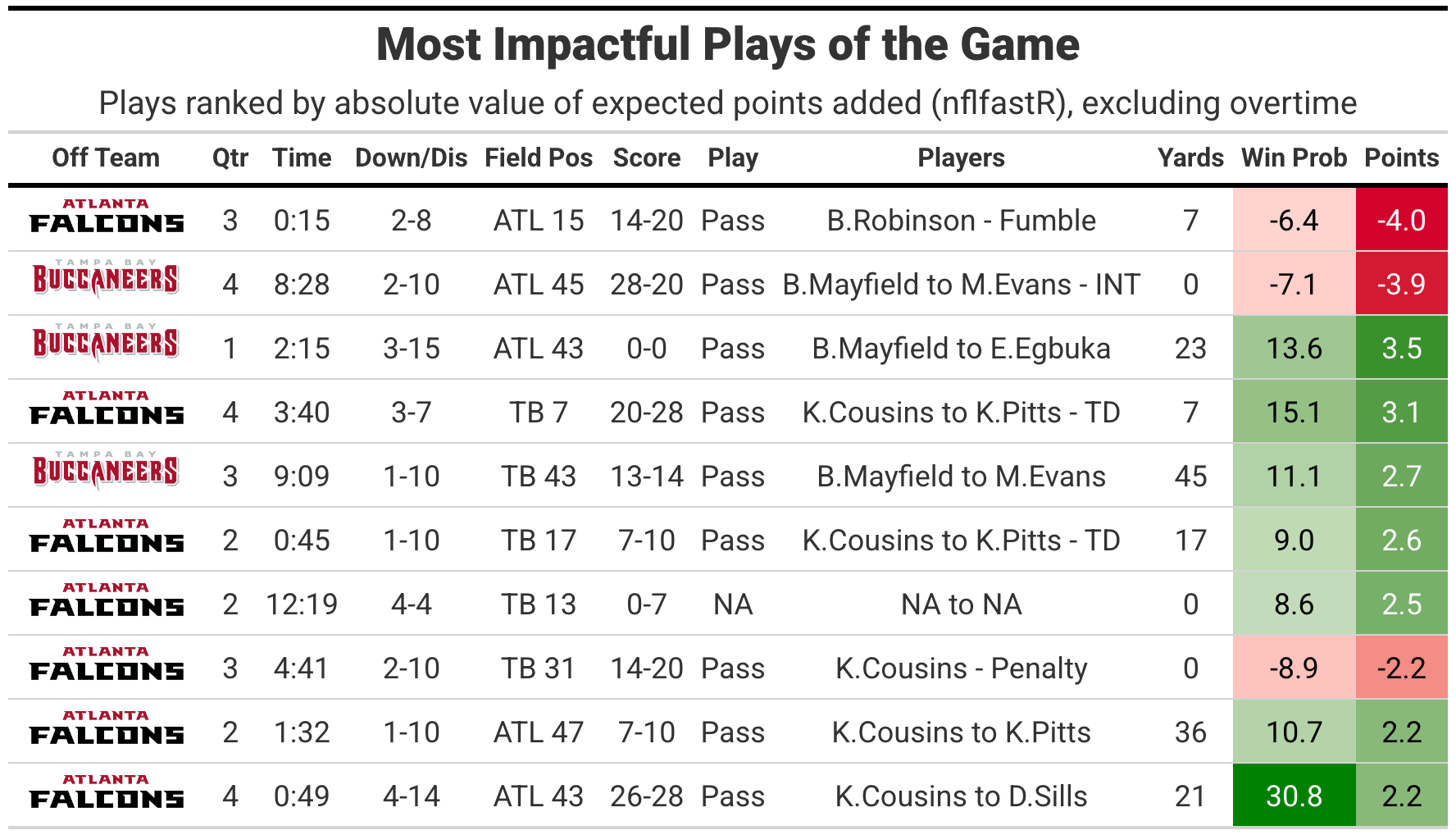
The reason the adjusted scores had the Bucs as slightly better was mostly based on their better offensive success rate (52% to 46%), though the comeback charge from the Falcons forced them to drive the ball down the field in the passing game, raising their EPA efficiency higher (84th percentile to 78th). Where the Bucs were “lucky” by my model is via penalties, gaining 125 yards and seven first downs. Looking at non-penalty yardage figures, the Falcons appear unlucky to only win by two, out gaining the Bucs in total (476 to 338) and per play (7.2 to 5.5).
It was a fantastically efficient and totally unexpected performance from Kirk Cousins, after posting negative EPA in four of his other six games this season with at least 15 dropbacks. Baker Mayfield was also efficient, though his interception and five sacks taken dragged his EPA lower, even though he should get credit for producing big plays down the field, rather than relying on receiver YAC.

Thanks for the very clear write up on the go for 2 down 14 discourse.
Re: Baker and Bucs benefit of falcons penalties skewing the game outcomes (adjusted and actual), I think Baker’s stats in your calculation are actually deceivingly high. At least 2 sacks wiped off by penalties. Do your # account for that?