


We’ve finally gotten to and finished the first round of the NFL draft. There will be a ton of content hitting the streets in the next 12 hours to tell you the feeling and opinions on which teams made the best use of their draft capital.
In this post, I eschew the vibes-based analysis that dominates NFL media and judge the first round on explicit metrics that matter. I leveraged the excellent weighted mock draft data from Grinding the Mocks and consensus media Big Board data aggregated from Jack Lichtenstein on his beautifully formatted website. In addition, I estimated the NFL value and subtracted the contractual commitment of each pick to determine the player’s surplus value, or value you’d have to pay in free agency over what the rookie contract demands. I went through this exercise earlier this month building a more useful Big Board using Sports Info Solutions draft grading and positional contract data from Over the Cap.
Let’s get to the data. The first section below has a table with a row for every pick. It has the pick number, the mock draft-based estimated draft position, the consensus big board ranking, and the estimated values of the prospect, his contract amount and the surplus value to the team. The “NFL values” for the picks are based on my research for draft curve value by pick and position.
I also have a plot showing the differences better than the actual pick numbers and the consensus opinions on mocks and big boards. Let’s get to the data
TOP-12 PICKS OF THE ROUND
The “Value” number is my estimate for salary cap equivalent for the player based on positional value and historical trends for prospects taken at his draft slot. Contract is the annual amount due, and surplus value is the difference that the team gains acquiring the player through the draft.
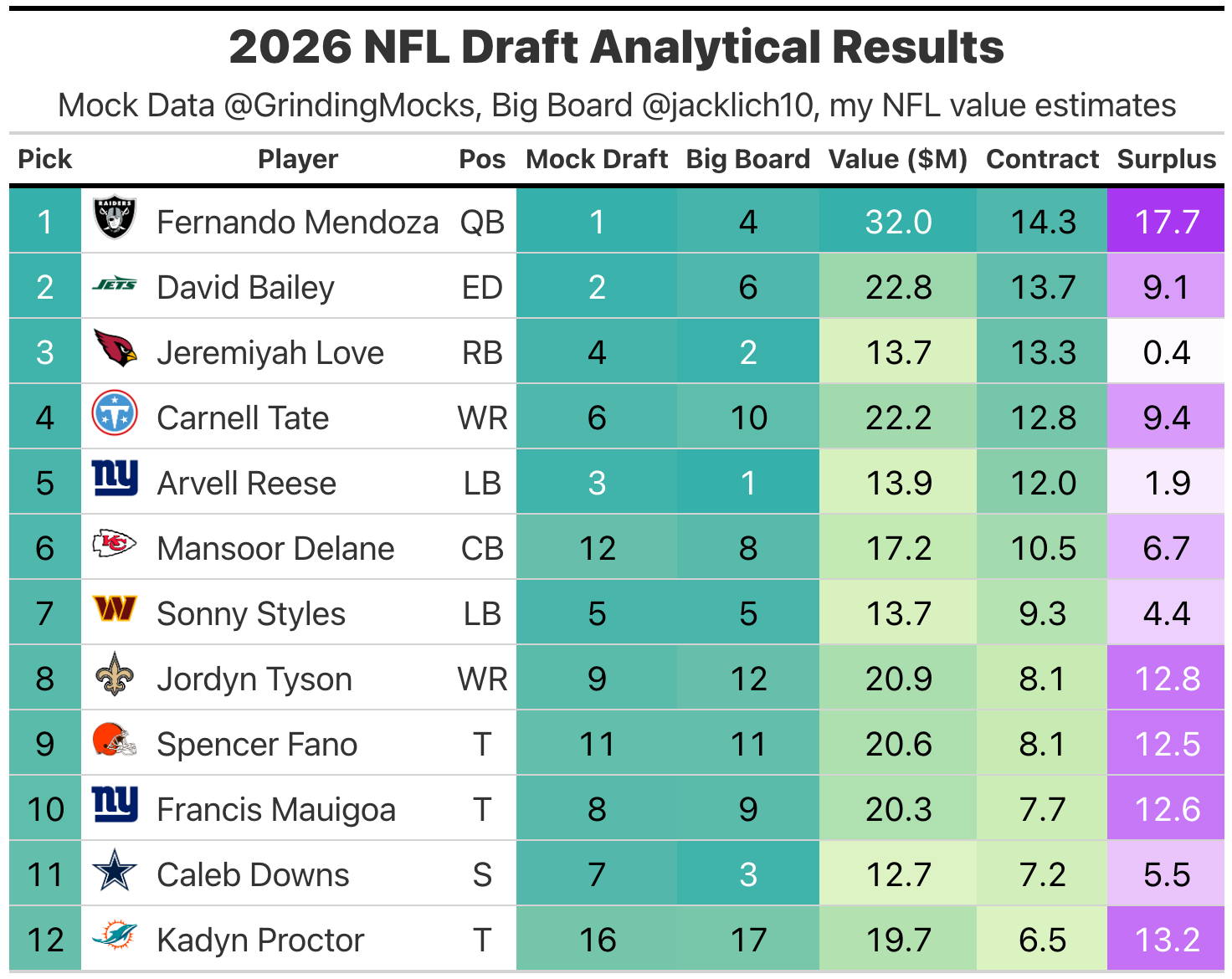
The expected No. 1 pick by mock drafts was Fernando Mendoza, and he goes first overall. His big board consensus ranking was a bit lower at fourth, and that assessment is likely inflated by assumptions of where he would go in the draft. For what it’s worth, Sports Info Solutions had Mendoza ranked 25th on its position-agnostic big board. There’s no higher expected NFL value in the draft than for a quarterback taken No. 1 overall, which offsets the higher price in contract costs to give Mendoza an estimated average surplus value of a little under $18 million a season over his four-year rookie contract.
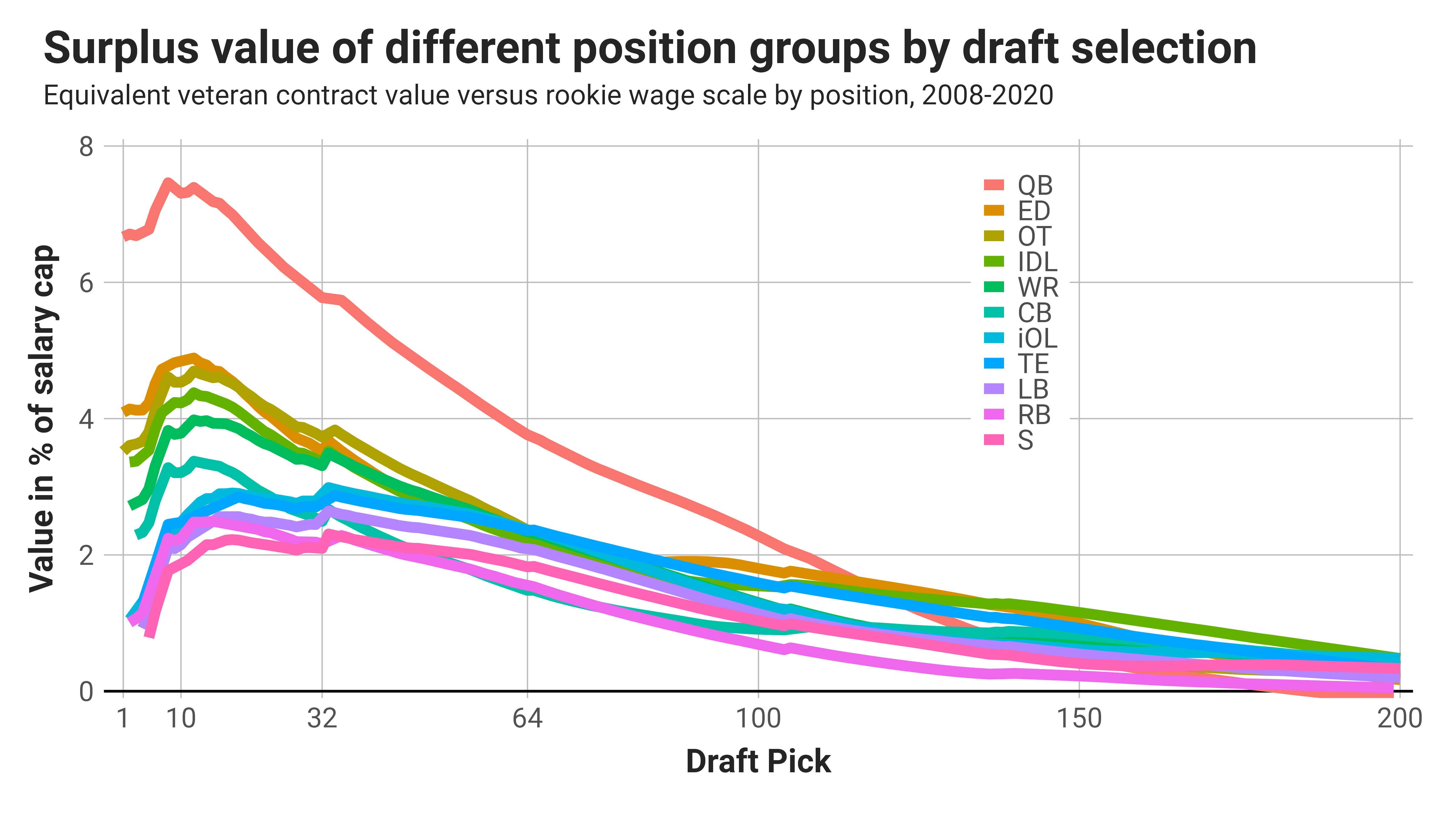
The New York Jets followed next with the selection of David Bailey, who represents the second most valuable position in the NFL, according to what league general managers are willing to shell out in veteran costs on the free market1 . Because of the exponential increase in contract costs near the top of the draft, Bailey’s second-highest projected “NFL Value” only translates into the seventh highest surplus value of the top-12 picks. What isn’t represented in those numbers is the range of outcomes that truly represent the value of the picks, not only the mean estimates. Bailey has a greater likelihood of being a truly elite player, and therefore exceedingly valuable asset, than players drafted below him at the same position. That said, the degree to which early taken players are assumed in NFL circles to have higher upside is probably overstated.
The running back discussion will never die, and the selection of Jeremyiah Love at third overall by an Arizona Cardinals team that isn’t projected to be very good (Cardinals over/under win total is currently 4.5 and skewed to the downside at DraftKings) will keep the most worn-out debate in the mix this season. Using expected value numbers derived through positional veteran contracts and pick-adjusted hit rates, this selection appears to be a wash - the Cardinals took one of the most valuable assets in the NFL (an early draft pick) and turned it into a pumpkin. However, veteran contracts are less representative of NFL value for running backs than at any other position, with their value peaking much earlier, often playing at an elite level immediately as rookies.
NFL teams are smart to low-ball veteran running backs in contract talks, not knowing if their useful NFL lives will last much beyond their mid-20s. That’s not an issue for rookie running back contracts, but you also can’t make the mistake to assume top-10 running back selection will automatically turn into an elite player. Yes, running backs are more likely to “hit” in terms of productive early years than at other positions, but you can’t ignore that busts exist. From 2010 to 2025, nine running backs were selected in the top-10 picks, which includes some relative disappointments, like Trent Richardson (third overall), Leonard Fournette (fourth) and CJ Spiller (ninth).
Carnell Tate projects as a solid value selection at fourth overall, with wide receiver contracts skyrocketing in recent years. The hedge on the increasing value of wide receivers is that elite ones are more likely to be found later in the draft than at positions like edge and offensive tackle.
The valuations of picks of Arvell Reese and Sonny Styles take a big hit due to positions, with off-ball linebackers generally projecting as “tier 3” values, below several other positions.The market for veteran linebackers has been stagnant recently, with elite players commanding far less than at edge and interior defensive line, not to mention cornerback. These players will likely generate surplus value, though the New York Giants and Washington Commanders may have been better served to address the position at market rates in free agency, and then use their early draft picks to fill other needs.
