


The adjusted scores quantify team play quality, with emphasis on stable metrics (success rate) and downplaying higher variance events (turnovers, special team, penalties, fumble luck, etc). Adjusted expected points added (EPA), in conjunction with opportunity-based metrics like total plays and drives, projects adjusted points. Adjusted scores have been tested against actual scores and offer slightly better predictive ability, though their primary benefit is explanatory.
All 2025-2022 and historical Adjusted Scores and other site metrics are available in a downloadable format to paid subscribers via Google Sheet.
Find previous advanced reviews here
** Adjusted Scores table:
“Pass” - Pass rate over expectation (based on context of each play and historical averages
“Success” - Success rate on offense, a key metric in adjusted score vs actual
“H & A” - Home or away team
PIT vs HOU (-3)

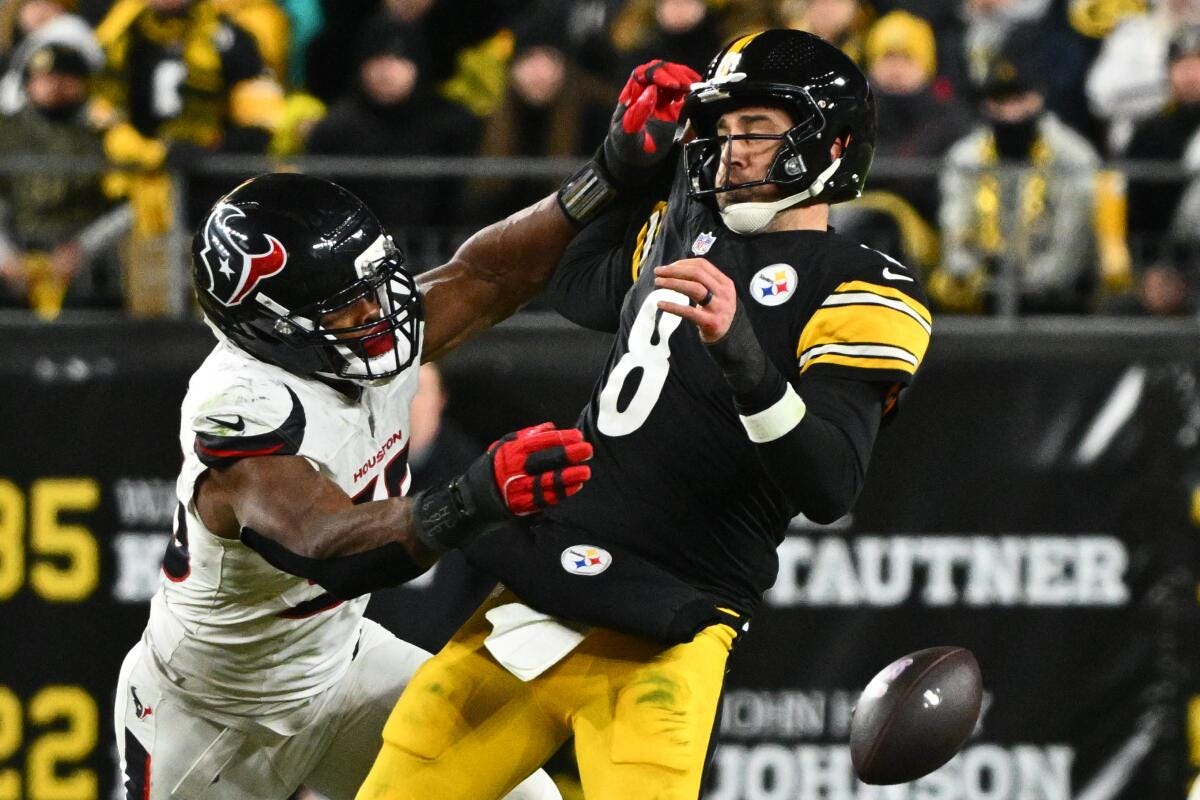
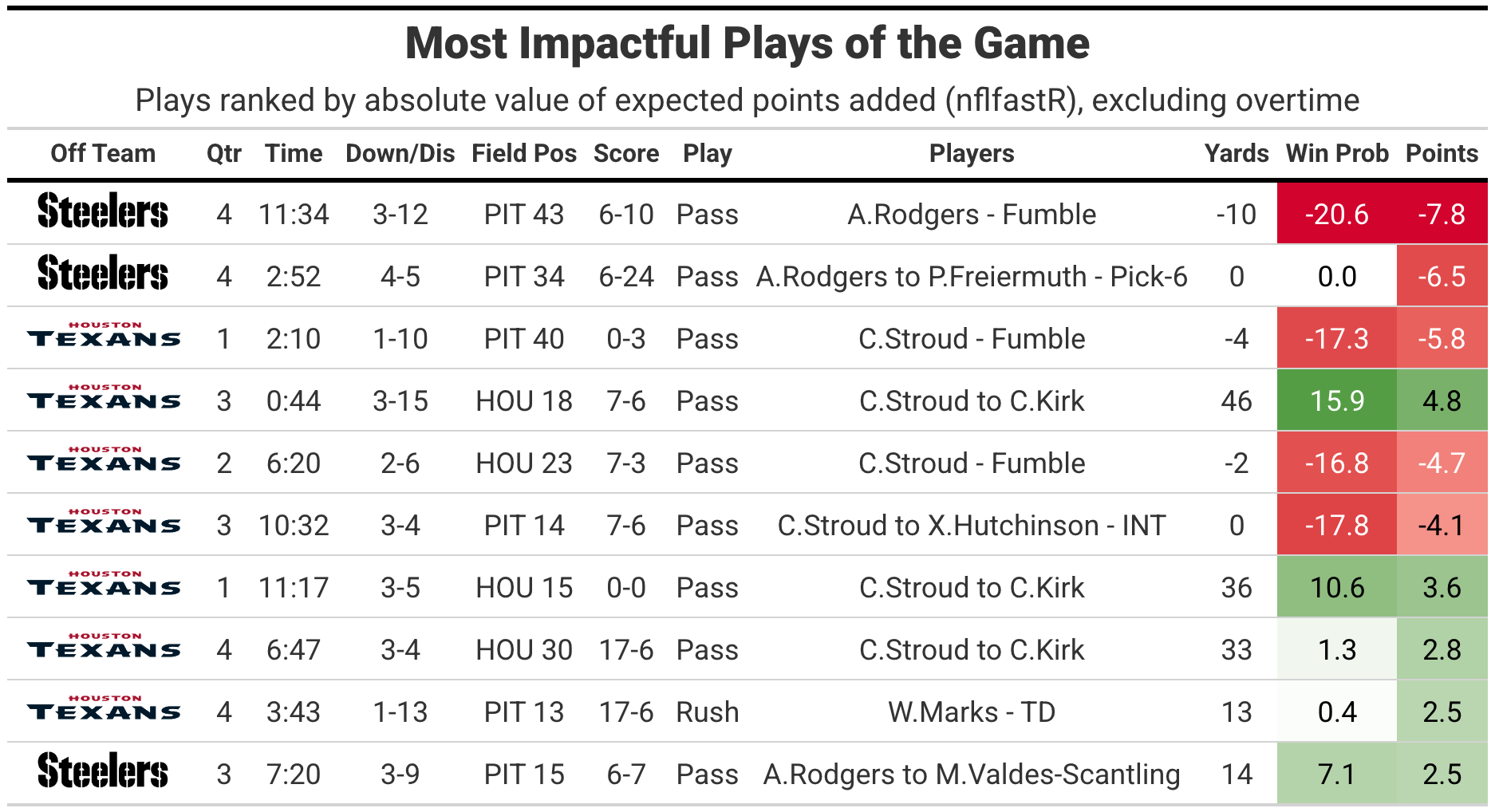
It was a close game early that eventually widened into a blowout down the stretch. The theme for the first two-and-a-half quarters of the game was the Pittsburgh Steelers’ inability to convert third downs (ended the game 2-for-13, -13.9 EPA) offset by C.J. Stroud’s generous nature (two fumble losses and an interception, -14.6 EPA). That left the score 7-6 with the Houston Texans having a slight lead. Then all hell broke loose for the Steelers in the fourth quarter, with two of their offensive drives ending in Texans defensive touchdowns, and the Texans offense finally kicking into gear with 10 points on their final two possessions.
Outside of third down conversion issues, the Steelers offense wasn’t horrible in the first half, but they couldn’t translate generous field positions into points, and the total breakdown in the second half left them with horrendous metrics, including a 29% success rate and below 1st percentile EPA efficiency. Despite all the losses to turnovers, the Texans offense was able to post slightly positive EPA, and their rushing attack ground down the Steelers defense in the second half, with their running backs Woody Marks and Nick Chubb finishing with 160 yards on 29 carries (+5.1 EPA).

The Texans offense was able to offset big losses with explosive plays, with Christian Kirk the star. Kirk registered huge plays on third downs, including a 46-yard reception by Christian Kirk with 15 yards to go (+4.8 EPA), and two more big gains of 36 and 33 yards (+3.6 and +2.8 EPA). The Texans generated +13.8 EPA on Kirk’s nine targets, while their 23 targets to other receivers totaled -1.9 EPA.
It was a disaster game for Aaron Rodgers, in what you’d be reasonable to assume was the last game of his career. I’m sure the sentiment on Rodgers will now totally underplay just how awesome he was throughout his career, as we often see at the end, before a rebound in perception a few years later. By my numbers for quarterback value, Rodgers ranks sixth all-time (1947 to present, including AFL and AAFC) among quarterbacks.
There were two Stroud’s on Monday night, one horribly inadequate protecting the ball, the other willing to stretch the ball down the field and make big plays on high-leverage downs. They evened out to a perfectly flat EPA performance, which is relatively poor considering that quarterback dropbacks average slightly positive EPA.
The Texans travel to face the New England Patriots, currently 3-point underdogs on the road.
