


The adjusted scores quantify team play quality, with emphasis on stable metrics (success rate) and downplaying higher variance events (turnovers, special team, penalties, fumble luck, etc). Adjusted expected points added (EPA), in conjunction with opportunity-based metrics like total plays and drives, projects adjusted points. Adjusted scores have been tested against actual scores and offer slightly better predictive ability, though their primary benefit is explanatory.
All 2026-2022 and historical Adjusted Scores and other site metrics are available in a downloadable format to paid subscribers via Google Sheet.
Find previous advanced reviews here
Unexpected Points is a reader-supported publication. To receive new posts and support my work, consider becoming a free or paid subscriber.
** Adjusted Scores table:
“Pass” - Pass rate over expectation (based on context of each play and historical averages
“Success” - Success rate on offense, a key metric in adjusted score vs actual
“H & A” - Home or away team
Cowboys (-9.5) vs Buccaneers

The Tampa Bay Buccaneers get a shock win over the Dallas Cowboys on the road on Thursday Night. The Bucs were 9.5-point underdogs going into the game, but ended up winning by eight points, though the adjusted scores saw the Cowboys as a slightly better team. The Cowboys had a chance to score a touchdown, convert a 2-pointer and tie the game near the end, but their second tipped interception sealed the game (-4.4 EPA).
The adjusted scores are focused on the Cowboys’ better offensive success rate (51% to 46%), with the assumption that their elevated turnover losses weren’t an indication of fundamental performance. What the adjusted score might not properly account for is how lost the Cowboys defense has looked, making the Bucs’ big plays on offense seem less lucky than inevitable.

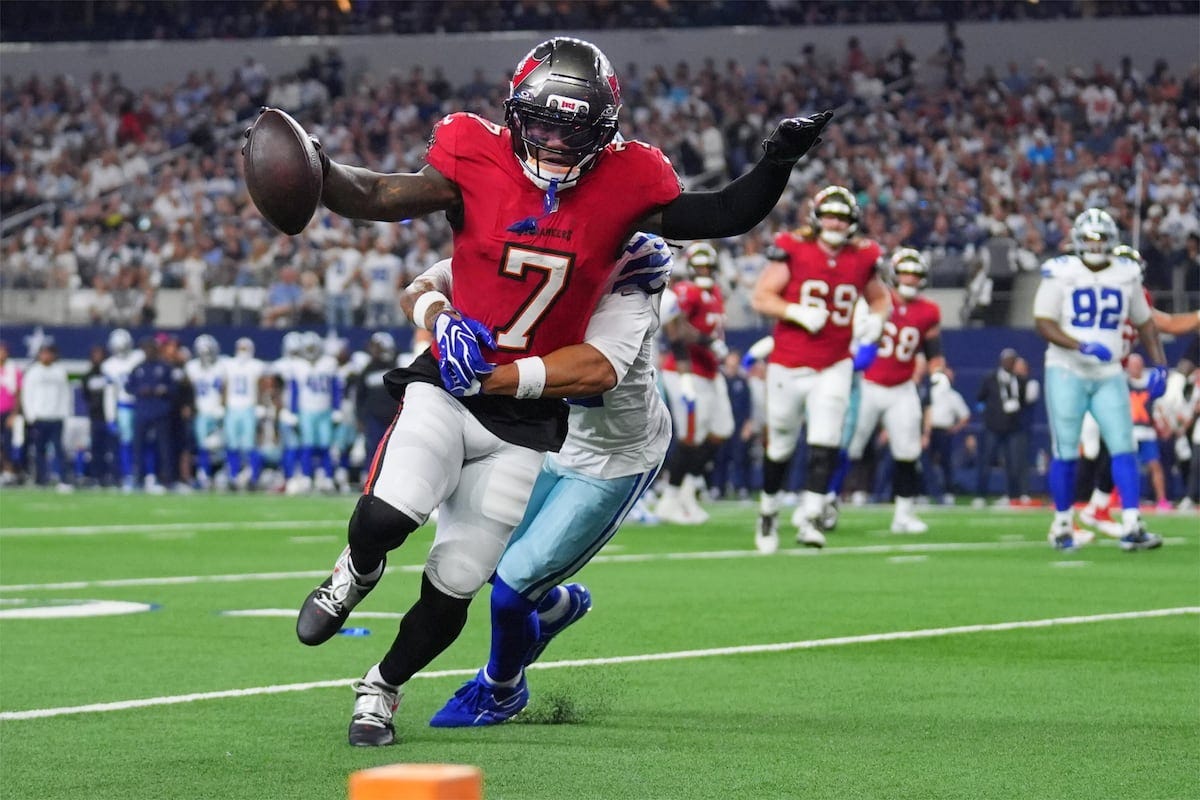
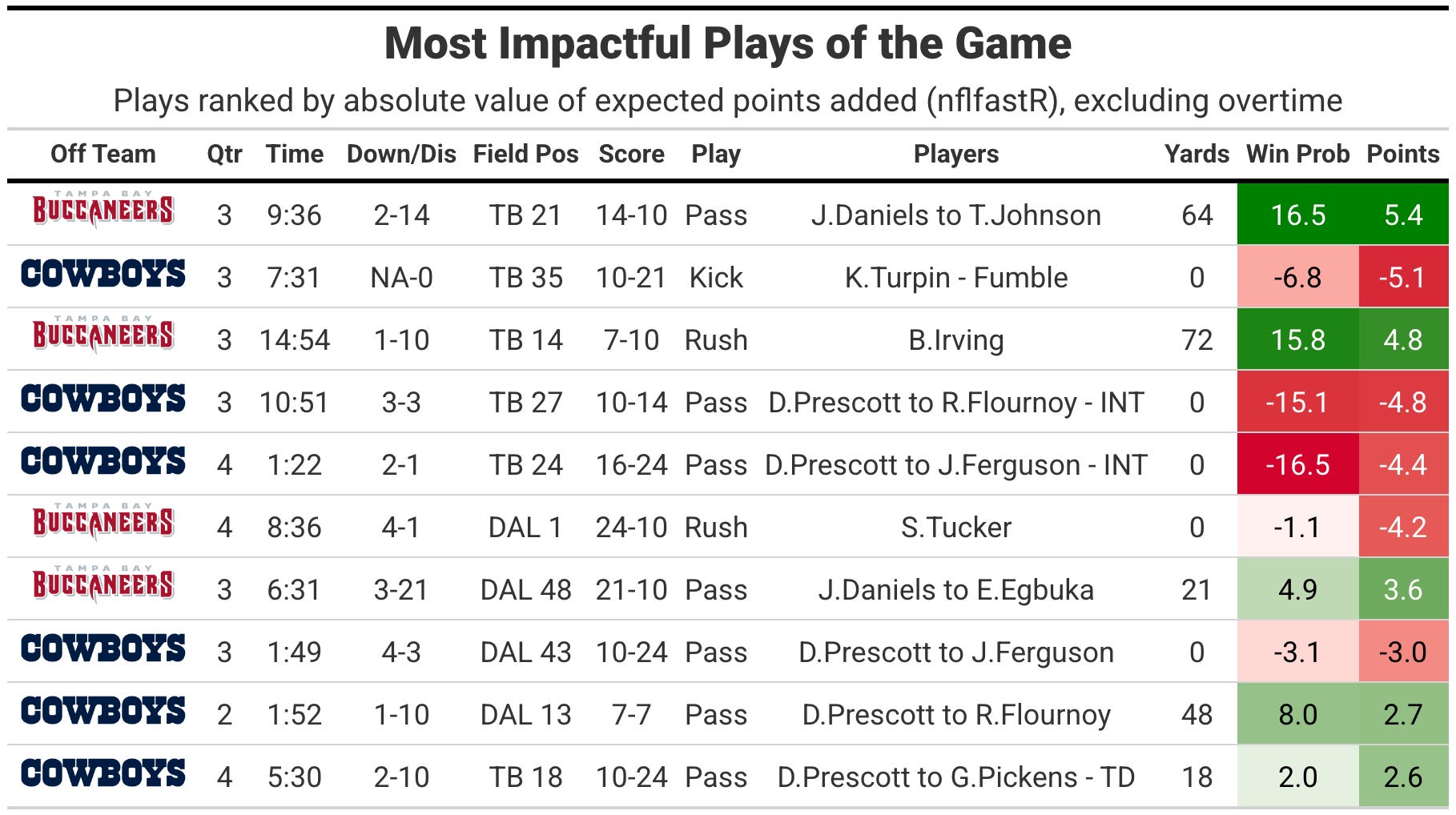
The Cowboys were up 10-7 and halftime, before the Cowboys defense decided to allow monstrous gains to Bucky Irvin on the ground (72-yarder for +4.8 EPA) and Tez Johnson through the air (64-yarder, +5.4 EPA) on the Bucs first two second-half drives that set up touchdowns. The Cowboys offense started the second half by driving 41 yards before throwing an interception that went through the hands of Ryan Flournoy (-4.8 EPA), then fumbling away the kickoff return on their next possession (-5.1 EPA).
If that sequence of events wasn’t bad enough, the Bucs converted a 3rd & 21 on the next drive (+3.6 EPA) that eventually led to three points. The first five possessions of the second half shifted the score from 10-7 Cowboys to 24-10 Bucs, with the win probability flipping from Cowboys at 77% to the Bucs at 78%.

Beyond turnover losses, another factor the adjusted scores discounts in higher variance EPA swing on late downs, with the Cowboys losing 6.7 expected points on third downs and another -3.0 EPA on a 4th & 3 failure that the Cowboys needed to convert on their own side of the field to get back into the game going into the fourth quarter. The Bucs also failed on their 4th & Goal try from the 1 yard-line (-4.2 EPA), but big third down conversions on other drives kept their late-down efficiency only modestly negative.
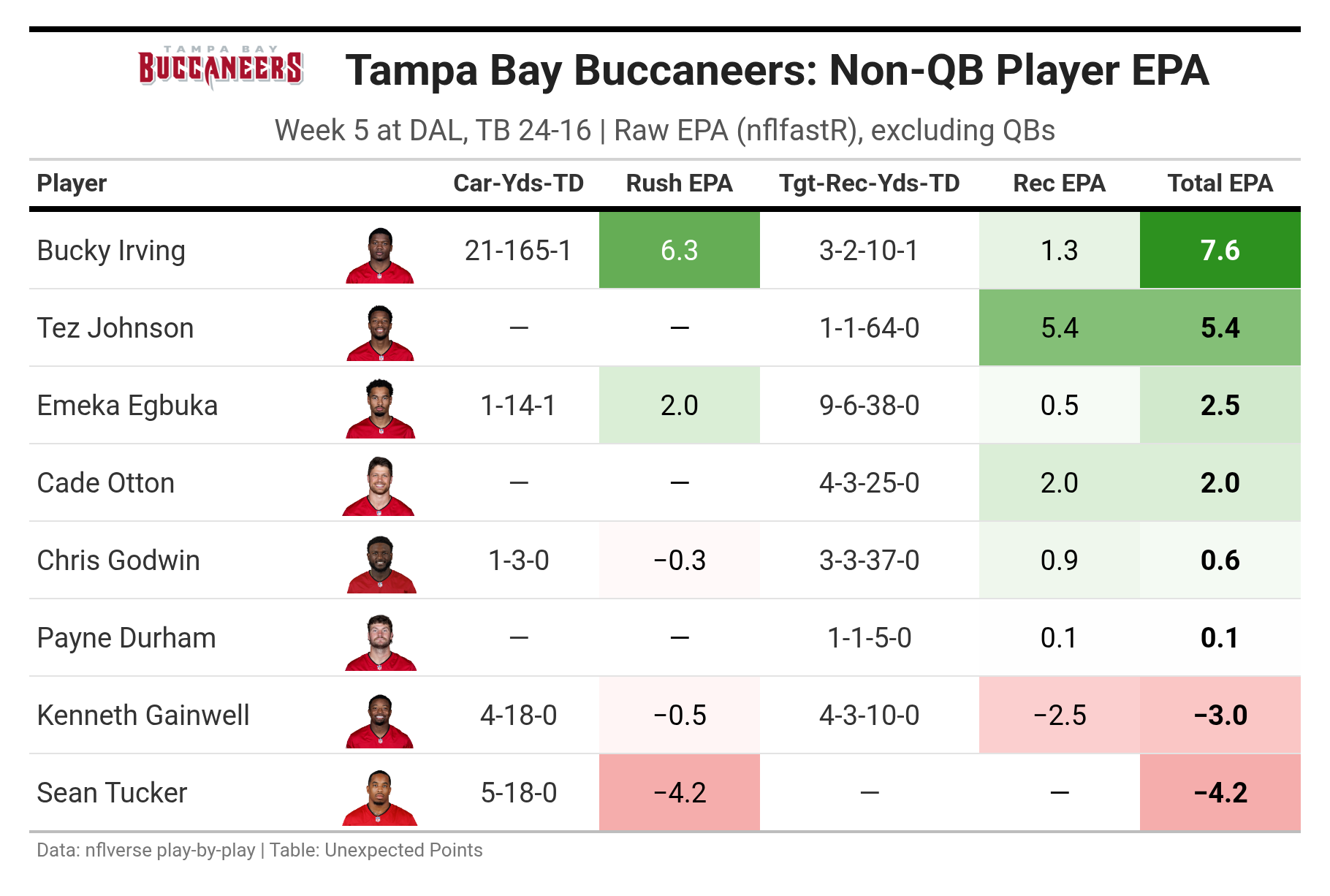
The Cowboys averaged 6.7 yards per play to the Bucs at 6.4, but ran 10 fewer plays, and their efficiencies were killed by tipped interceptions. They ran the ball, but didn’t do it often, especially in the second half while trailing. The Bucs, on the other hand, were able to use the rushing game to kill clock and sustain drives, plus getting an explosive play from Irving, who finished with +6.3 EPA on 21 carries for 165 yards and a score.
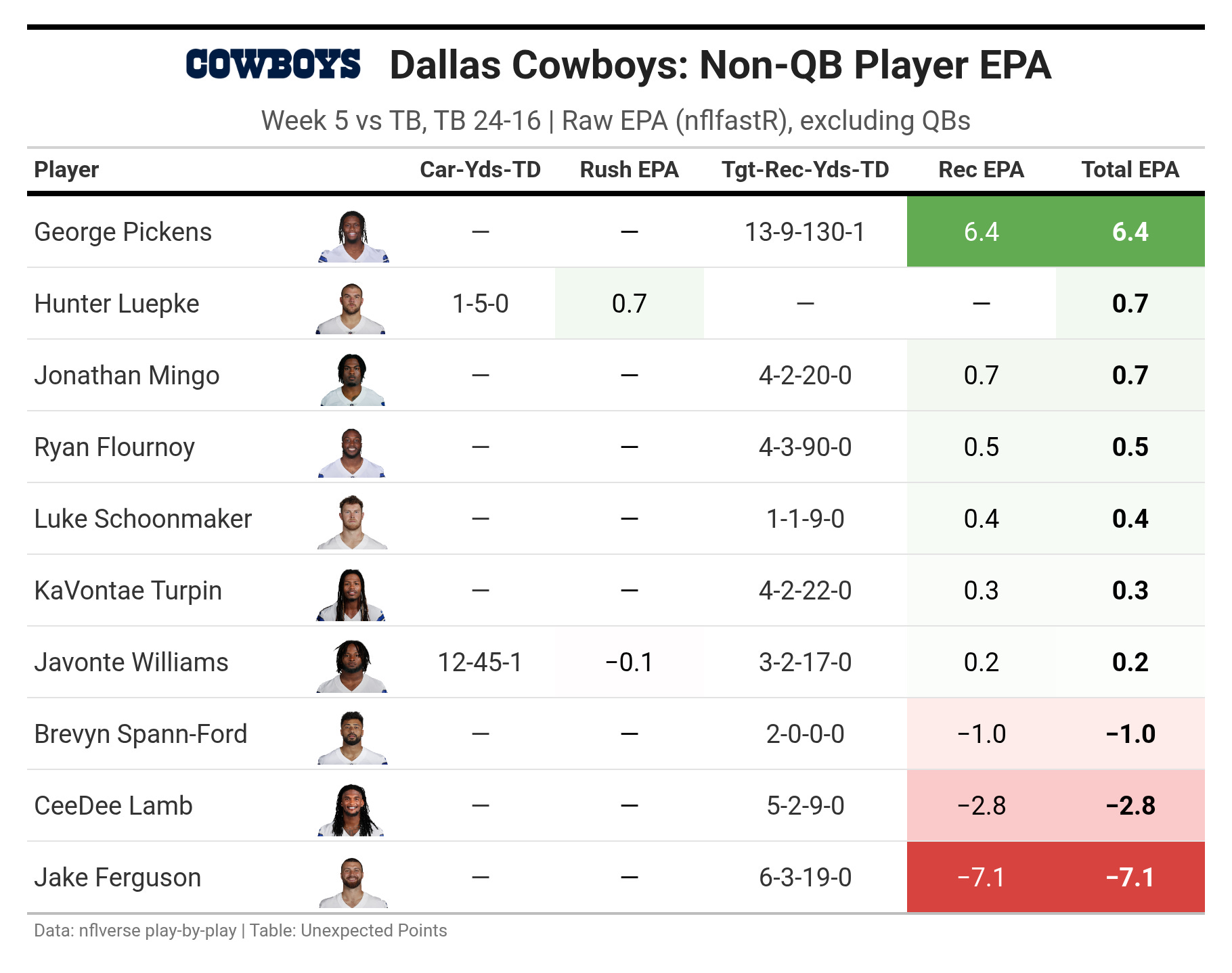
For the Cowboys, George Pickens stepped up with the disappearance of CeeDee Lamb, as the former gained +6.4 EPA on 13 targets (9-130-1), and Lamb dropping from 17 catches and 189 receiving yards a week ago to two catches for nine yards last night (-2.8 EPA). Lamb was seen limping on the sideline in the fourth quarter, leaving his health in question for Week 6.
You could pin Dak Prescott’s inefficiencies on the two dropped/tipped interceptions that cost him a combined 9.2 expected points, but they don’t fully excuse his poor metrics. Prescott only completed 24/42 pass attempts (57%, -10% versus expectation) and didn’t add any value on scrambles, but also avoided sacks.
Jalon Daniels looks fantastic by the numbers in a controlled gameplan, avoiding turnovers (PFF does chart him with one “turnover-worthy play”) and only taking one sack. His adjusted efficiency numbers will likely be lower when I update those next week, as his 4.4-yard aDOT and YAC EPA contributions discount some of his value accumulation on pass attempts.

The loss drops the Cowboys to 2-3, but they’re still the favorites to win the dysfunctional NFC East at 37%, though down about 12% from pre-game. They’re now in virtual tie with the Philadelphia Eagles.
The Cowboys travel to face the Green Bay Packers in Week 6, with the early market making the Cowboys slight favorites (53% win probability, -1.5). My numbers are higher on the Packers than the market, making them a push.
The market isn’t buying a major turnaround for the now 1-4 Bucs, though their NFC South odds did rise roughly 4% with the win, now sitting at 12%. The Atlanta Falcons and Carolina Panthers have looked good in recent weeks, but there still isn’t a winning team in the division (both 2-2). The most recent news on Baker Mayfield is that he’s pushing for a return 10 days from now in Week 6, but Daniels’ surprisingly solid performance this week might extend that timeline.
The Bucs face the Pittsburgh Steelers at home in Week 6, with the market making them 2.5-point underdogs (45% win probability), and my power rankings in agreement (Steelers -2.6).
Love the additions to this write up! Hope they can continue.