The adjusted scores quantify team play quality, with emphasis on stable metrics (success rate) and downplaying higher variance events (turnovers, special team, penalties, fumble luck, etc). Adjusted expected points added (EPA), in conjunction with opportunity-based metrics like total plays and drives, projects adjusted points. Adjusted scores have been tested against actual scores and offer slightly better predictive ability, though their primary benefit is explanatory.
All 2026-2022 and historical Adjusted Scores and other site metrics are available in a downloadable format to paid subscribers via Google Sheet.
Find previous advanced reviews here
Unexpected Points is a reader-supported publication. To receive new posts and support my work, consider becoming a free or paid subscriber.
** Adjusted Scores table:
“Pass” - Pass rate over expectation (based on context of each play and historical averages
“Success” - Success rate on offense, a key metric in adjusted score vs actual
“H & A” - Home or away team
Browns vs Steelers (-2.5)

The Cleveland Browns get a huge win over the divisional rival Pittsburgh Steelers to take sole possession of first place in the AFC North at 3-1. The advanced stats point to nearly equivalent performances for both teams, while the scoreboard looked lopsided in favor of the Browns until the back-half of the fourth quarter.
The Browns’ win probability approached 90% at the end of the third quarter, up 21-10 with the ball, and it never dropped below 60% down the stretch, as they had possession of the ball when the score was briefly tied near the end of the fourth quarter.

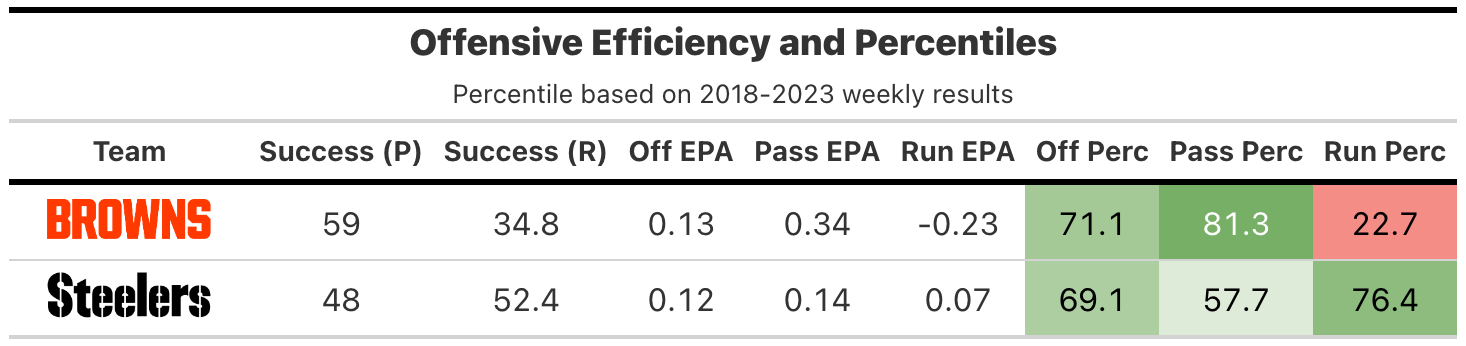
Both teams posted strong offensive success rates (47.7% Browns, 48.1% Steelers), and ended up with roughly equivalent strength in EPA efficiencies (71st and 69th percentiles). The teams produced those value numbers in similar ways, with elevated turnovers offset by explosive plays, as both teams combined for 312 yards-after-catch in their dropback passing attacks (55% of total passing yards).
The basic box score stats also paint a near identical picture. The Browns and Steelers finished with similar yards-per-play (6.0 to 5.6), total yards (372 to 361) and first downs (22 to 24).
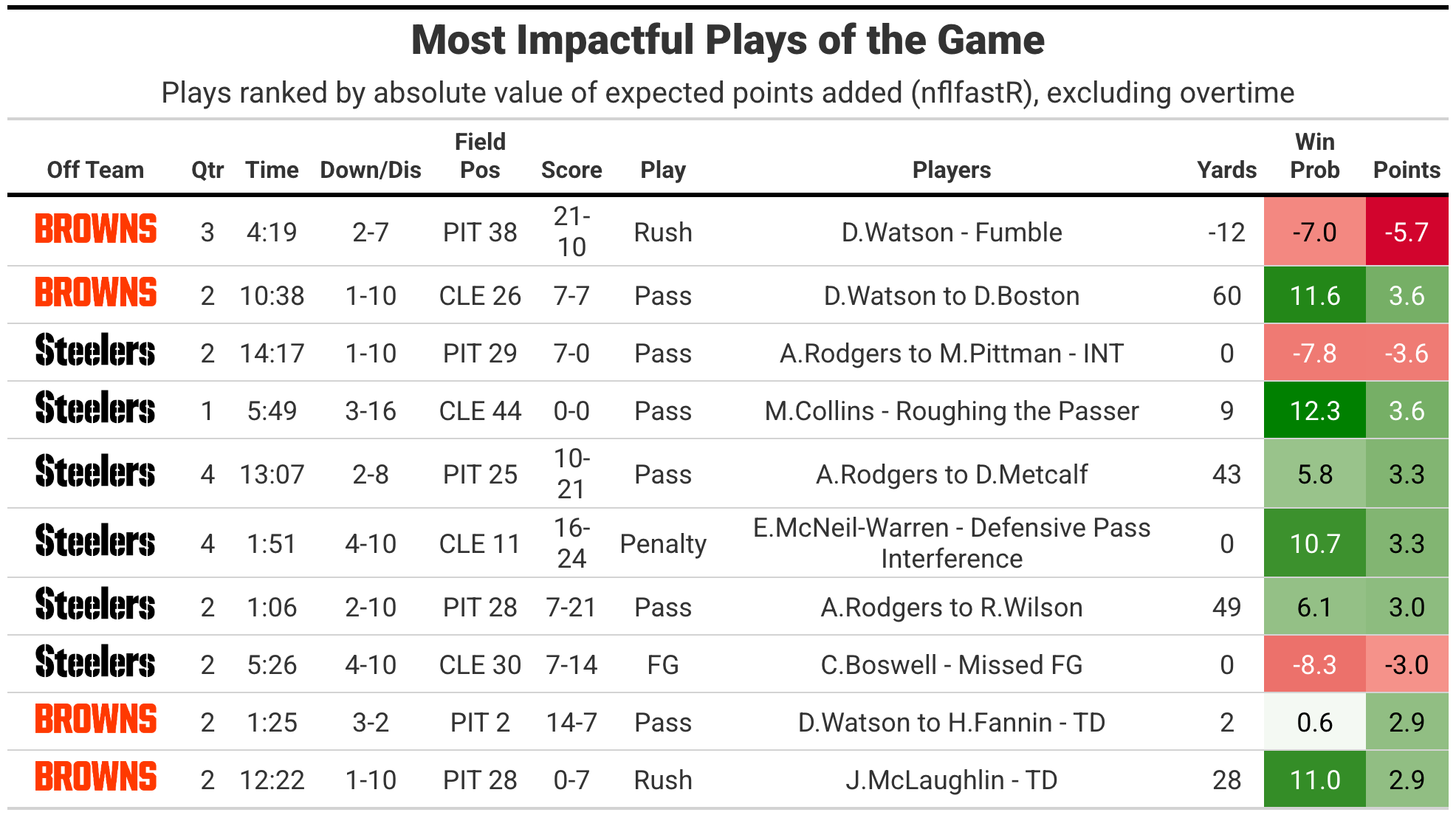
The Browns gave away 4.4 more expected-points value on turnovers, but more than offset that deficiency with better third-down conversion rates, going 4-for-10 while the Steelers went 4-for-13 (net +6.9 EPA advantage). The Steelers lost special teams value with a missed 48-yard field goal attempt (-3.0 EPA), while the Browns committed more costly penalties, including a 4th & 10 defensive pass interference at the Browns’ 11 yard-line on an incompletion that would have sealed the game (-3.3 EPA).
One big play that the adjusted scores model is blind to assess properly was a highly questionable roughing the passer call on 3rd & 16 that extended the Steelers’ first drive and eventually ended in a touchdown (-3.6 EPA). While the model down-weights penalty gains, this one shouldn’t have been called at all.
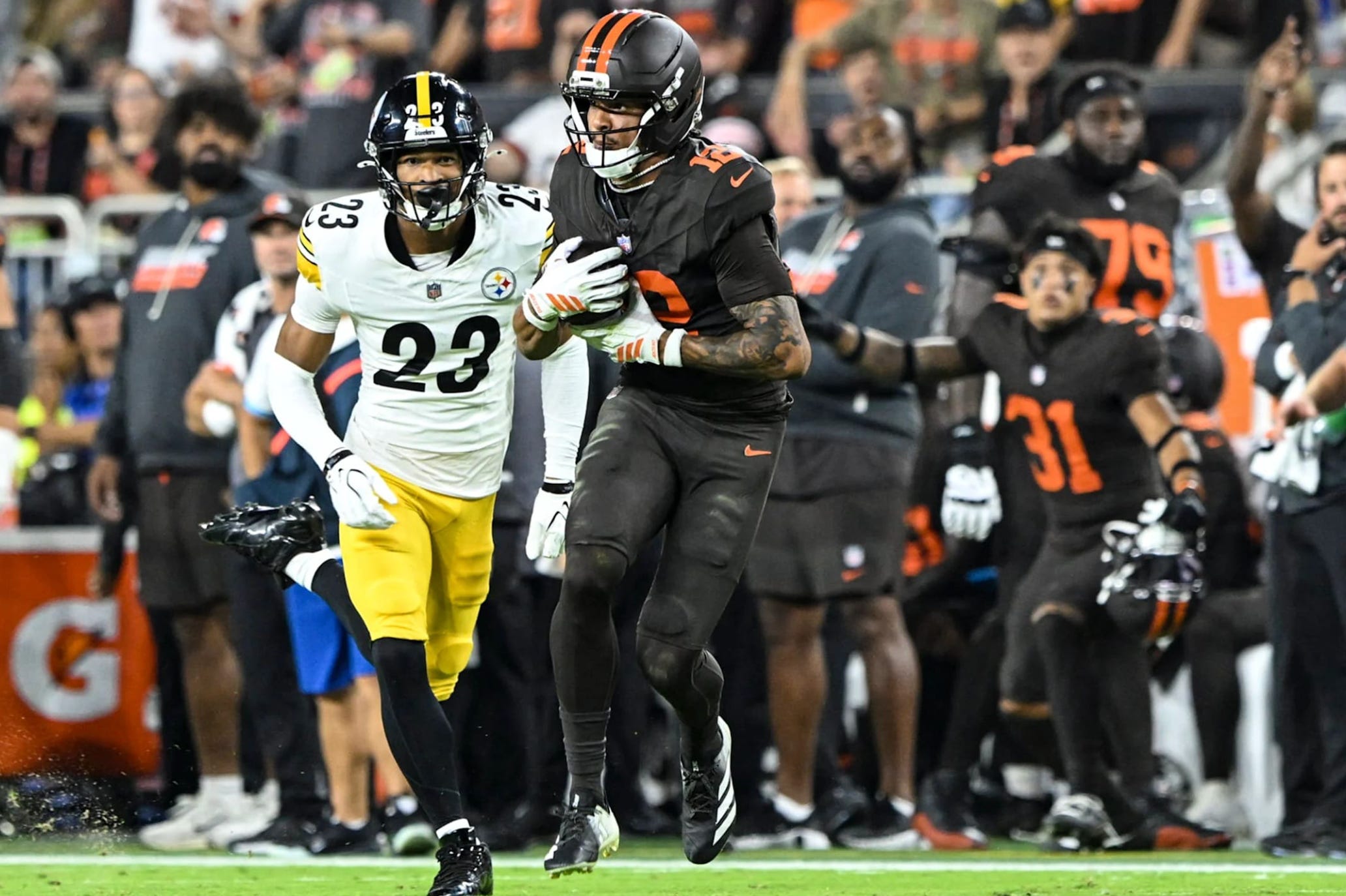
D.K. Metcalf had, by far, his best game of the season so far, catching five balls for 115 yards on nine targets (+5.6 EPA). His previously high yardage total was 40 in Week 1. But Roman Wilson was the valuable receiver targeted, adding +6.3 EPA with 74 yards and a score on only three catches.
The Browns spread the ball around in the passing game, with five receivers totaling more than two expected points added when targeted, but none catching more than six passes or accumulating more than 89 yards.
The Steelers were much more efficient running the ball, but did it less often while trailing for significant portions of the game. Jaylen Warren added positive EPA on 17 carries for 93 yards, and Aaron Rodgers gained +1.1 EPA on a rare quarterback sneak 2-point conversion following a penalty-derived shortened try.
The Browns were largely ineffective rushing the ball, with their efficiency cratering due a Deshaun Watson fumble that cost 5.7 expected points on a read option play that Watson, mistakenly, decided to keep the ball. T.J. Watt forced the fumble and made the recovery.
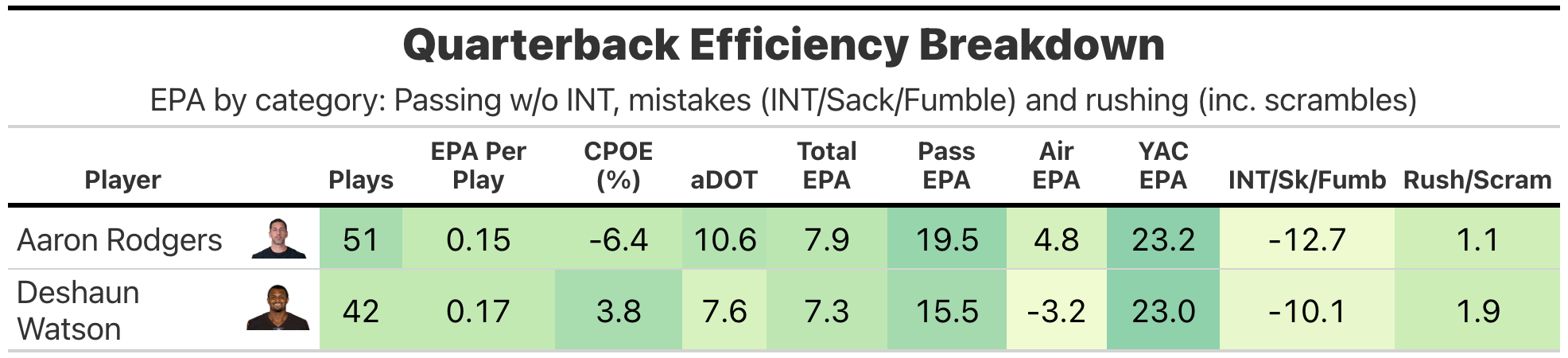
The quarterbacks ended up with similar numbers, though their negative plays came in different manners. Watson had the costly fumble and threw an interception, but surprisingly avoided sacks (just two) to hold down his EPA losses.
Rodgers’ two interceptions were less costly (only 3.7 expected points lost), as one came on a desperation heave at the end and barely lost any value. Rodgers was sacked five times for 30 yards lost, meaningfully dropping the Steelers’ offensive efficiency.
The EPA adjustments will likely take a hammer to both quarterbacks, with both driving value through receiver YAC, penalties boosting Rodgers’ EPA, and Watson being somewhat lucky to recover his own fumble later in the game.
The betting markets aren’t buying the Browns’ status as division leader lasting through the season, currently placing their implied odds of winning the AFC North at under 10%. The Steelers are in a similar boat, as the Baltimore Ravens (53%) are the favorites, followed by the Cincinnati Bengals (35%).