


The adjusted scores quantify team play quality, with emphasis on stable metrics (success rate) and downplaying higher variance events (turnovers, special team, penalties, fumble luck, etc). Adjusted expected points added (EPA), in conjunction with opportunity-based metrics like total plays and drives, projects adjusted points. Adjusted scores have been tested against actual scores and offer slightly better predictive ability, though their primary benefit is explanatory.
All 2025-2022 and historical Adjusted Scores and other site metrics are available in a downloadable format to paid subscribers via Google Sheet.
Find previous advanced reviews here
** Adjusted Scores table:
“Pass” - Pass rate over expectation (based on context of each play and historical averages
“Success” - Success rate on offense, a key metric in adjusted score vs actual
“H & A” - Home or away team
DET (-3.5) vs DAL

In an ultra competitive NFC playoff race, this game had huge implications for both teams. The Detroit Lions secured the 14-win over the Dallas Cowboys, though the adjusted scores saw it as a closer contest. The Lions move to 8-5, but that still leaves them with a slightly worse than 50/50 chance of making the playoffs, with six other teams having at least eight wins, and one of the seven playoffs spots going to the NFC South.
The Cowboys aren’t completely out of the playoff picture at 6-6-1, but at roughly a 10% chance they’d have to win-out the final four games to boost their chances to around 40%, therefore still needing a decent amount of help.

In this contest, the teams posted similar offensive success rates, but turnover differential explains the final score, with the Cowboys giving away the ball three times (-13.2 EPA) versus a clean sheet for the Lions. In addition to turnovers, the Lions pass rush was key to stopping a Cowboys offense that was otherwise able to move the ball, sacking Dak Prescott five times for 50 yards lost (-9.0 EPA).
Those turnovers provided great field position for the Lions, whose five touchdown drives needed an average of only 42 yards gained. The Lions were also more explosive, especially on the ground, with their touchdown drives requiring relatively few plays: 6, 4, 2, 5, and 3. The lack of play volume for the Lions led to the Cowboys finishing with more total yards offensively (326 to 299), despite averaging significantly less per play (5.5 to 7.2). The Cowboys were able to extend two drives with fourth down conversions (2-for-2, +6.0 EPA), but one was on a final desperation possession that eventually ended in an interception.
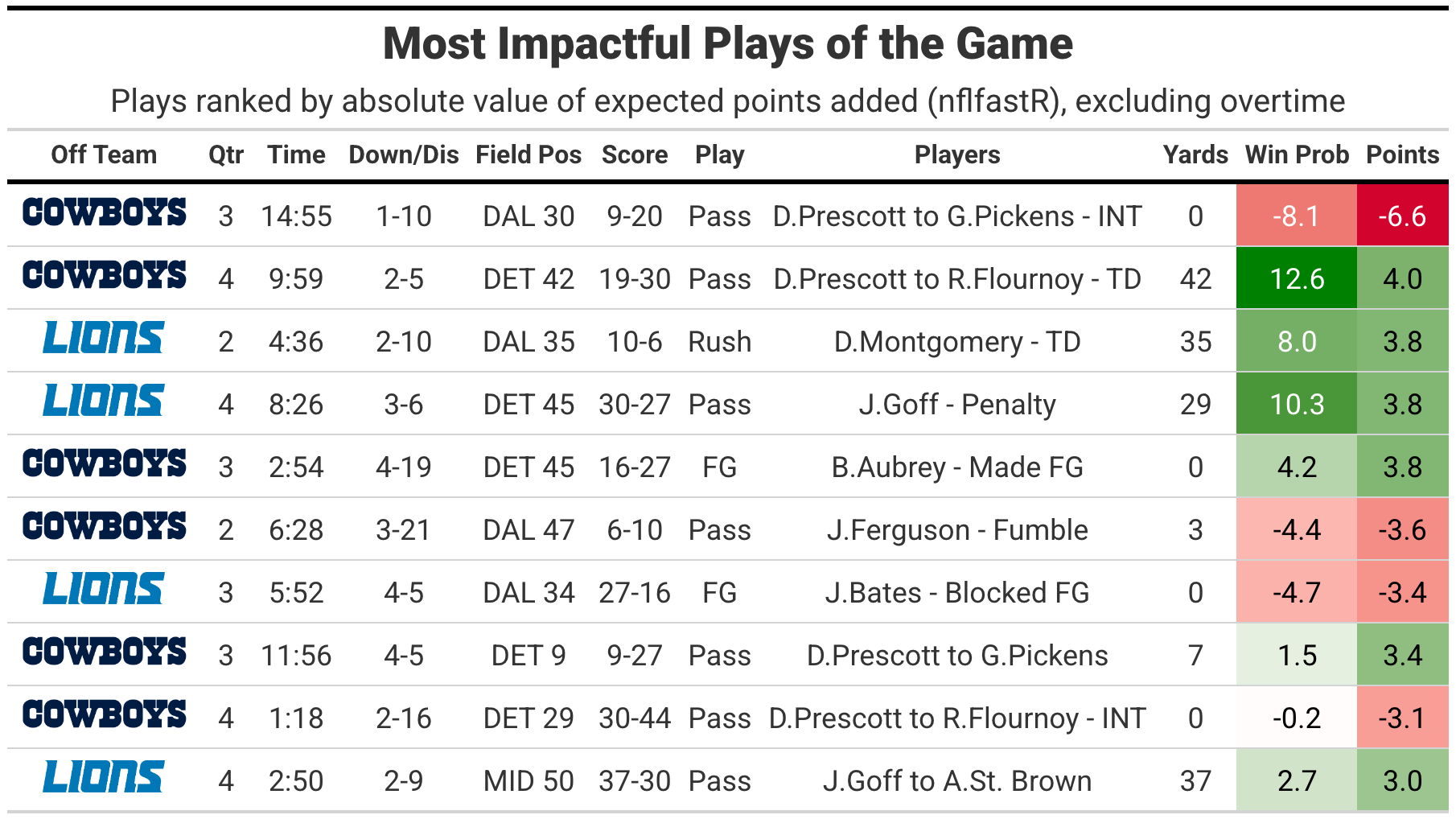
Prescott had looked really strong by my adjusted EPA numbers going into the game, with smart commentators like Aaron Schatz saying that he should be a MVP candidate. Well …. that campaign was short lived. A defeat in an island game that almost completely closes the door on the playoffs isn’t going to reflect well on Prescott, especially when it included a couple of turnovers, even if his last interception was essentially meaningless (-0.4% win probability loss).
What was impressive about Prescott’s performance was how positive he was outside of the turnover and sack negatives, pushing the ball down the field with a 10.6-yard average-depth-of-target, and generating most of his passing EPA in the air, not relying on receiver YAC.
Jared Goff had the ideal game for himself and likely his coaches: lower usage, a strong running game and a defense that gave him the ball in good positions. He was also able to use his athletic receiving options to make plays post-catch.
