


The adjusted scores quantify team play quality, with emphasis on stable metrics (success rate) and downplaying higher variance events (turnovers, special team, penalties, fumble luck, etc). Adjusted expected points added (EPA), in conjunction with opportunity-based metrics like total plays and drives, projects adjusted points. Adjusted scores have been tested against actual scores and offer slightly better predictive ability, though their primary benefit is explanatory.
All 2022-2026 and historical Adjusted Scores and other site metrics are available in a downloadable format to paid subscribers via Google Sheet.
Find previous advanced reviews here
Unexpected Points is a reader-supported publication. To receive new posts and support my work, consider becoming a free or paid subscriber.
** Adjusted Scores table:
“Pass” - Pass rate over expectation (based on context of each play and historical averages
“Success” - Success rate on offense, a key metric in adjusted score vs actual
“H & A” - Home or away team
Steelers (+4.5, 31%) vs Broncos

The Pittsburgh Steelers (7-4) turned two defensive scores into a 27-5 win over the Denver Broncos (8-3), but the adjusted scores saw a much closer game (15-9, 6-point differential). The Steelers had a 32.5% offensive success rate, well below their 41% coming in, while the Broncos managed only 26.6%, also well below their 41% average, a credit to the Steelers’ defense.
The Broncos were hurt by turnovers (3-1, -2 differential), including a T.J. Watt fumble return for a touchdown and a Jalen Ramsey pick-six. The Steelers leaned heavily into the run, calling 31 designed runs to only 16 dropbacks (35% pass rate).
Special teams and penalties added 5.6 expected points for the Steelers, the biggest swing coming when Wil Lutz missed a 53-yard field goal at the start of the fourth quarter.
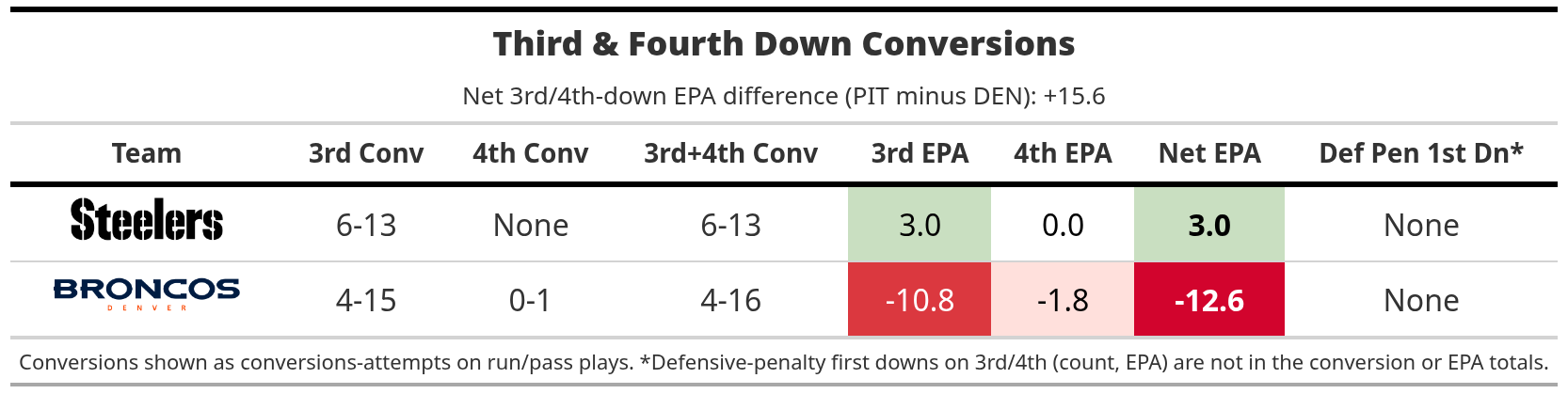
Late-down efficiency was the most significant difference. The Steelers converted 6 of 13 third downs (+3.0 EPA) and did not attempt a fourth down. The Broncos went just 4 of 15 on third down (-10.8 EPA) and failed on their only fourth-down try, a Bo Nix interception on fourth-and-21 (-1.8 EPA).
Several Broncos drives stalled in Steelers territory, setting up two field goal attempts by Lutz; he made one from 44 yards and missed from 53. Chris Boswell made both of his tries for the Steelers, from 47 and 33 yards.

The Steelers outgained the Broncos 247-205, and the gap was even wider on a per-play basis: 5.3 yards per play (44th percentile) to 3.0 (1st percentile). The Steelers’ passing was efficient when they did throw (8.1 yards per dropback, 84th percentile), but the running game managed only 117 yards on 31 designed runs (3.8 yards per carry, 42nd percentile). The Broncos were stuck at 3.2 yards per dropback (3rd percentile) and 2.6 yards per designed run (9th percentile).
By EPA, both offenses were poor, but in different ways. The Steelers were at -0.15 per play (16th percentile), with a strong passing game (72nd percentile) dragged down by a terrible running game (5th percentile, 23% success rate). The Broncos were at -0.33 per play (3rd percentile), with the passing game also at the 3rd percentile and the run game at the 23rd.
