



The adjusted scores quantify team play quality, with emphasis on stable metrics (success rate) and downplaying higher variance events (turnovers, special team, penalties, fumble luck, etc). Adjusted expected points added (EPA), in conjunction with opportunity-based metrics like total plays and drives, projects adjusted points. Adjusted scores have been tested against actual scores and offer slightly better predictive ability, though their primary benefit is explanatory.
All 2025-2022 and historical Adjusted Scores and other site metrics are available in a downloadable format to paid subscribers via Google Sheet.
Find previous advanced reviews here
** Adjusted Scores table:
“Pass” - Pass rate over expectation (based on context of each play and historical averages
“Success” - Success rate on offense, a key metric in adjusted score vs actual
“H & A” - Home or away team
Chargers (-3, 59%) vs Jets

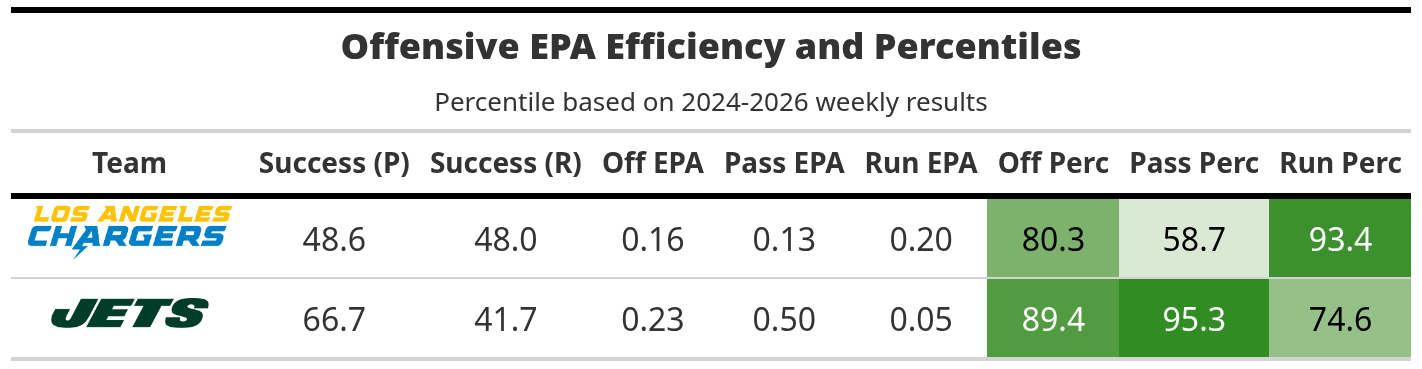
The New York Jets (3-8) won a shootout with the Los Angeles Chargers (1-9) 27-24 as 3-point underdogs, and the adjusted scores saw the Jets as the better team by a wider margin (22-15, 7-point differential). The Jets had a 53% success rate, their best of the season, while the Chargers posted a season-high 48%, well above their 36% coming in.
It was the Jets’ best offensive game in the last two years by EPA per drive. They didn’t turn it over or punt in a game with only six true possessions per team. Even after an 89th-percentile offensive day, the Chargers’ offense still ranks last in the league in EPA per drive.
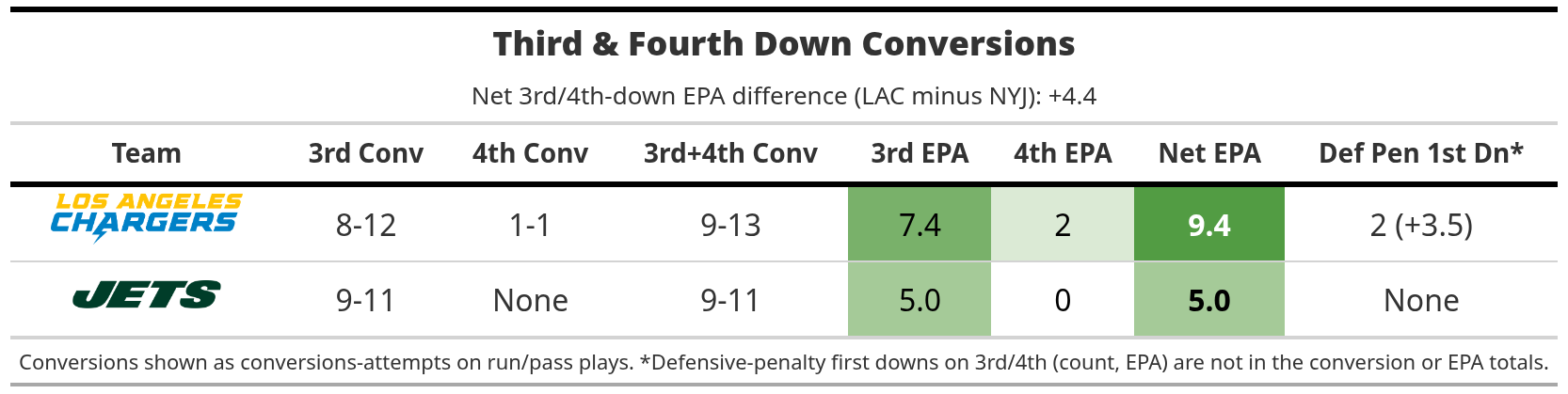
Both offenses were good on third down. The Jets converted 9 of 11 (+5.0 EPA), and the Chargers converted 8 of 12 (+7.4 EPA), including both of Ladd McConkey’s fourth-quarter touchdowns.

The Jets averaged 7.8 yards per dropback (81st percentile), while the Chargers managed just 3.9 (9th percentile) but ran for 5.4 yards per designed run (84th).
By EPA, the Jets’ +0.50 per dropback was in the 95th percentile, with a 67% dropback success rate.
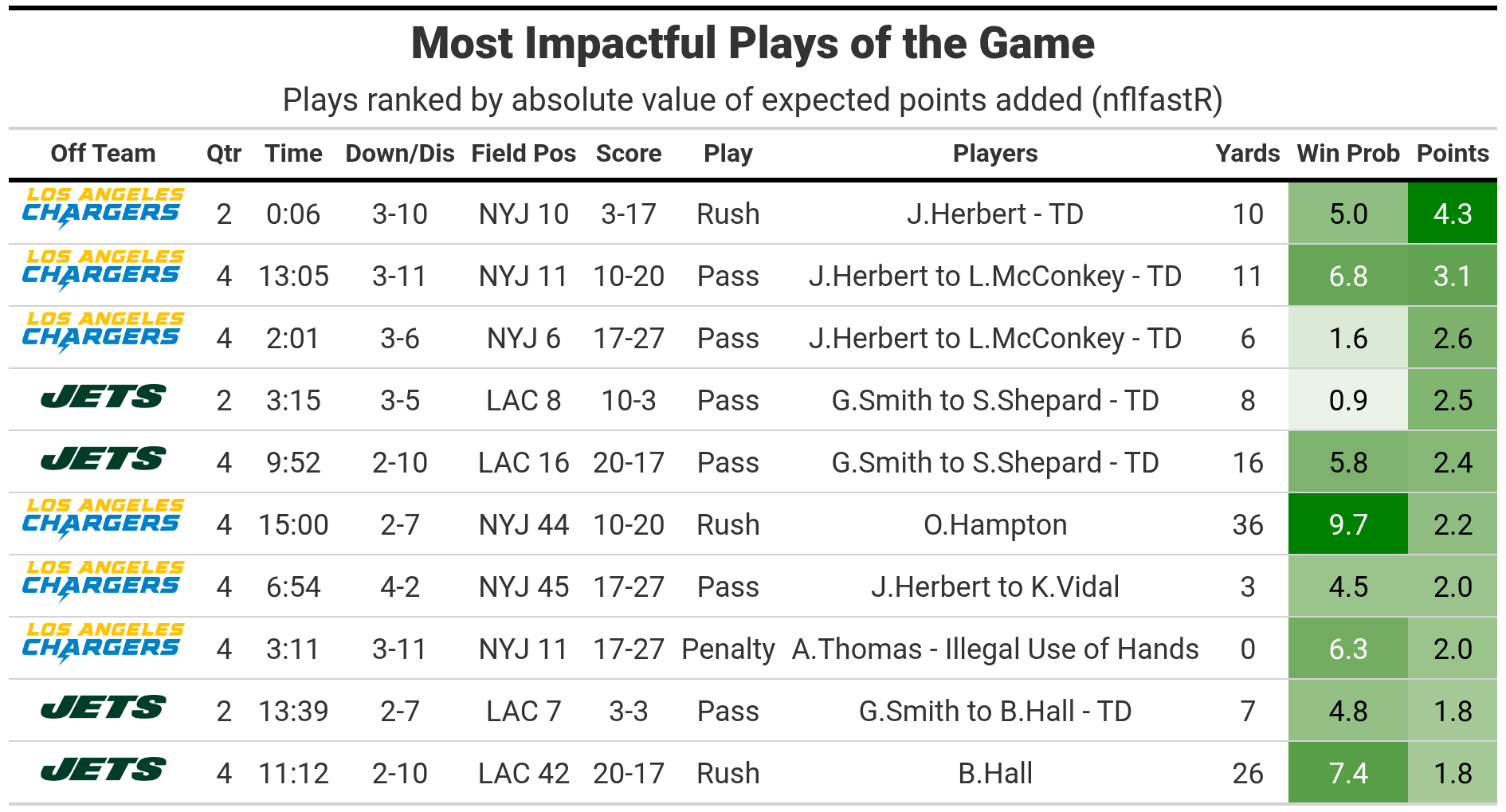
Justin Herbert’s 10-yard touchdown run on third-and-10 with six seconds left in the first half was the biggest play by EPA (+4.3 EPA, +5.0% win probability).
After McConkey’s 6-yard touchdown made it 27-24 with 2:01 left, the Jets ran out the clock on the ground, with Breece Hall carrying four straight times as the Chargers burned all three timeouts.
All ten of the most impactful plays by EPA were in the green.
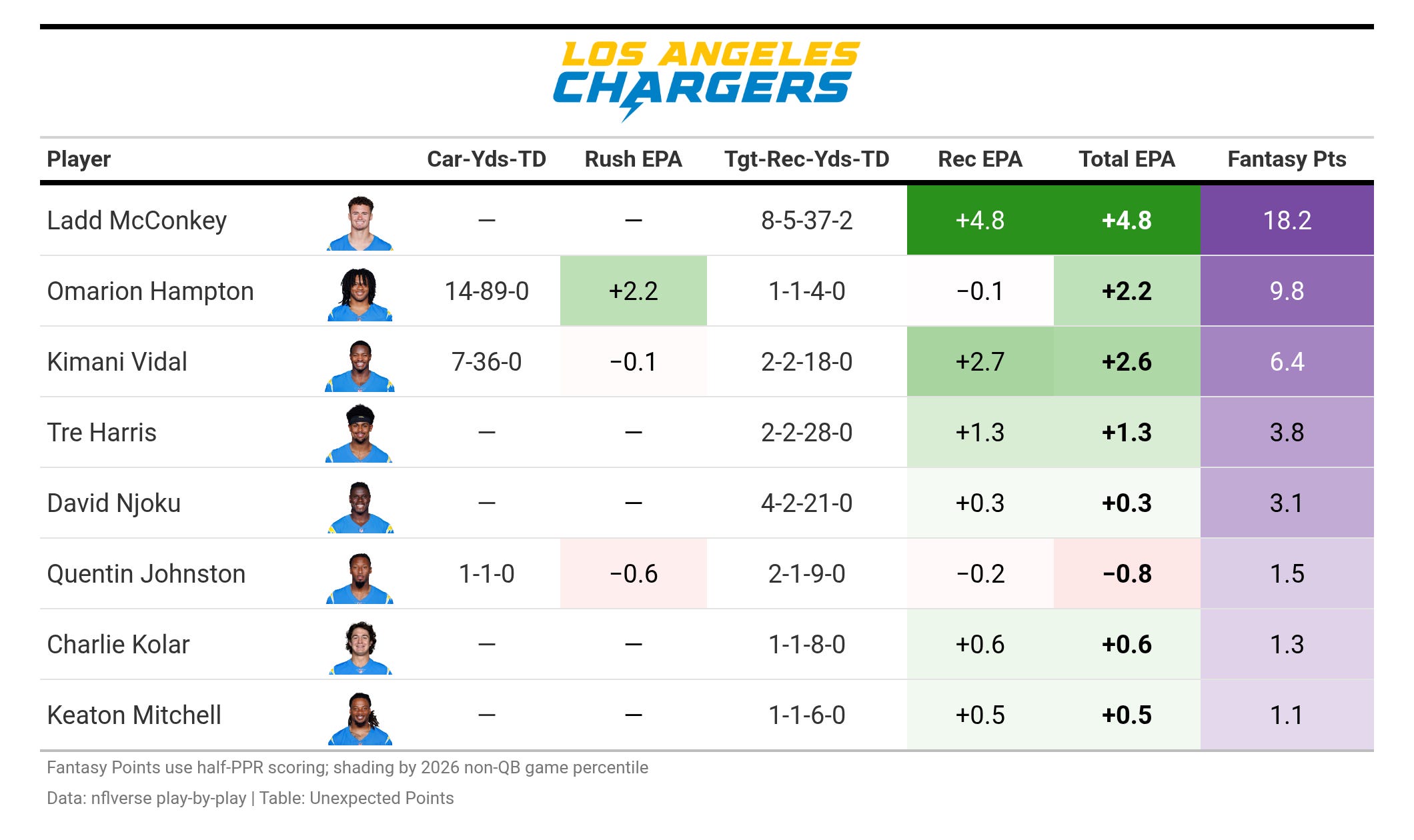
Ladd McConkey led the Chargers at +4.8 EPA and 18.2 half-PPR fantasy points, catching five of eight targets for 37 yards and two touchdowns.
Omarion Hampton ran 14 times for 89 yards (+2.2 rushing EPA), including a 36-yard run on the first play of the fourth quarter (+9.7% win probability).
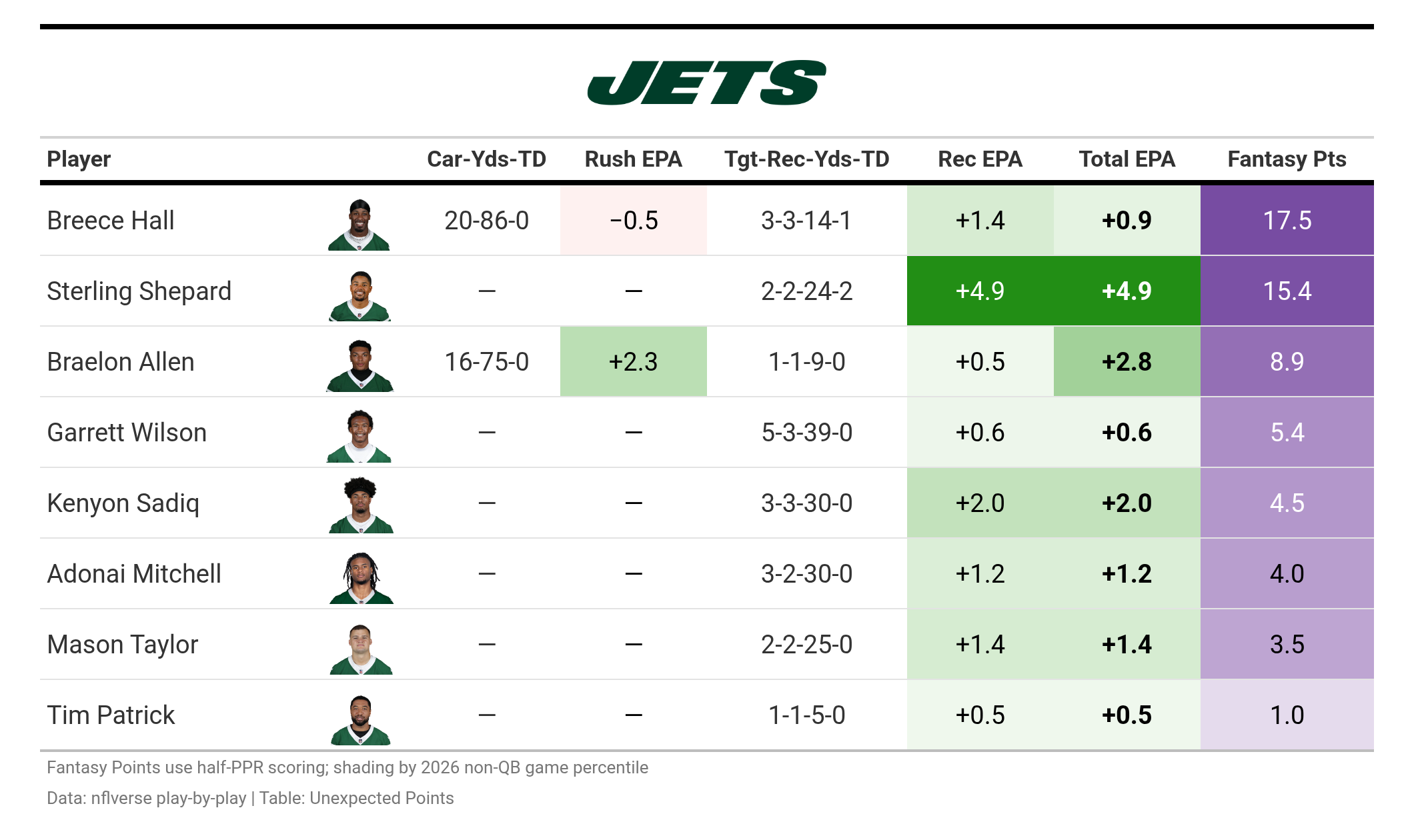
Sterling Shepard led all skill players at +4.9 EPA, but only had two catches, both touchdowns (24 yards).
Breece Hall had 17.5 half-PPR fantasy points on 20 carries for 86 yards plus a touchdown catch, though his runs were slightly negative by EPA (-0.5 rushing EPA). Braelon Allen was more efficient, with 75 yards on 16 carries (+2.3 rushing EPA).
Justin Herbert had his most efficient game of the season at +0.22 EPA per play, his first game above +0.02 this season. He did it with his legs as much as his arm, running eight times for 32 yards and a touchdown, though six sacks taken cost the Chargers 7.4 expected points. Even with Sunday’s game, he ranks 29th of 31 quarterbacks in EPA per play (min 175 dropbacks).
Geno Smith was excellent on light volume, at +0.50 EPA per play, his most efficient game of the season. He completed 17 of 21 passes for 176 yards and three touchdowns, taking just one sack.

