


The adjusted scores quantify team play quality, with emphasis on stable metrics (success rate) and downplaying higher variance events (turnovers, special team, penalties, fumble luck, etc). Adjusted expected points added (EPA), in conjunction with opportunity-based metrics like total plays and drives, projects adjusted points. Adjusted scores have been tested against actual scores and offer slightly better predictive ability, though their primary benefit is explanatory.
All 2022-2026 and historical Adjusted Scores and other site metrics are available in a downloadable format to paid subscribers via Google Sheet.
Find previous advanced reviews here
Unexpected Points is a reader-supported publication. To receive new posts and support my work, consider becoming a free or paid subscriber.
** Adjusted Scores table:
“Pass” - Pass rate over expectation (based on context of each play and historical averages
“Success” - Success rate on offense, a key metric in adjusted score vs actual
“H & A” - Home or away team
Commanders (+6, 27%) vs Bengals

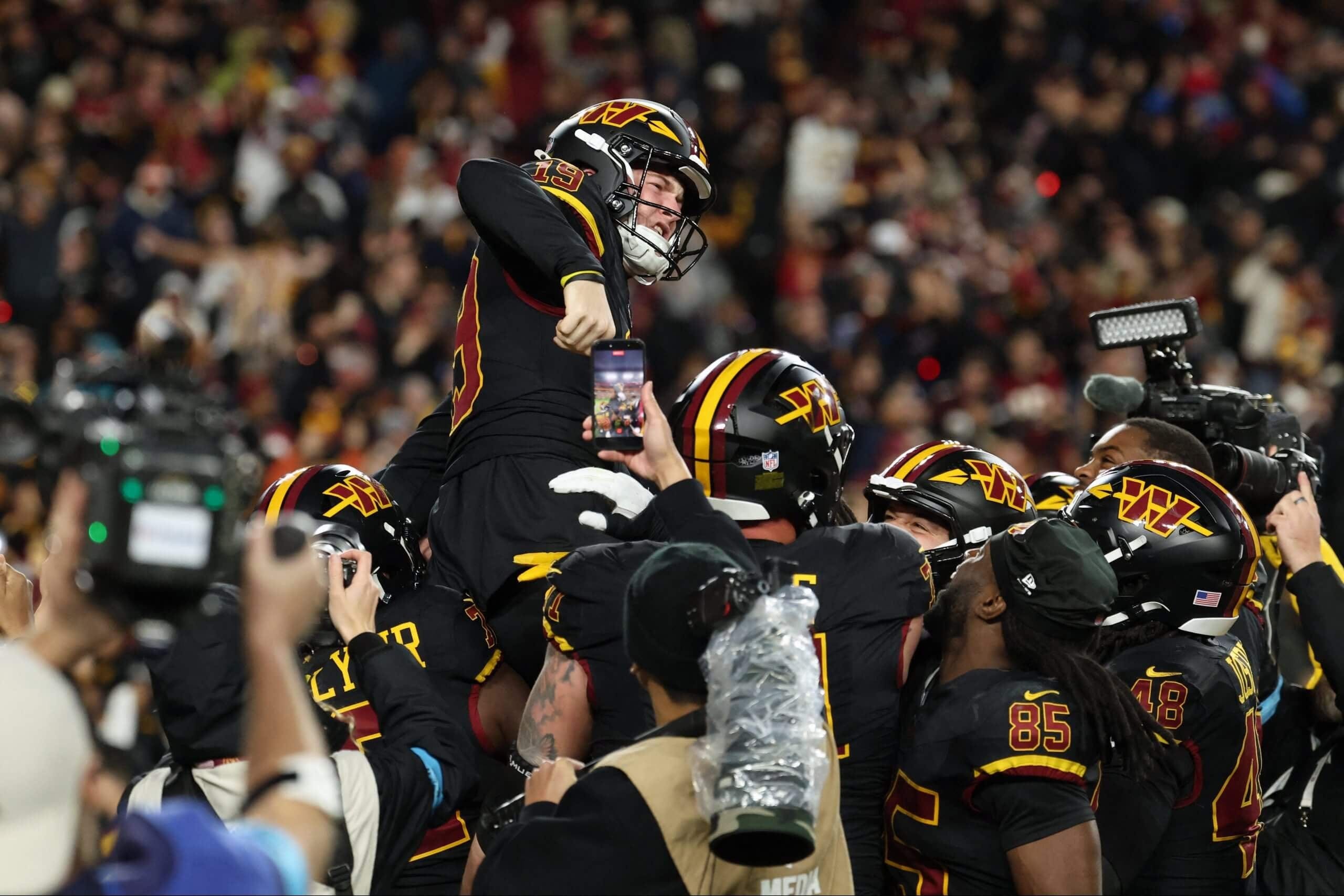
The Washington Commanders (4-5-1) slipped past the Cincinnati Bengals (7-3) 22-20 on a field goal with four seconds left, and the adjusted scores saw it slightly tilted the same way (22-19, 3-point differential). The Commanders had a 44% offensive success rate, while the Bengals were at 43%, well below their 53% coming in, a credit to the Commanders’ defense holding down the hottest offense in the NFL.
Neither team turned the ball over, and both struggled with late-down conversions. The Bengals continued to lean heavily into the pass, calling 44 dropbacks to only 13 designed runs (77% pass rate, +18.3% over expected).
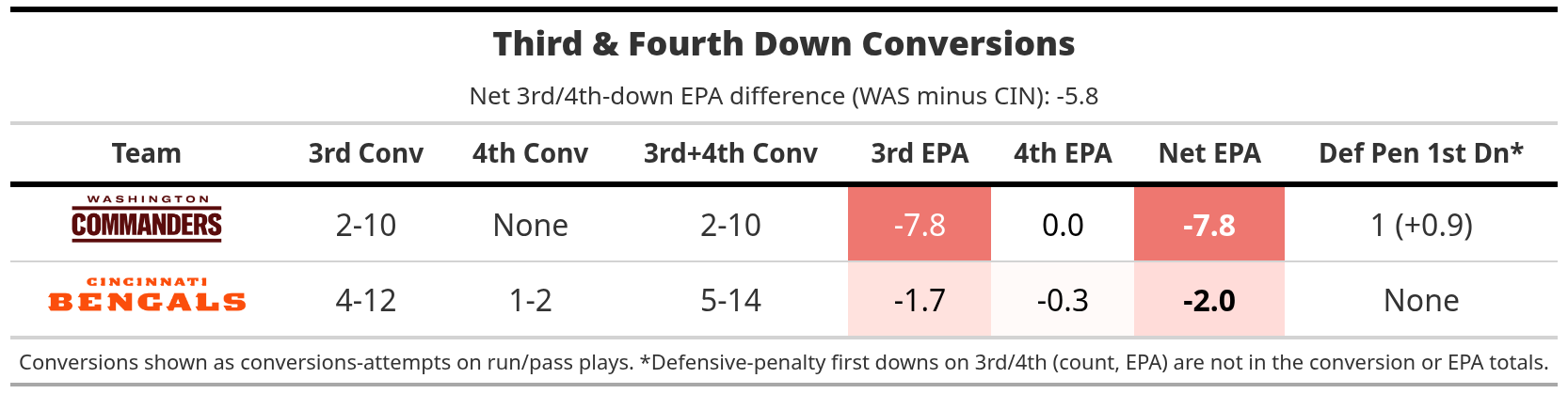
The Commanders went just 2 of 10 on third down, losing 7.8 expected points, with 20 of their 23 first downs coming on first or second down. Numerous failed conversions came in Bengals’ territory, setting up four of five field goal attempts by Drew Stevens, and he made all of them.
Head coach Zac Taylor went for it on fourth-and-1 from the Bengals’ 45 late in a scoreless first quarter, and Joe Burrow was stopped for no gain (-2.5 EPA, -6.0% win probability). The Bengals’ other fourth-down try, a fourth-and-2 conversion to Mike Gesicki in the second quarter (+2.2 EPA), set up their first field goal.

The Commanders outgained the Bengals 428-313 and averaged 6.9 yards per play (89th percentile), but three of their four red-zone trips ended in field goals, while the Bengals scored touchdowns on two of their three. That is why the yardage gap barely shows up in the efficiency numbers.
