


The adjusted scores quantify team play quality, with emphasis on stable metrics (success rate) and downplaying higher variance events (turnovers, special team, penalties, fumble luck, etc). Adjusted expected points added (EPA), in conjunction with opportunity-based metrics like total plays and drives, projects adjusted points. Adjusted scores have been tested against actual scores and offer slightly better predictive ability, though their primary benefit is explanatory.
All 2022-2026 and historical Adjusted Scores and other site metrics are available in a downloadable format to paid subscribers via Google Sheet.
Find previous advanced reviews here
Unexpected Points is a reader-supported publication. To receive new posts and support my work, consider becoming a free or paid subscriber.
** Adjusted Scores table:
“Pass” - Pass rate over expectation (based on context of each play and historical averages
“Success” - Success rate on offense, a key metric in adjusted score vs actual
“H & A” - Home or away team
Ravens (-4.5, 67%) vs Chargers

The Los Angeles Chargers (1-8) finally got their first win of the season, holding off the Baltimore Ravens (4-6) 23-20, while the adjusted scores saw this as a pure coin flip (21-21, no differential). The Chargers had a 41% success rate, up from 35% coming in, while the Ravens were at 40%, down from 44% coming in, in their first game with Jacoby Brissett at the helm.
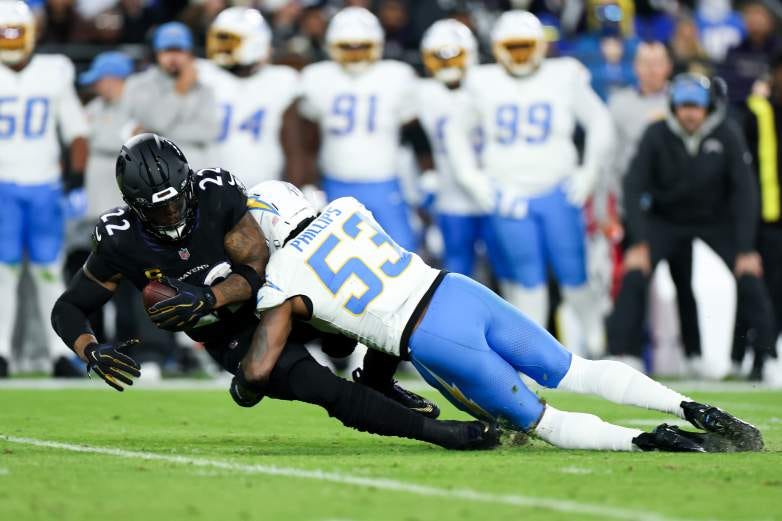
The difference in a close game was turnovers: the Ravens had a -7.4 EPA turnover disadvantage with -2 differential (2-to-0). The most meaningful win probability swing was when Zay Flowers caught a 15-yard pass on second-and-10 with the Ravens down 23-20 and 2:11 left, then fumbled at the Chargers’ 46 (-3.3 EPA, -24.5% win probability), dropping the Ravens’ chance to win from 39.0% to 14.5%.
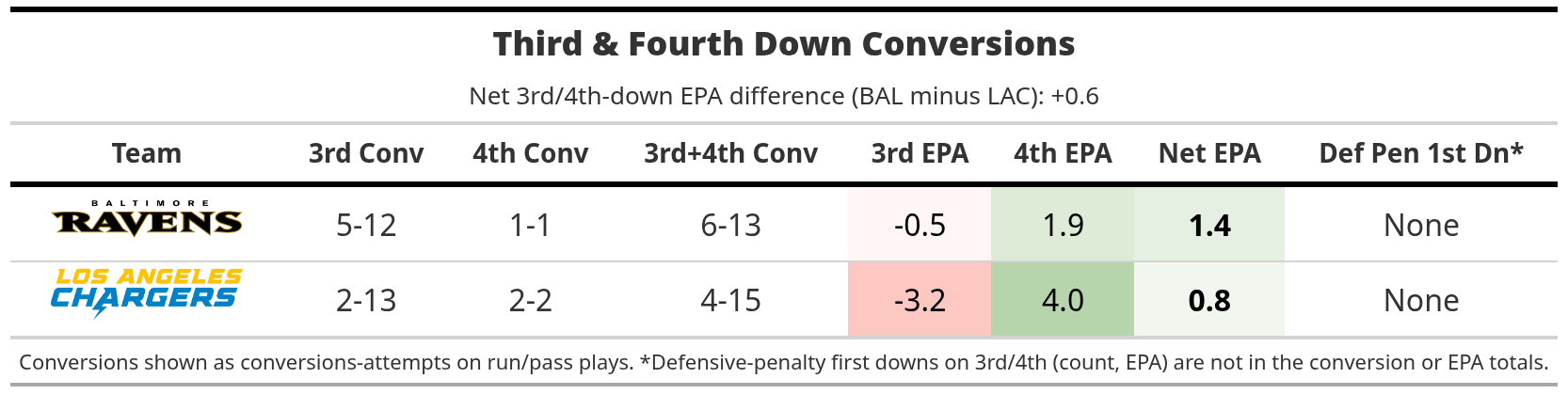
The Chargers went just 2 of 13 on third down (-3.2 EPA) but 2 of 2 on fourth down (+4.0 EPA), more than mitigating the loss. Omarion Hampton’s 1-yard touchdown on fourth-and-1 with 2:00 left in the first half (+2.6 EPA, +7.0% win probability) made the game 17-7.
The Ravens’ lone fourth-down try, a 1-yard Justice Hill run on fourth-and-1 from their own 40 down 23-20 in the fourth quarter (+1.9 EPA, +9.7% win probability), kept the drive alive, but it ended in a punt on fourth-and-9 from their own 42 with 4:11 left.

The Ravens outgained the Chargers 347-287, but both teams averaged 5.3 yards per play (46th and 45th percentiles) and 6.6 per dropback (59th and 58th). The gap was on the ground: the Ravens ran for 16 yards on designed runs, 1.1 per carry (below the 1st percentile), while the Chargers averaged 4.0 (51st). The Ravens only called 16 designed runs to the Chargers’ 28.
By EPA, both offenses were mediocre. The Chargers finished at 0.01 EPA per play (47th percentile) and the Ravens at -0.06 (35th).
