


While this preview is available to free and paid subscribers, the longer Sunday and MNF reviews will be behind the paywall
The adjusted scores quantify team play quality, with emphasis on stable metrics (success rate) and downplaying higher variance events (turnovers, special team, penalties, fumble luck, etc). Adjusted expected points added (EPA), in conjunction with opportunity-based metrics like total plays and drives, projects adjusted points. Adjusted scores have been tested against actual scores and offer slightly better predictive ability, though their primary benefit is explanatory.
All 2026-2022 and historical Adjusted Scores and other site metrics are available in a downloadable format to paid subscribers via Google Sheet.
Find previous advanced reviews here
** Adjusted Scores table:
“Pass” - Pass rate over expectation (based on context of each play and historical averages
“Success” - Success rate on offense, a key metric in adjusted score vs actual
“H & A” - Home or away team
Seahawks (-3) vs Patriots

The adjusted scores made this game a slightly lucky victory for the Seattle Seahawks, primarily due to the improbability of a three-turnover game having all the negatives flow in one direction — specifically, towards the New England Patriots. As I’ll discuss more later, only one of those picks had dramatic effect on win probability, but boy was it a doozy. In total, the Patriots lost 8.5 expected points to turnovers, with the equivalent gained by the Seahawks on the flip side of the equation.
Neither offense performed well by the advanced metrics, with the Patriots’ unit barely topping 40% in success rate and the Seahawks marginally lower at 36%. The latter produced above average EPA efficiency overall with the support of big plays (+6.1 EPA on the 4th & 1 touchdown) and lack of turnover negatives. The Patriots’ EPA efficiency underperformed success rate -0.09 per play, roughly a 30th percentile outcome.
The Seahawks’ Super Bowl odds haven’t moved much from the pre-game range of +1100 (8%, the Los Angeles Rams leading the NFL at 16%), with uncertainty around the severity of Sam Darnold’s injury offset by the benefit of winning a tough first matchup to their ability to win a highly competitive NFC West.
Darnold is scheduled for an MRI on his injured hip this Thursday, but the positive spin is that an X-ray taken during the game was negative for a fracture. Darnold wasn’t the only player to leave the game with an injury and be ruled out. The Patriots lost their marquee offseason acquisition, A.J. Brown, to an ankle injury.
As much as Maye’s giveaways will be the focus of post-game discussions, the Patriots EPA efficiency on dropbacks wasn’t that bad (+0.13, 56th percentile), and it was their horrendous rushing numbers (-0.45 EPA, 5th percentile) that weighed on results. Five separate Rhamondre Stevenson runs lost more than an expected point, including a failure to convert on 3rd & 1, and multiple yardage losses from favorable down-distance contexts. In total, Stevenson lost 8.1 expected points on 18 carries.

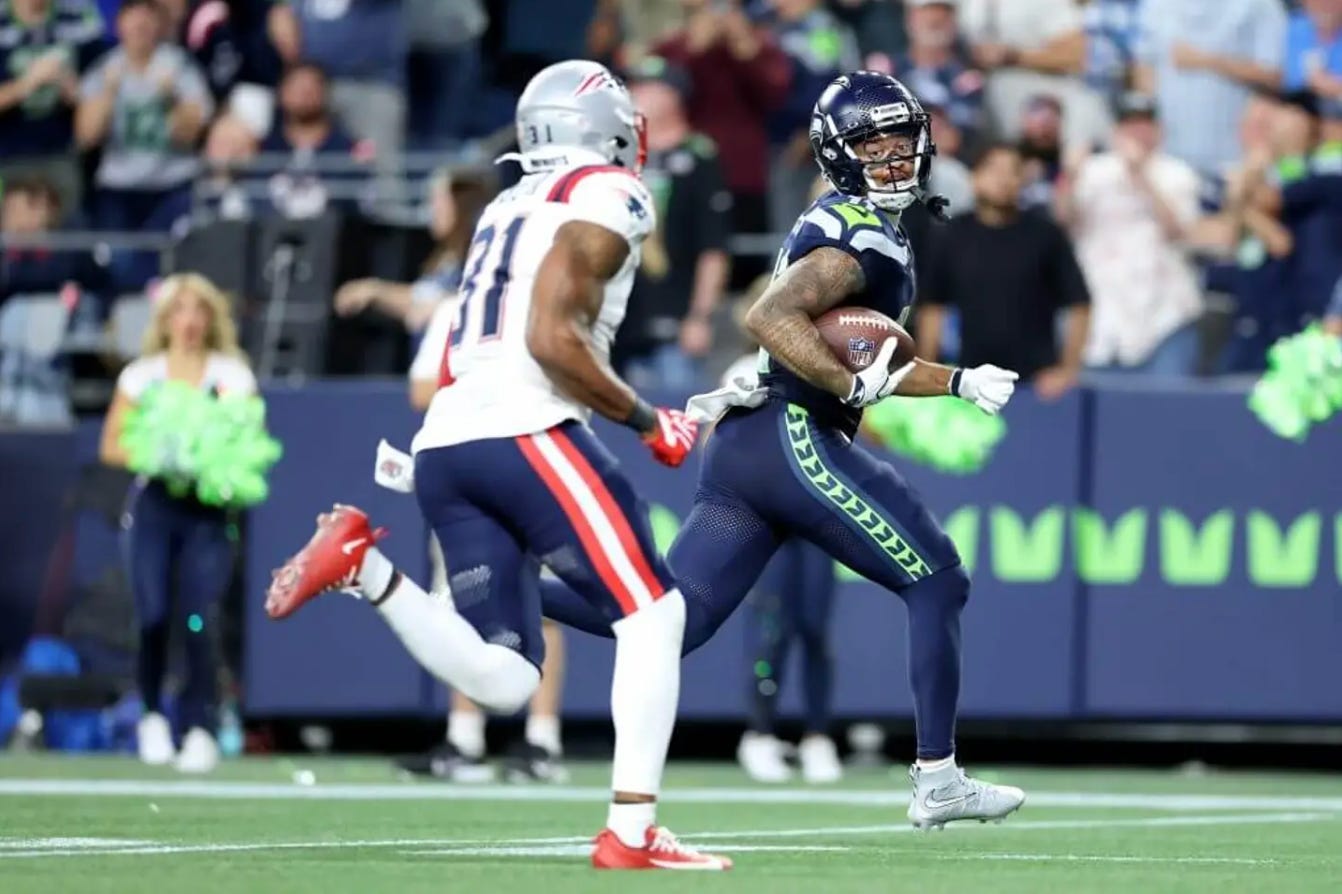
The deciding play of the game from a positive perspective was a the 45-yard touchdown catch-and-(mostly)-run by Jaxon Smith-Njigba on 4th & 1 and the game tied, which raises the Seahawks’ win probability from 17% pre-play to 52%. All but four of the 45 yards gained on the reception came after-the-catch, with last season’s offensive player of the year putting his stamp on this contest.
The biggest win-probably shift came on the last play of the game (42% to 0%). It came in the form of Maye’s third interception, this one in the end zone, and erasing the opportunity to kick a relatively easy, potential 34-yard field goal to tie the game and send it to overtime.
What doesn’t show up in these numbers - but will factor into my adjusted quarterback efficiency numbers released next week - was a pivotal drop by Romeo Doubs on 2nd & 14 with roughly 9:30 left that would have put the Patriots around midfield and in great position for at least a field-goal to take the lead. Instead, Drake Maye threw an ill-advised interception on the next play, trying to thread the needle on 3rd & 14, putting the ball at Seahawks’ 47-yard line and eventually leading to their game-winning field goal with a little under six minutes remaining.
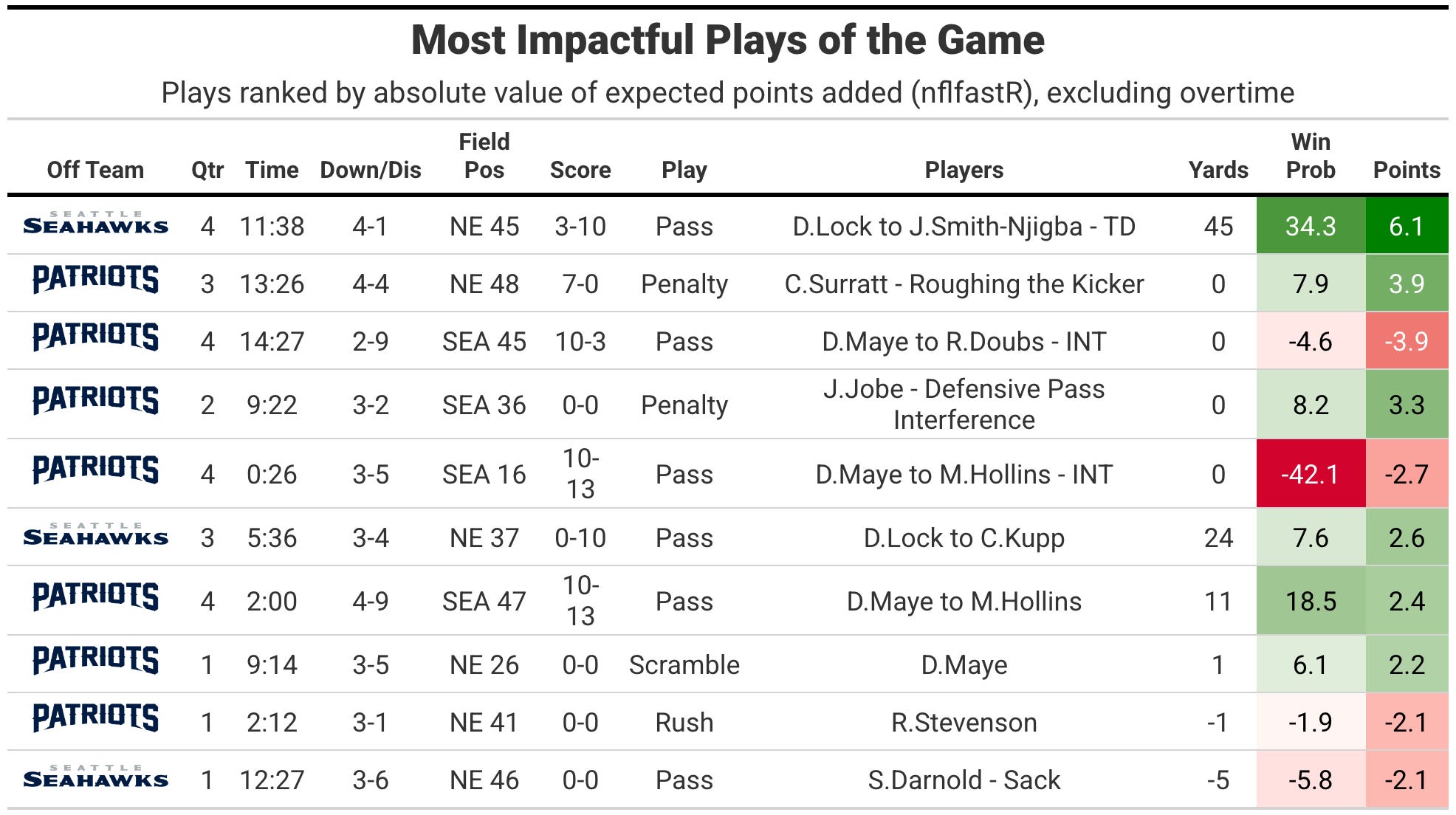
Whether it will hold up for an extended period is highly questionable, but for 25 plays Drew Lock hit superficially strong EPA efficiency last night. Looking deeper into the numbers illuminates the uneven nature of his EPA total, with +6.1 of his total +7.6 expected points generated on one play, and most of that coming via YAC. What Lock did well was avoiding mistakes, with zero turnovers and only one sack taken (-1.3 EPA). The low-volume passing formula the Seahawks used with Lock wasn’t all that different from what they employed last season with Darnold.
Maye’s EPA efficiency overall was decent considering the 10.5 expected points lost to interceptions (3) and sacks (3). Maye bolstered his numbers with strong scrambling gains, including a 4th & 2 conversion in the fourth quarter (+2.0 EPA). The Patriots failed to capitalize in the first half with the Seahawks’ offense looking out-of-sync, but ultimately Maye and the rest of the unit looked much more competent than during their dismal Super Bowl performance — a positive takeaway from a game their fans will think they should have won.

How do you approach penalty’s when crediting qb for epa? I think 2 of Mayes biggest gainers were the PI and the late hit penalty?