The adjusted scores quantify team play quality, with emphasis on stable metrics (success rate) and downplaying higher variance events (turnovers, special team, penalties, fumble luck, etc). Adjusted expected points added (EPA), in conjunction with opportunity-based metrics like total plays and drives, projects adjusted points. Adjusted scores have been tested against actual scores and offer slightly better predictive ability, though their primary benefit is explanatory.
All 2025-2022 and historical Adjusted Scores and other site metrics are available in a downloadable format to paid subscribers via Google Sheet.
Find previous advanced reviews here
** Adjusted Scores table:
“Pass” - Pass rate over expectation (based on context of each play and historical averages
“Success” - Success rate on offense, a key metric in adjusted score vs actual
“H & A” - Home or away team
Chargers (-8.5) vs Cardinals

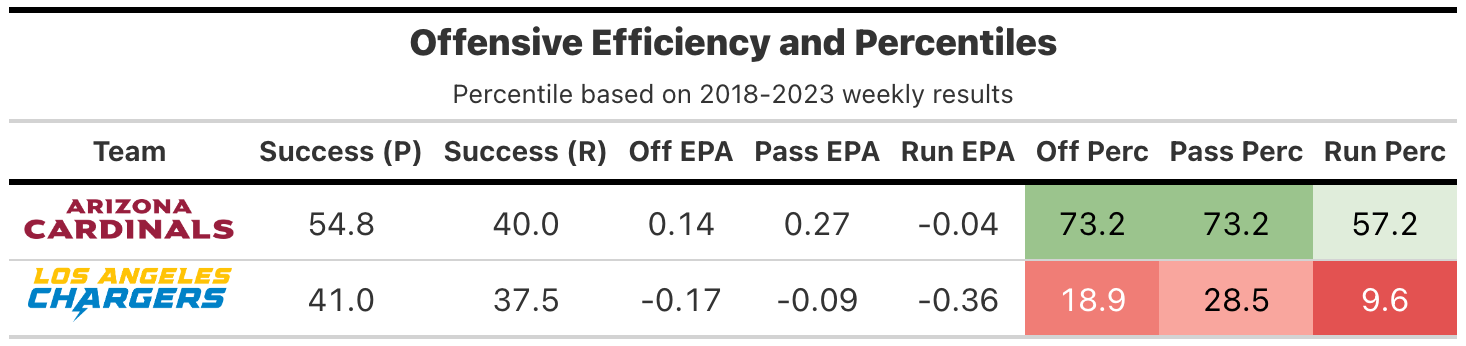
The biggest upset of the week comes in the form of the Arizona Cardinals - close to the worst team in the NFL according to betting markets coming into the season - defeating the Los Angeles Chargers on the road. The adjusted scores nearly agree with the 12-point differential of the final score, as the Cardinals’ offense was materially better than the Chargers’ in success rate (47% to 39%), and enhanced EPA efficiency differentiate further through turnover (+2, +7.5 EPA) and late-down value (+9 EPA).
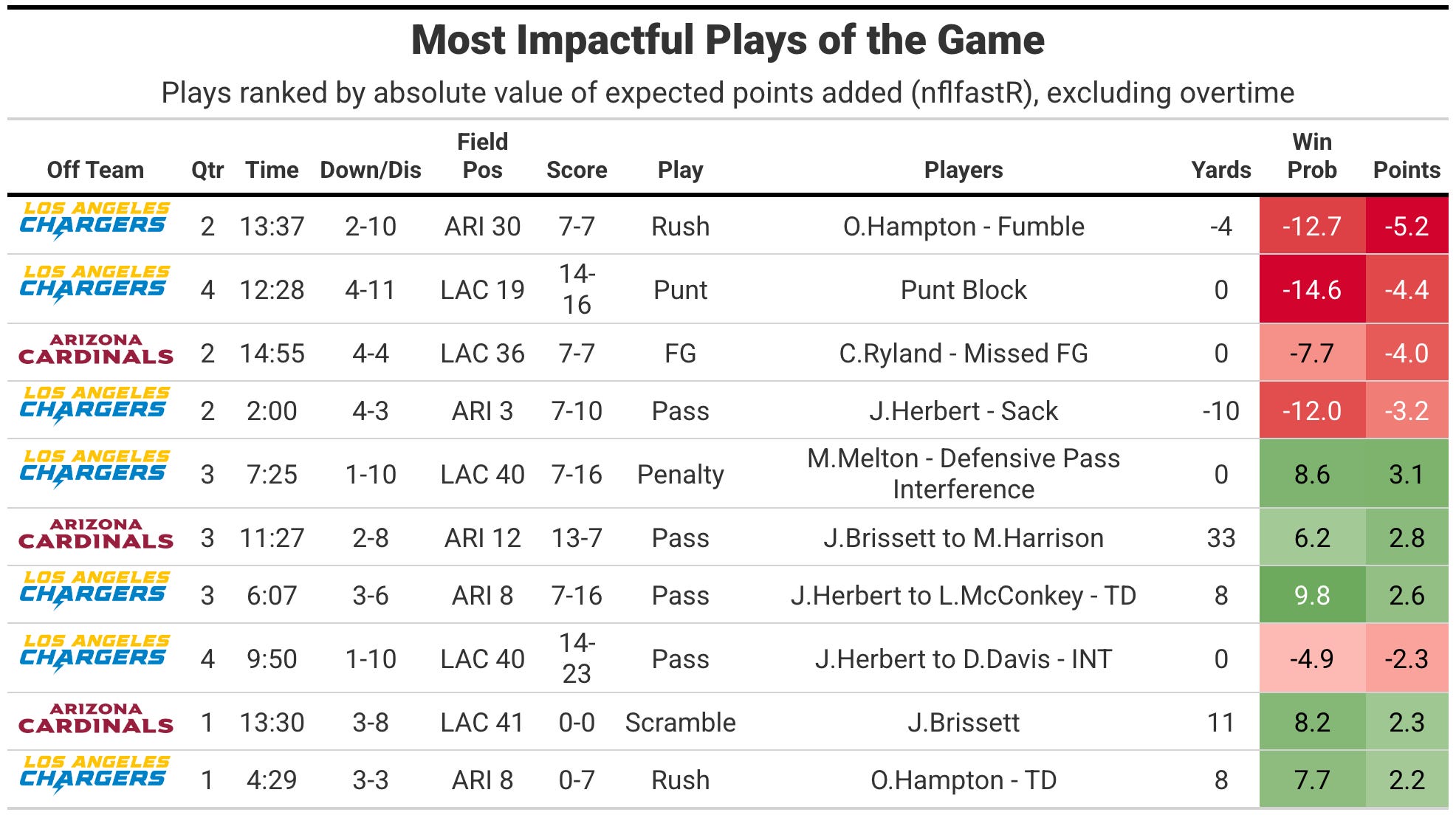
The Chargers could have done themselves favors on the highest leverage fourth downs, but they went 0-for-3, losing 7.0 expected points on failures, including from 4th & Goal from the Cardinals’ 3-yard line coming out of the 2-minute warning in the second quarter.
Another highly visible mistake from the Chargers came on special teams with the Cardinals blocking a fourth quarter punt and starting their go-ahead touchdown drive from the Chargers’ 3-yard line (-4.4 EPA). However, the Cardinals suffered their own special teams mistake when Chad Ryland missed a 54-yarder in the early second quarter that gave the Chargers offense excellent field position (-4.0 EPA).
The running game EPA efficiencies are a bit deceiving, as the teams had similar success rates, but the Cardinals juiced value mostly through two Jacoby Brissett sneaks conversions (+1.3), while losing value in total on their 28 running back carries (-2.7 EPA). Whereas the Chargers’ running backs would have gained EPA on the ground if not for an Omarion Hamption fumble, the costliest play of the game at 5.2 expected points lost.
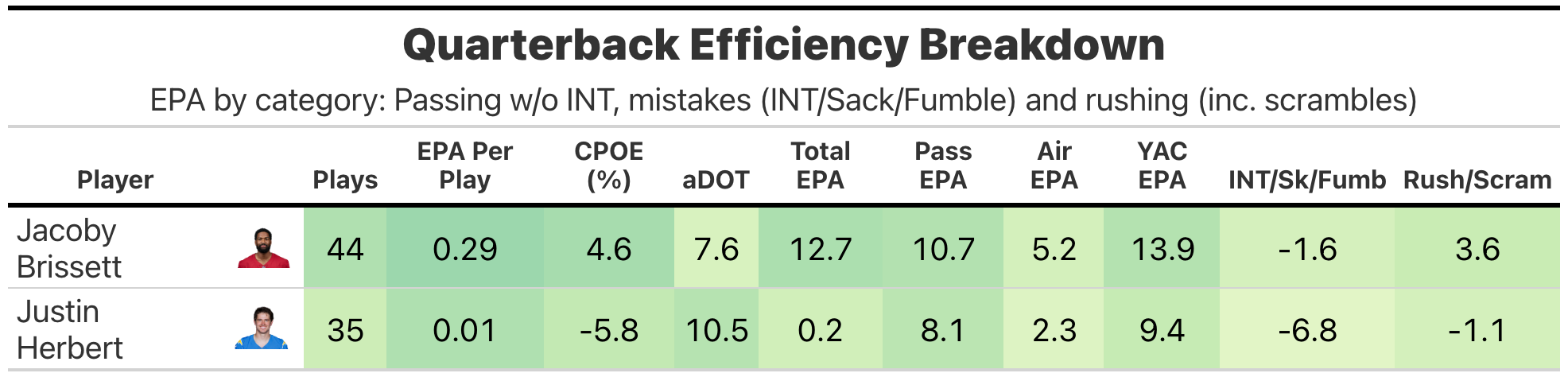
Brissett was excellent by the numbers in Los Angeles. He generated strong EPA value through the air and on the ground, while only taking one sack for zero yards lost, making it no worse than an incompletion. The Cardinals can’t count on this type of play from Brissett, but he’s been one of the better backups for years based on his ability to put it all together on occasion.
It felt like Justin Herbert defenders had the upper hand this offseason, but the haters will be dancing on your social media timelines and sports talk shows this coming week. Herbert wasn’t bad, and he made the customary number of impressive throws that keep the film hipsters with a candle burning for his prospects to truly become the guy. Especially frustrating was the inability of Herbert and the Chargers offense to get anything going in the fourth quarter, aka winning time. They only mustered 16 total plays on four final-period possessions, ending three-and-out, interception and two turnover-on-downs.