


There was a minor kerfuffle this week when Yahoo’s Nate Tice commented on an analysis of how the MLB’s Milwaukee Brewers are zigging when others are zagging, emphasizing undervalued hitting traits, rather than turning the knob to 11 on the “analytically favored” strategy of always pulling the ball in the air.
Tice shoehorned that analysis into a strawman argument around the football-guy-versus-nerd never-ending war on how often teams should be passing the ball.


Of course there was never an argument of “throw on every down”, though there was a simplification of theory into “higher EPA means you should do more of something”. Football guys hate that simplification, as it fails to validate their feelings, and it doesn’t give proper deference to the established maxims of the game.
In fact, further down the thread that Tice quoted was an actually good analogy for what always trying to pull the ball in the air would be in the NFL.

The strategy of trying to execute one type of swing pattern among several choices isn’t the same as choosing between one of two broad categories of offensive play-types in the NFL. But I’ll take this opportunity anyway to show that there hasn’t been a shift back and forth in the understanding of how often teams should pass: the evidence has always shown, and continues to show, that teams should be passing it more on early downs.
It simply is the case that dropping back to pass produces way more value on early downs.
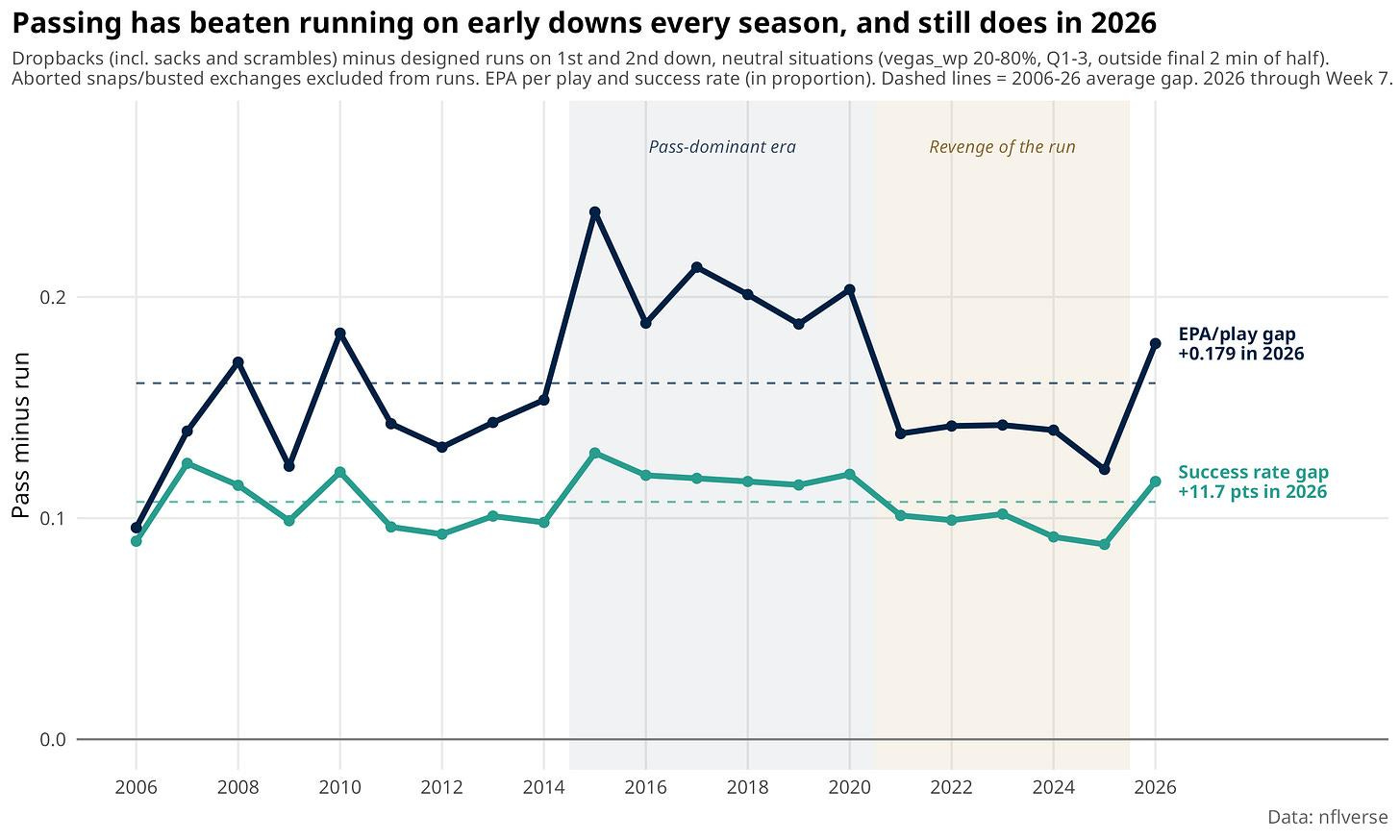
I’ve labeled 2015-2020 as the “pass-dominant era”, which is likely equivalent to the “pass the ball on every down” era Tice references. While the gap in success rate between early down (1st & 2nd) passes and runs didn’t widen significantly, the EPA per play did, mostly due to more effective downfield passing, and an uptick in explosive plays. Right as the NFL started to believe passing was relatively neglected on early downs, the Empire Struck Back, and the success rate differential fell, with a more meaningful fall in EPA differential.
Some of this was due to a rise in rushing efficiency, but mostly it was about pass defenses stymying the high-flying NFL offenses of the prior era. What we’ve seen so far in 2026 is a return of the passer, with success rate and EPA differentials jumping above the longer-term trendlines.
It’s important to note here that even during the worst years for relative passing performance, it was still materially more profitable to pass for per play point value and consistent value gains. There will be up-and-downs in the value spreads, but we never got close to an equilibrium point that would have motivated a reversal in strategy to more rushing.
What’s funny about the discussion is how the nerd view of “always pass” is such a mischaracterization. The nerd view has always been to follow the evidence and change your opinion when the evidence changes. In fact, it’s been a long-standing assumption from nerds that teams could be running more often on 3rd downs.
