


THE CLAIM
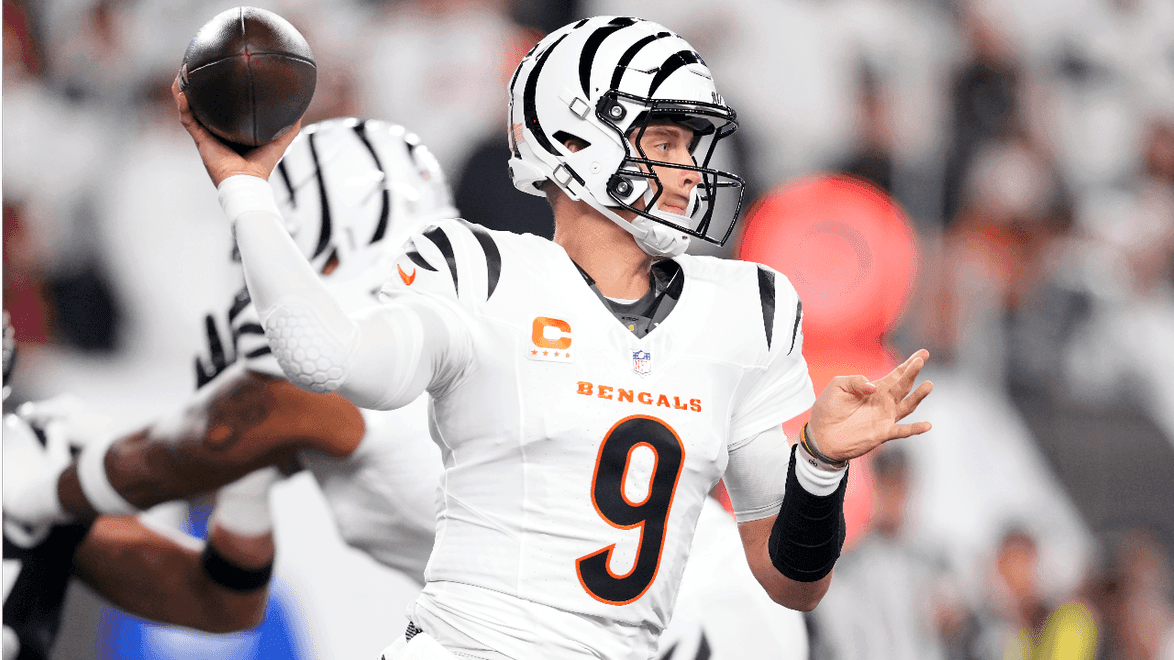
The claim we’re testing is that the Cincinnati Bengals (7-2) can’t keep winning while throwing at such an elevated rate. In Week 10, they beat the Pittsburgh Steelers 38-18, and Joe Burrow threw 44 times for 409 yards and 4 touchdowns. Burrow has averaged 37.8 pass attempts a game, and he has thrown 30 or more times in 8 of 9 games. The one exception was 29 at the Atlanta Falcons.
The Bengals’ volume isn’t just a product of game script. They rank first in pass rate over expected, at +10.2%, more than double the next closest team (Kansas City Chiefs, +4.8%).
Alex Smith said this pass-heavy offense was “not sustainable”, and Bengals’ offensive coordinator Dan Pitcher pushed back against that assessment.
Will performance eventually fade and wins dry up in pass-dominant offenses, or are the Bengals smart in maximizing their advantage?
THE VERDICT: DEBUNK
Historically, throwing this much hasn’t led to suffering performance and losses. The Bengals have a top-tier offense, an average defense, and a passing game that has been significantly better than the run game. Teams with that profile usually keep winning.
One potential issue with dropping back so much to pass is exposing the quarterback to more hits and injury risk, which I attempt to address. It’s a factor, but only a marginal increase in injury likelihood, not a reason to forgo the efficiency benefits of leaning into the pass.
THE EVIDENCE
Pass rate over expected measures how often a team drops back relative to the average team in the same situation, accounting for down, distance, score, time, and field position.
Looking across the NFL, the Bengals are the top team in pass rate over expected when trailing and when leading (also when tied, not pictured).
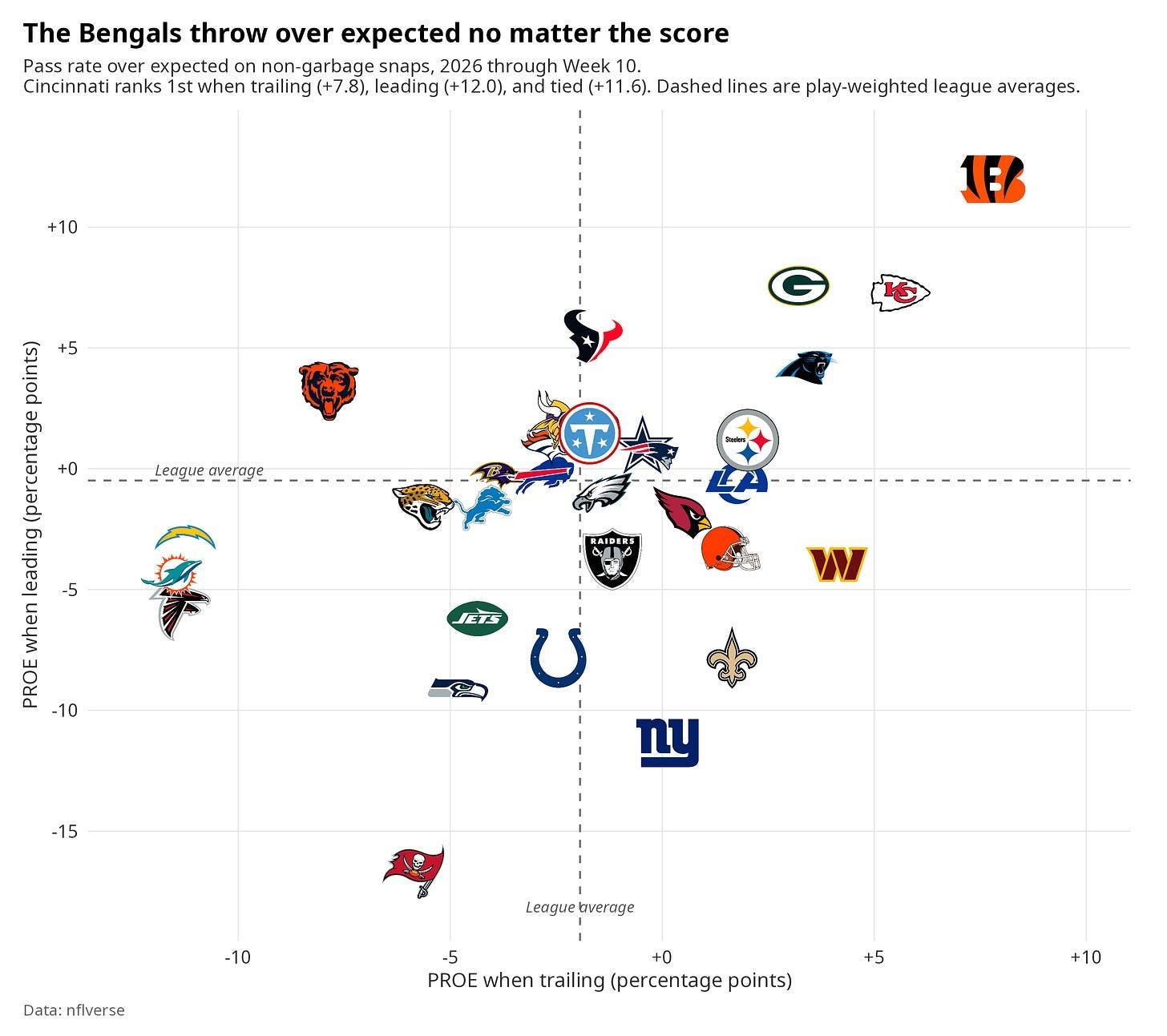
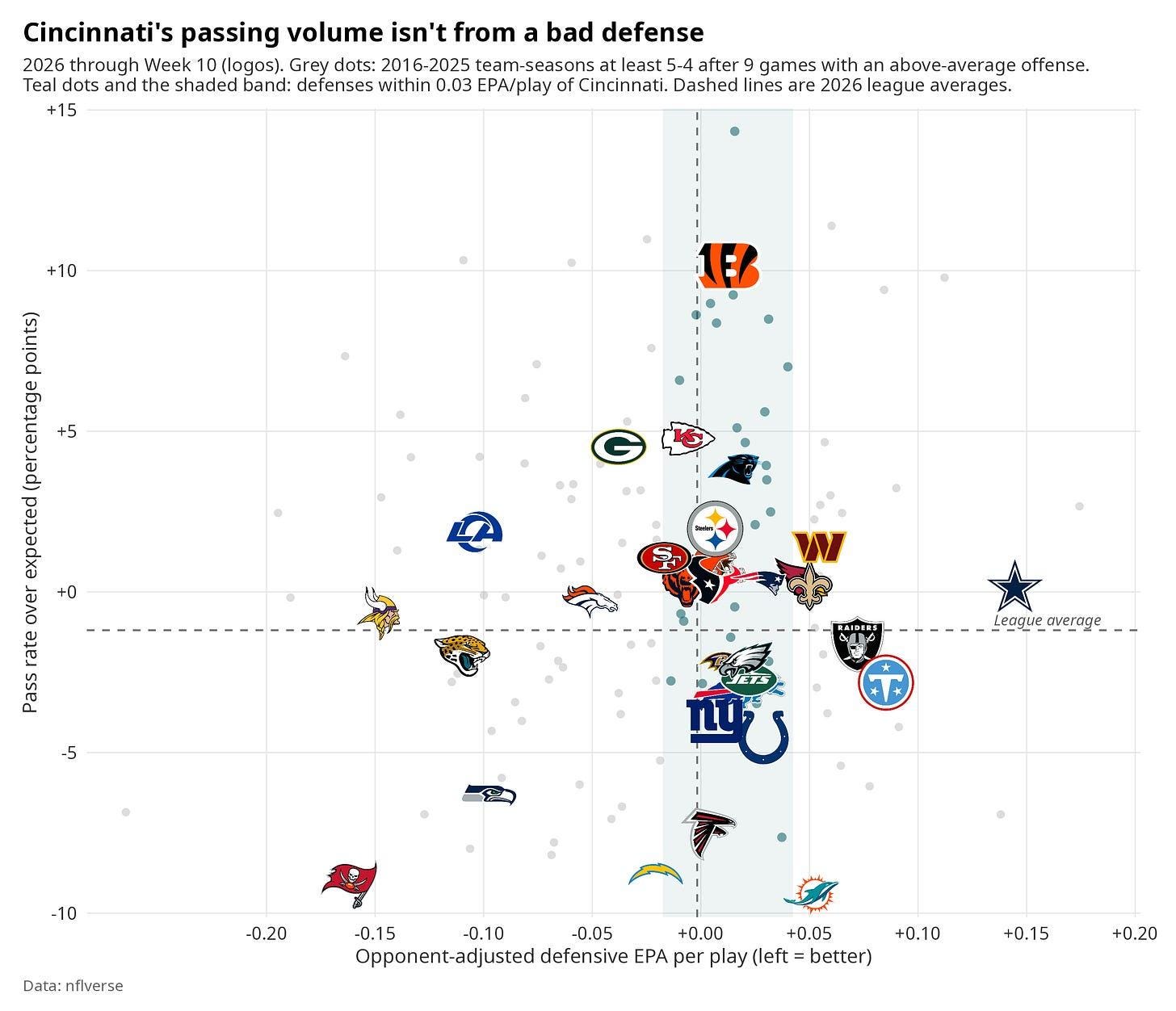
The Bengals have led on 40.0% of their snaps, 8th-most in the league, and trailed on 41.8%, below the league average of 46.8% and 23rd-most. Their defense has ranked 19th in EPA per play, about average, meaning they likely aren’t meaningfully changing their offensive playcalling to stay in front of anticipated scores from the other side.
The Bengals rank first in pass rate over expected when leading (+12.0%), when tied (+11.6%), and when trailing (+7.8%). They have ranked first in one-score leads (+16.4%) and when their win probability has been 80% or higher (+12.6%).
Looking at how that volume lines up with defensive quality, the Bengals sit alone: a middle-of-the-pack defense, and a passing rate that no other 2026 team, and almost no good team with a similar defense since 2016, has matched. The 2022 Kansas City Chiefs were the only historical team with materially higher pass rate over expectation (they’re the dot above the Bengals’ logo).
The Bengals rank third in EPA per dropback and second in offensive EPA per play. Their run game has ranked ninth, not much off from average, not a liability they have had to pass around.
The question is whether this much passing volume has been a sign of trouble later.
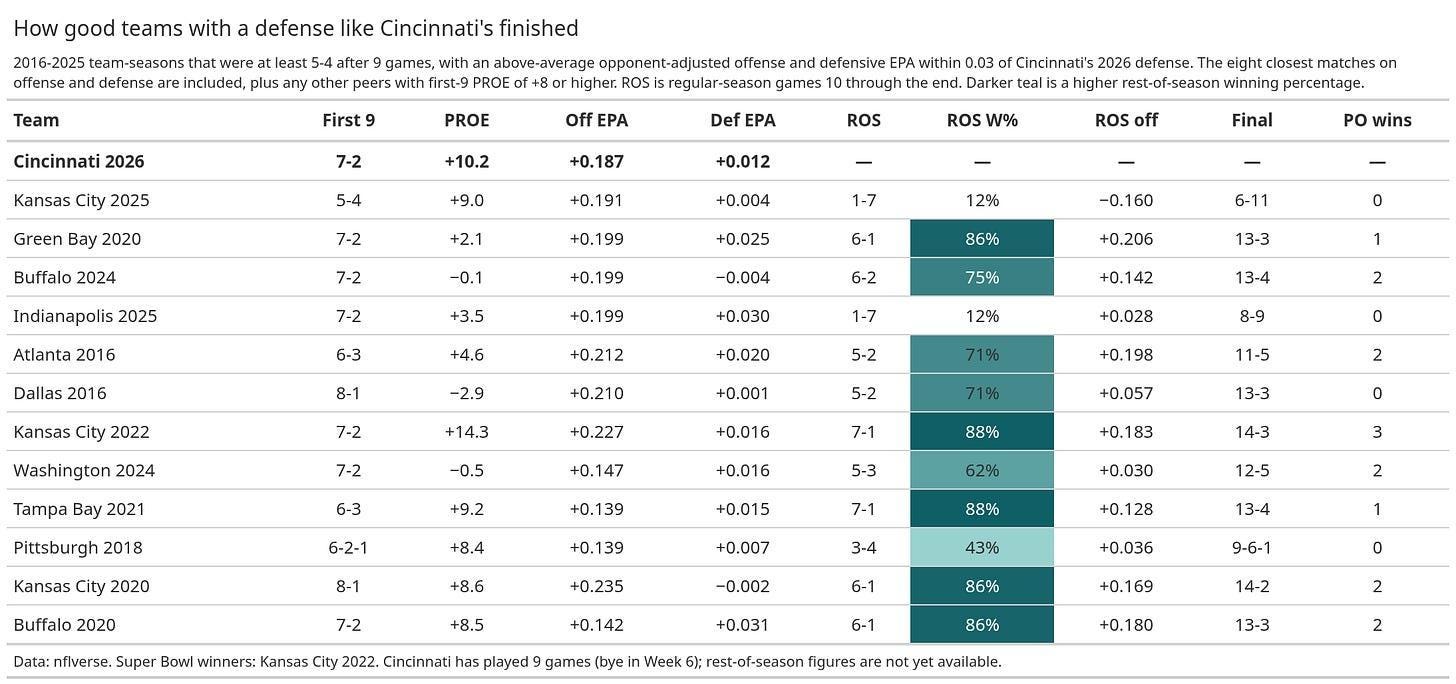
The closest volume analogue is the 2022 Kansas City Chiefs, who were 7-2 after 9 games with a +14.3% pass rate over expected, went 7-1 the rest of the way, and won the Super Bowl.
