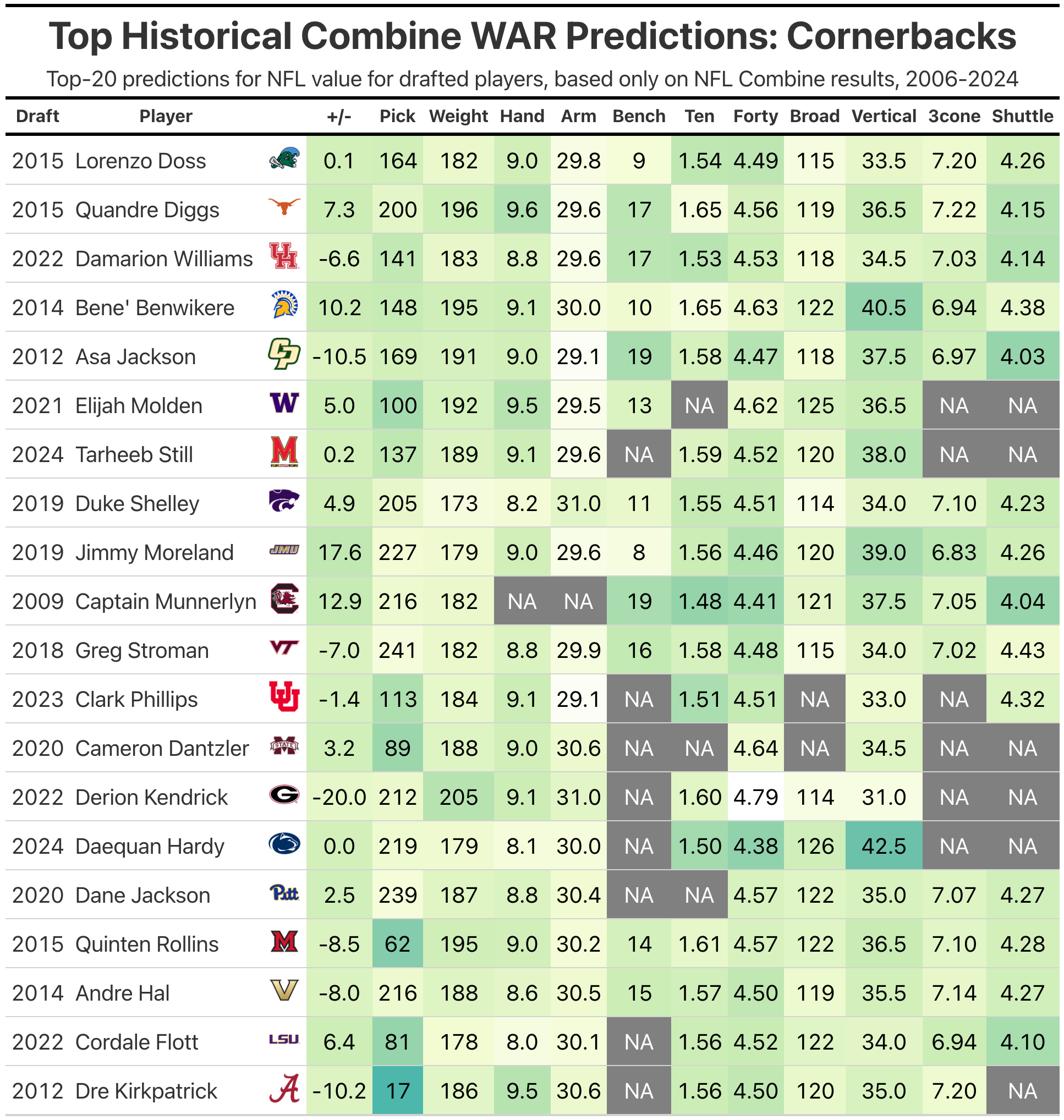
This is my updated version of a prior analysis, adding more data in the form of historical prospects aging into relevance, plus an expanded sample of combine participants from prior years. I also dig a little more into the why there’s a lack of correlation between athleticism and NFL value, specific for players who derive much of latter through coverage.
The degree of importance of NFL Combine drills and measurements depends on what you’re looking to predict: draft position or actual player value. The former is known for all historical draft picks; the latter more estimation and shared understanding. I’ve attempt to push forward our understanding of non-quarterback player value with the NFL Plus/Minus metric, a universal, points-based measure.

The relationship between draft position and NFL value is fairly strong, but contrasting the two gives additional insight into systemic errors in over/underweighting certain traits and how teams can more productively harness information gathered at the combine.
METHODOLOGY
This analysis is built on strong work from former Harvard Sports Analysis Collective member Bill Lotter in his series detailing why the NFL Combine actually matters. Lotter used ridge regression to estimate the coefficients for the different Combine results and measure their importance in explaining prospects’ draft positions and value — the latter estimated using Pro Football Reference’s approximate value (AV) over players’ first three seasons.
Approximate value was a tremendous advancement in player valuation and the best public metric available to Lotter at the time of the analysis. The shortcomings of AV mostly relate to its focus on volume and the inability to differentiate between players on the same team for certain position groups that lack traditional stats, such as offensive linemen. Even for position groups with more extensive traditional stats such as tackles and sacks, their production can be more a function of luck and opportunity than adding value.
This is where NFL Plus/Minus can truly add the proper context and weighting to the performance of each player. For my analysis, I’m contrasting Plus/Minus to draft position, in substitution of AV. You can find the most recent Plus/Minus numbers for the 2024 season on the offensive and defensive sides of the ball, which pointed to Ja’Marr Chase and Myles Garrett being the most valuable non-quarterbacks in the NFL.
NFL Plus/Minus: Who Should Be The 2024 NFL Offensive Player Of The Year?

I (re)introduced my favored methodology for measuring player value two years ago, and then applied it to all the non-quarterbacks in the NFL the last two season. Tyreek Hill was the most valuable offensive non-quarterback in my 2022 and 2023 seasonal
The plots below give the coefficient for each measurement or drill denominated by standard deviation within the position group. The draft positions and Plus/Minus for position groups are translated to percentile, giving both the same scale. Each bar below represents the amount of percentile movement you’d expect for a player with one standard deviation above or below the positional average.
The sample for this analysis covers all players who participated in all drills or all but one drill from 2006 to 2021, giving them a full four years to accumulate NFL value during their rookie contracts. For players who missed a drill, the value was estimated through a regression on the remaining variables, with a discount applied to the result because of an assumption that the drill was purposely skipped with an expectation of underperformance.
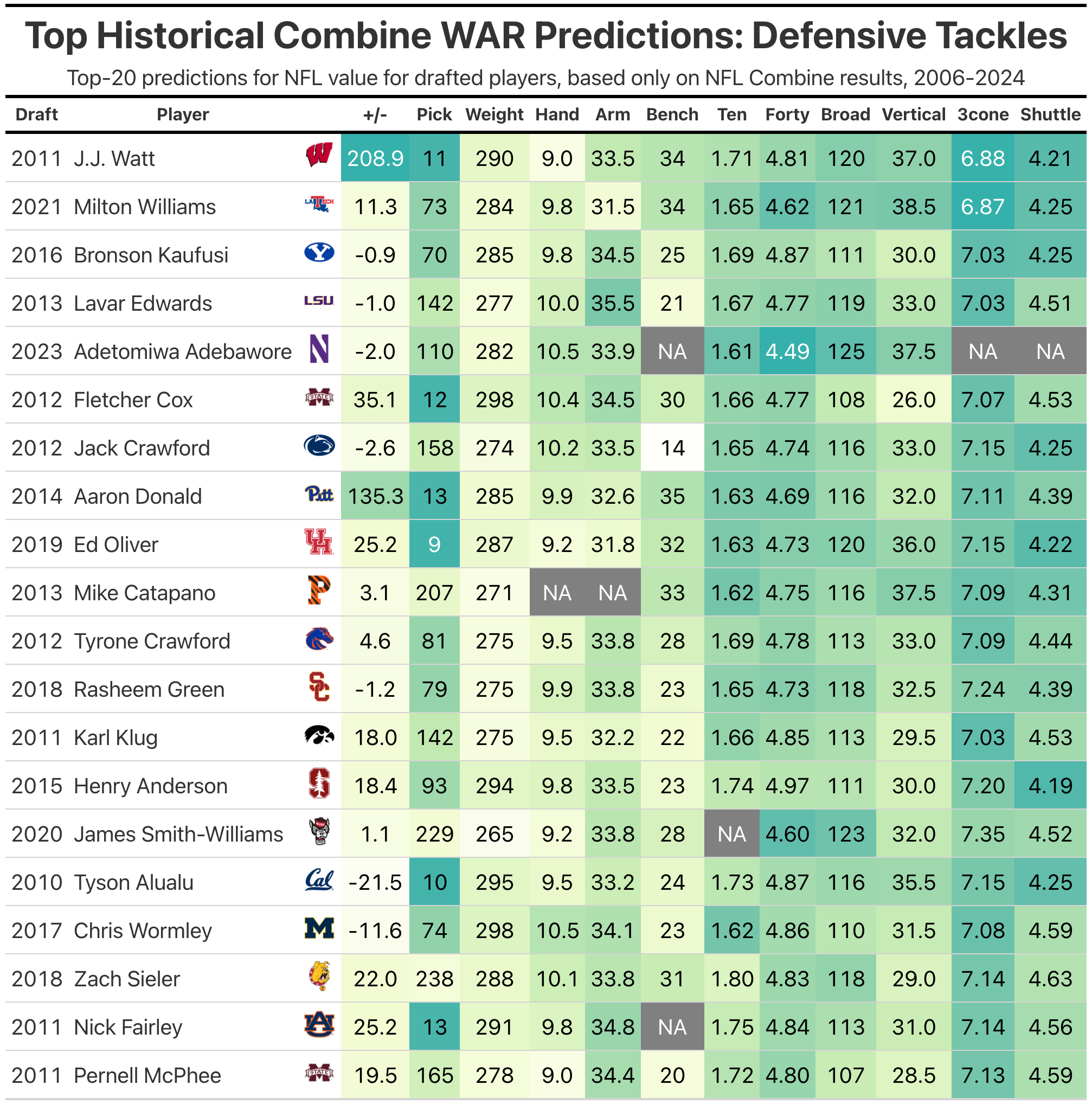
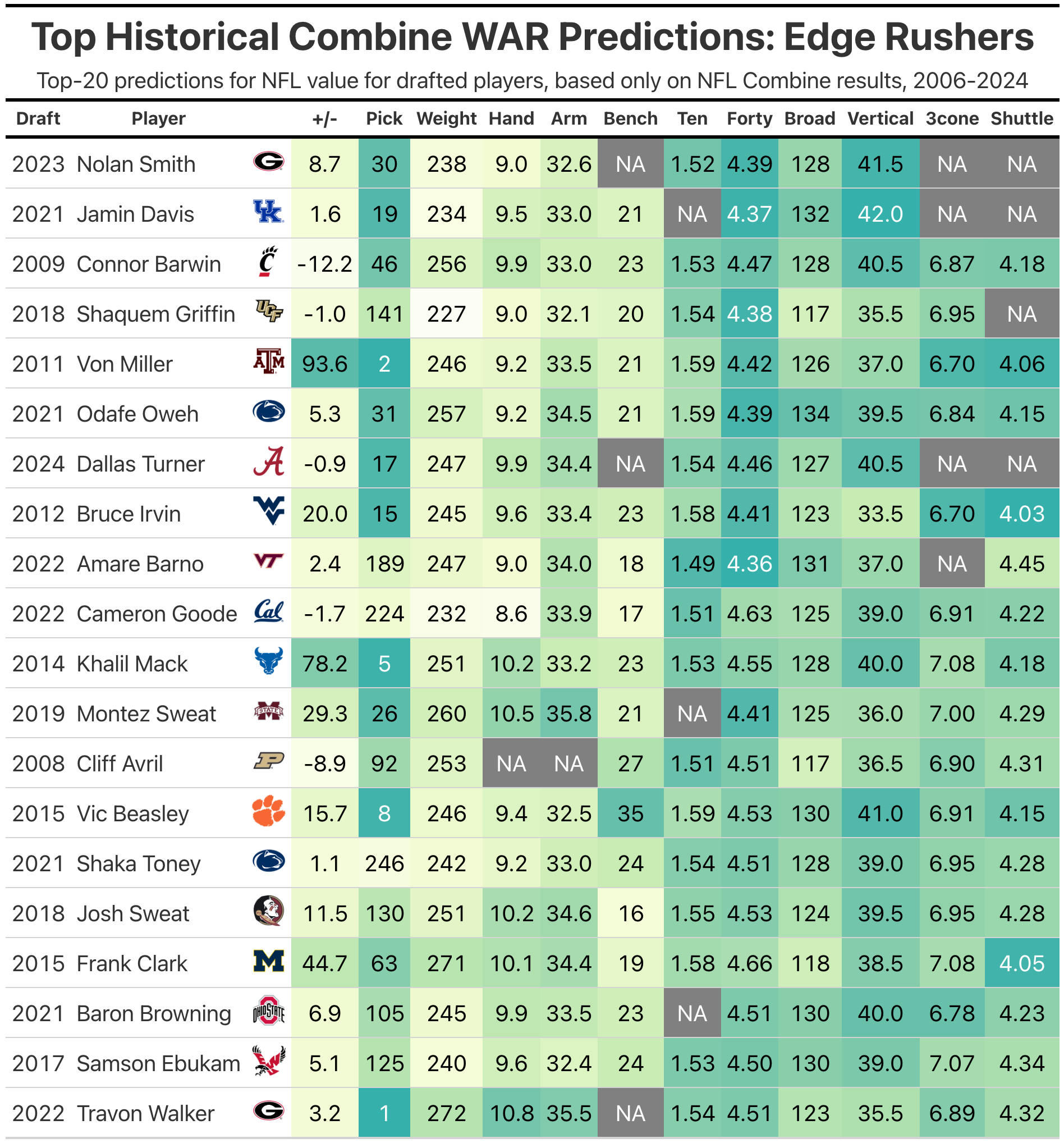
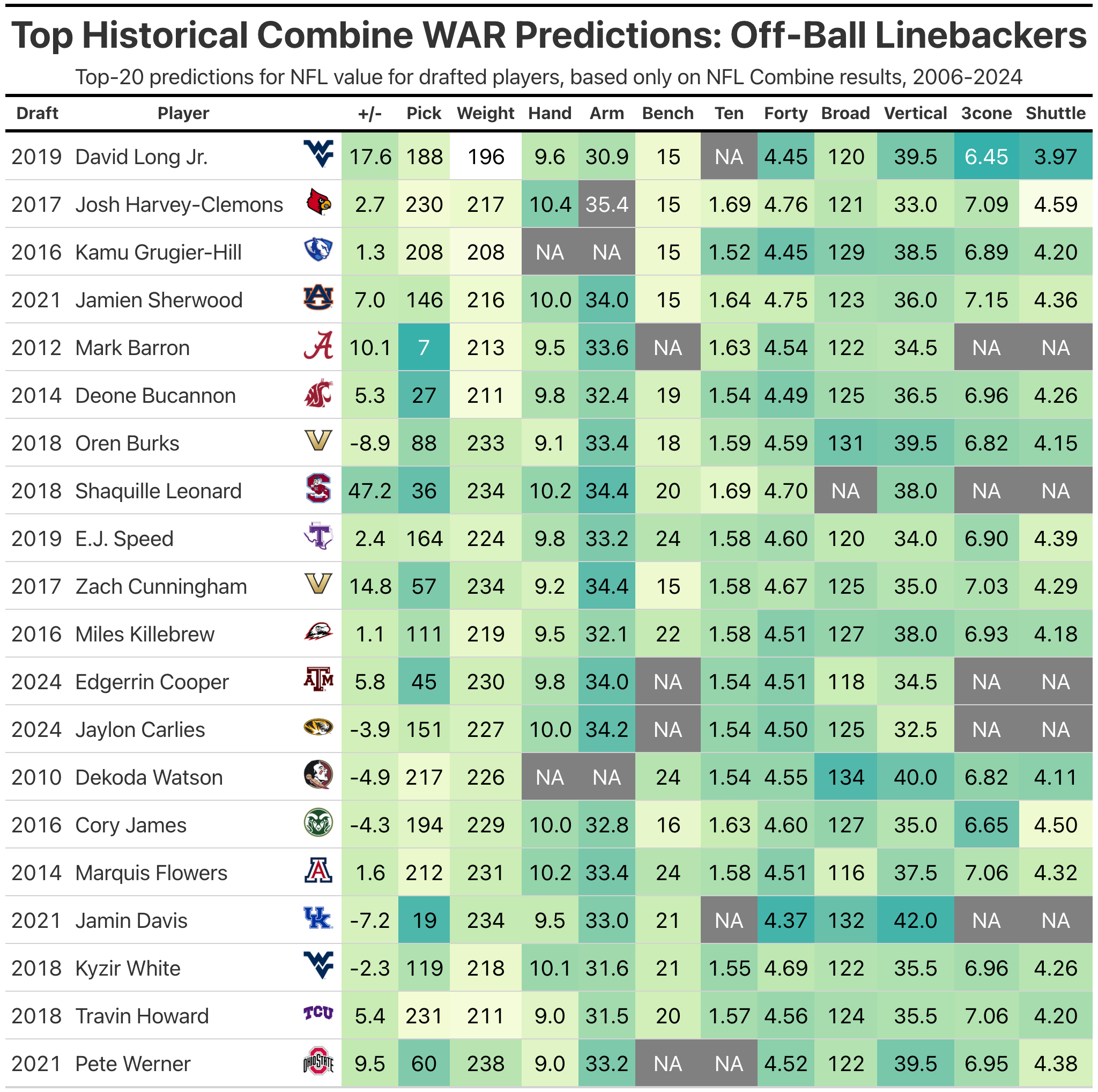
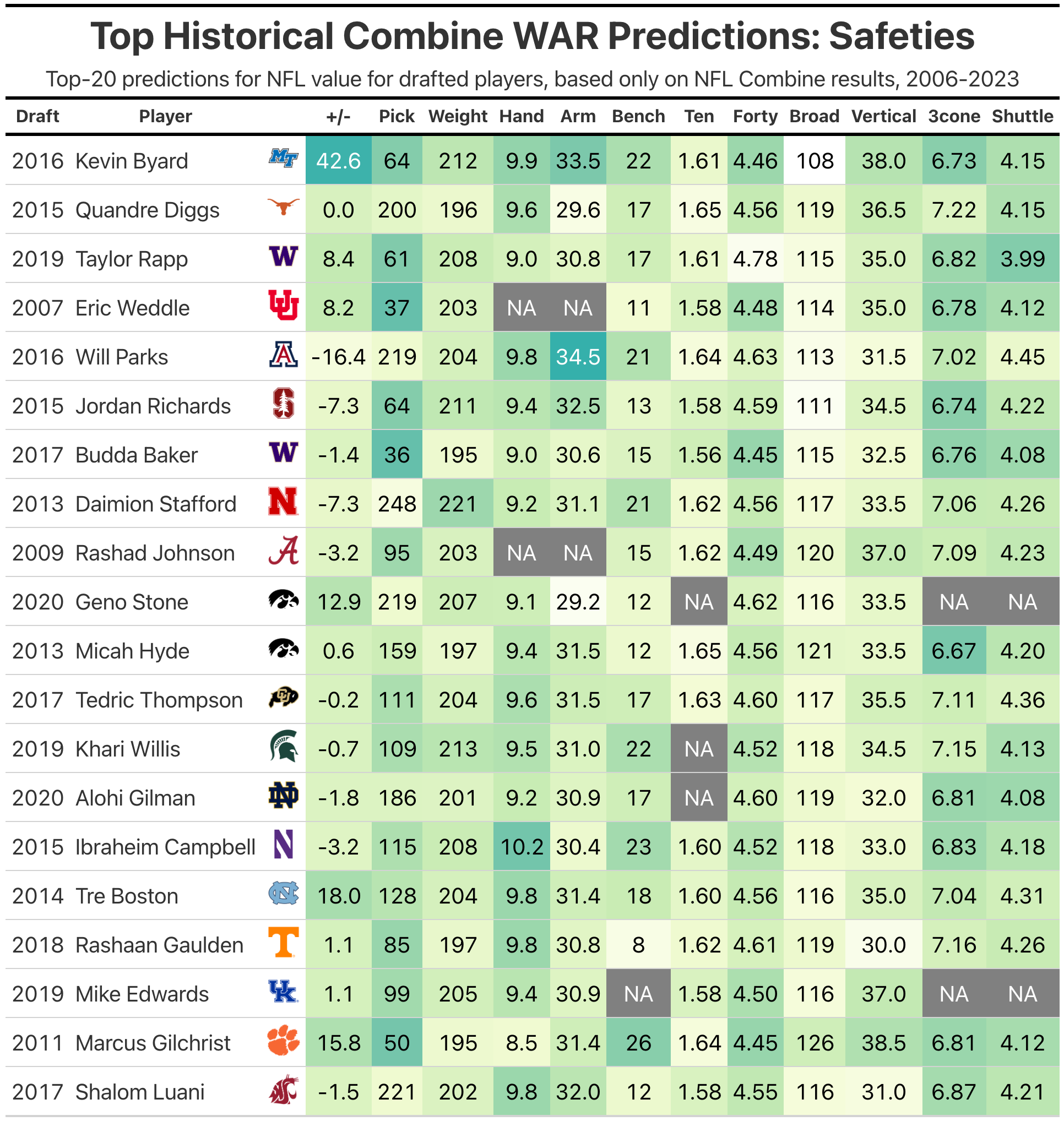
Below each plot, I’ve included a table with the top-20 projections for positional Plus/Minus (first four seasons) in the 2006 to 2024 period, including the players’ combine marks and their actual Plus/Minus produced.
INTERIOR DEFENDER

Interior defender begin a theme you’ll see across the defensive line: being bigger (specifically heavier) drives draft value but not NFL value. There’s always the risk that these models are overfitting to a few productive players (See J.J. Watt below), but I think we can still take a lot from looking back at the past, with a potential bias towards drafting bigger defensive tackles with higher floors earlier than their ceilings justify. If you’re spending a lot of draft capital on a prospect in the first couple rounds, you want to focus not only on floor but, more importantly, ceiling, which comes from the smaller interior defenders who can more effectively rush the passer.
Weight-adjusted three-cone times jump out as a huge indicator of NFL success, and somewhat surprisingly a lower weight. Like all defensive players, interior defensive linemen have dual responsibilities against the pass and run, but those roles have very different profiles at the positions.
When you look Plus/Minus against the run and pass as target values separately, three-cone is significant for both, but above-average size is linked with run defense. In the modern NFL interior defenders have become increasingly important in rushing the passer, and that’s why the overall Plus/Minus correlation points to smaller, faster players for the best NFL value.
J.J. Watt was one of the most productive non-quarterbacks in recent memory by points added at over 200 his first four years, which translates to around one-and-a-half wins added per season. In addition to Watt, the top-20 includes another all-time elite rusher from the interior Aaron Donald, plus successes like and Fletcher Cox and Ed Oliver.
EDGE RUSHER
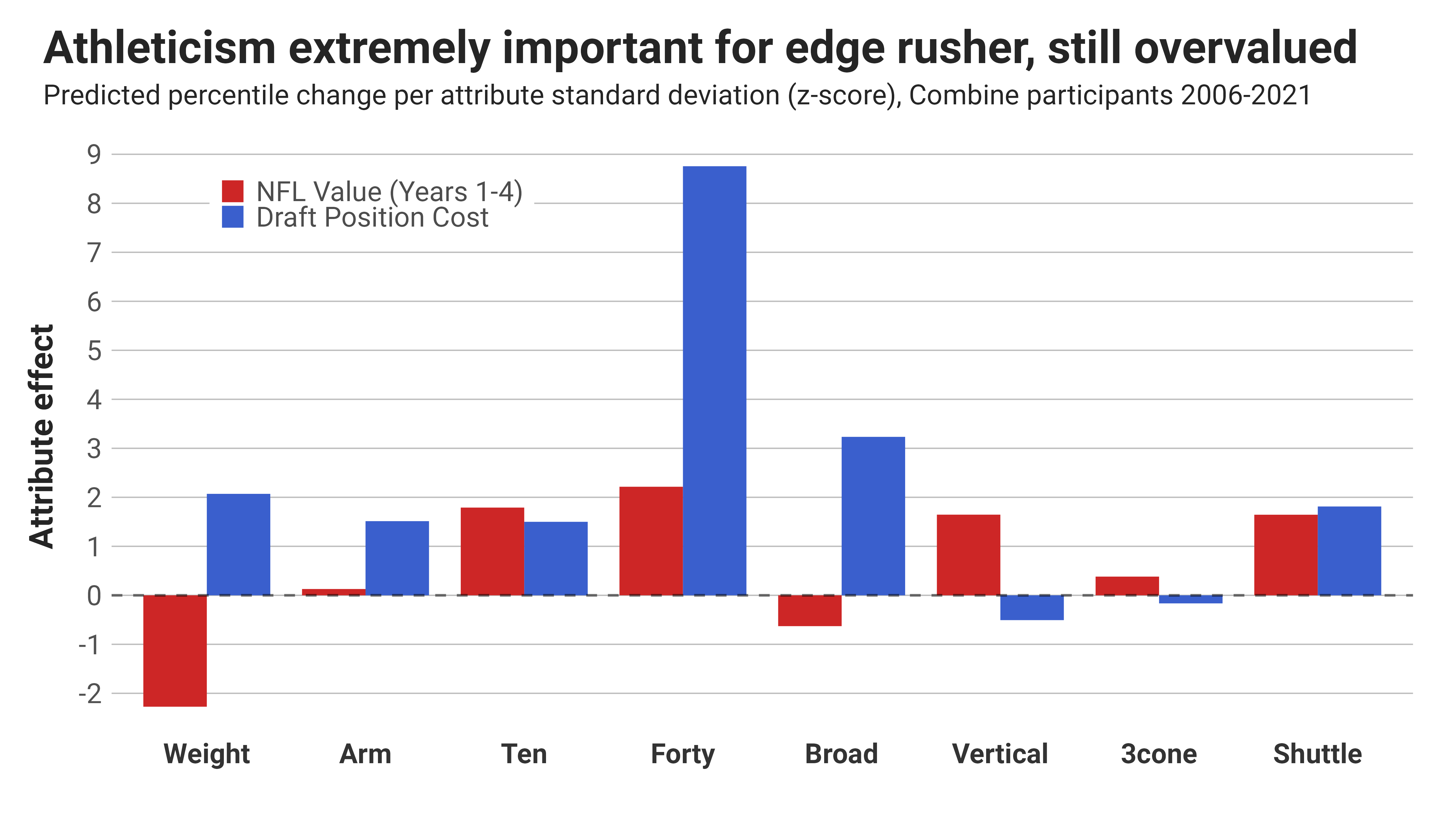
It’s speed, speed and more speed when looking at what drives capital spent on edge rushers in the actual NFL draft, though it looks a bit overvalued in terms of NFL value added.
I don’t want to undersell how important athleticism is for edge rushers: there are hugely significant correlations between weight-adjusted speed, explosion (mostly vertical) and agility and NFL value, even when only looking at a subset of combine invitees who are all incredibly athletic versus the general population of college players. It’s just that NFL teams are extremely aware of how important athleticism is for edge rushers, perhaps even weighing it too heavily in their draft decisions, especially versus production metrics and other advanced stats that have been developed in recent years.
Like we saw for interior defenders, a lower weight is correlated with NFL value, but to a lesser degree. That said, there are probably diminishing returns the lower weight gets, meaning a linear model will project abnormally small edge defenders too well.
The 10-yard dash time is relatively important and not as valued in the draft, and the vertical jump has the most signal of an drill. By the anecdotal sample of stories I’ve heard, the 10-yard split has probably been nearly fully incorporated as more important than the forty at this point, but historical data goes back to when it was underappreciated.
Von Miller, Khalil Mack, Frank Clark, Bruce Irvin and Montez Sweat all show up in the top-20 historical Plus/Minus projections, with smaller sizes and strong drill performances across the board.
OFF-BALL LINEBACKER
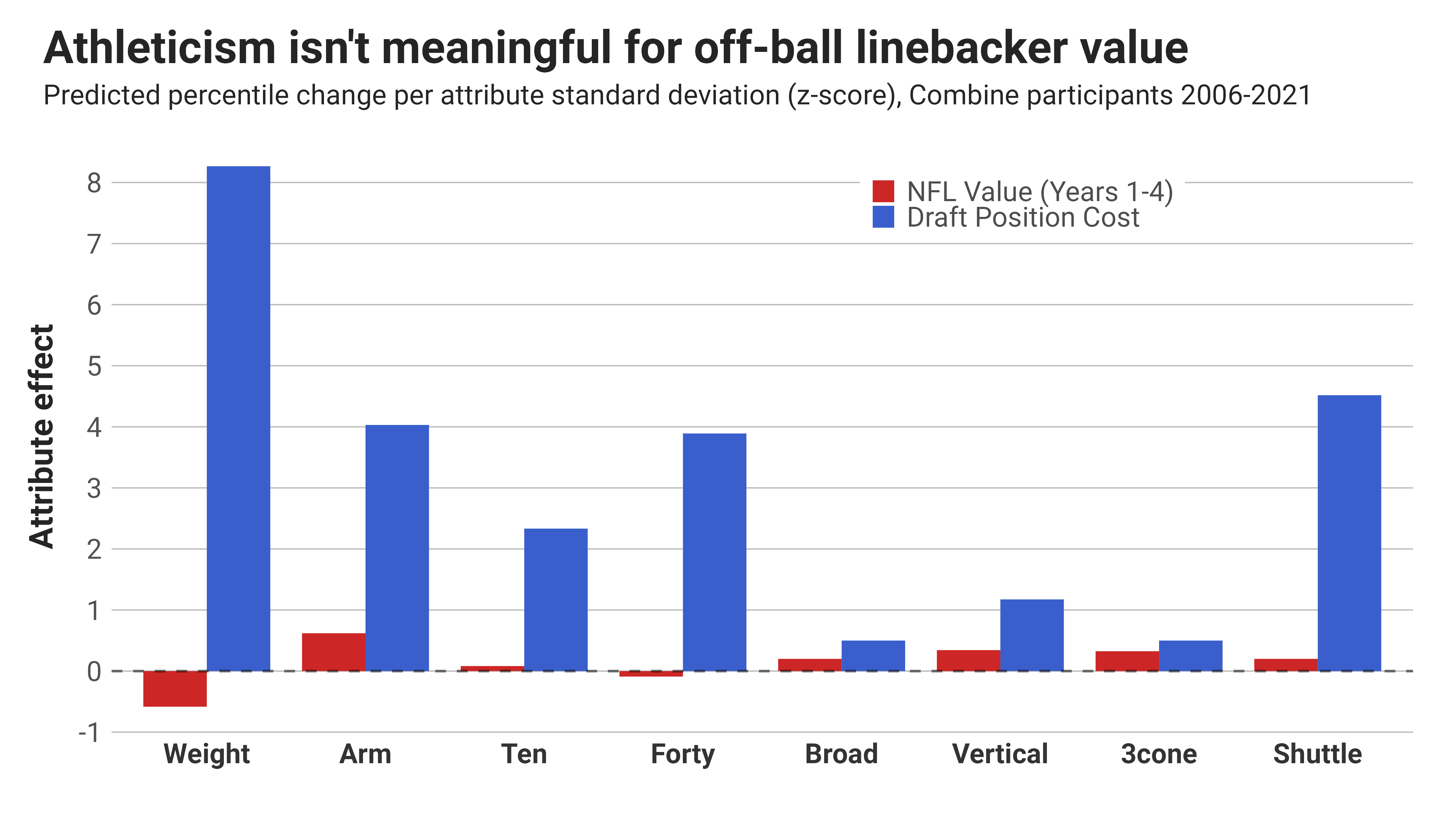
Linebacker has the one of the weakest signal for NFL value from combine drills and measurements, but they do play an outsized role in determining draft position. I wouldn’t recommend fading athleticism at the position, but perhaps don’t greatly adjust your big board after surprising results. The biggest takeaway is probably to fade the combine for linebackers. What you’ll see for all the positions that derive most of their NFL value in coverage (off-ball linebackers, safeties and cornerbacks), is that you can’t measure that skill simply by picking the best athletes.
There’s something more skillful and cerebral (or maybe instinctual) that goes into homing the craft of being a top-notch coverage player that doesn’t seem to apply as much to rushing the passer. It’s also important to remember that this analysis is only applied to a slice of hyper-athletes who are invited to the NFL combine, which is already chosen from a slice of hyper-athletes within the general population. Athleticism is extremely important for success as a coverage player in the NFL, it’s just not necessarily relatively important in the tiny cohort of draft prospects.
Many of the most productive early career linebackers according to NFL plus minus, like the top-two Luke Kuechly (+82.4 points) and NaVorro Bowman (+72.3), were quite athletic. At the same time, the NFL draft is littered with linebackers who ran in the 4.4s and then didn’t pan out in the NFL. Linebacker is increasingly about pass coverage for value, which is a combination of sheer athleticism and skill/senses, lowered the value of the former.
I wouldn’t read too much into the top-20 list below, as the combine measurements and drills have such little effect.
SAFETY
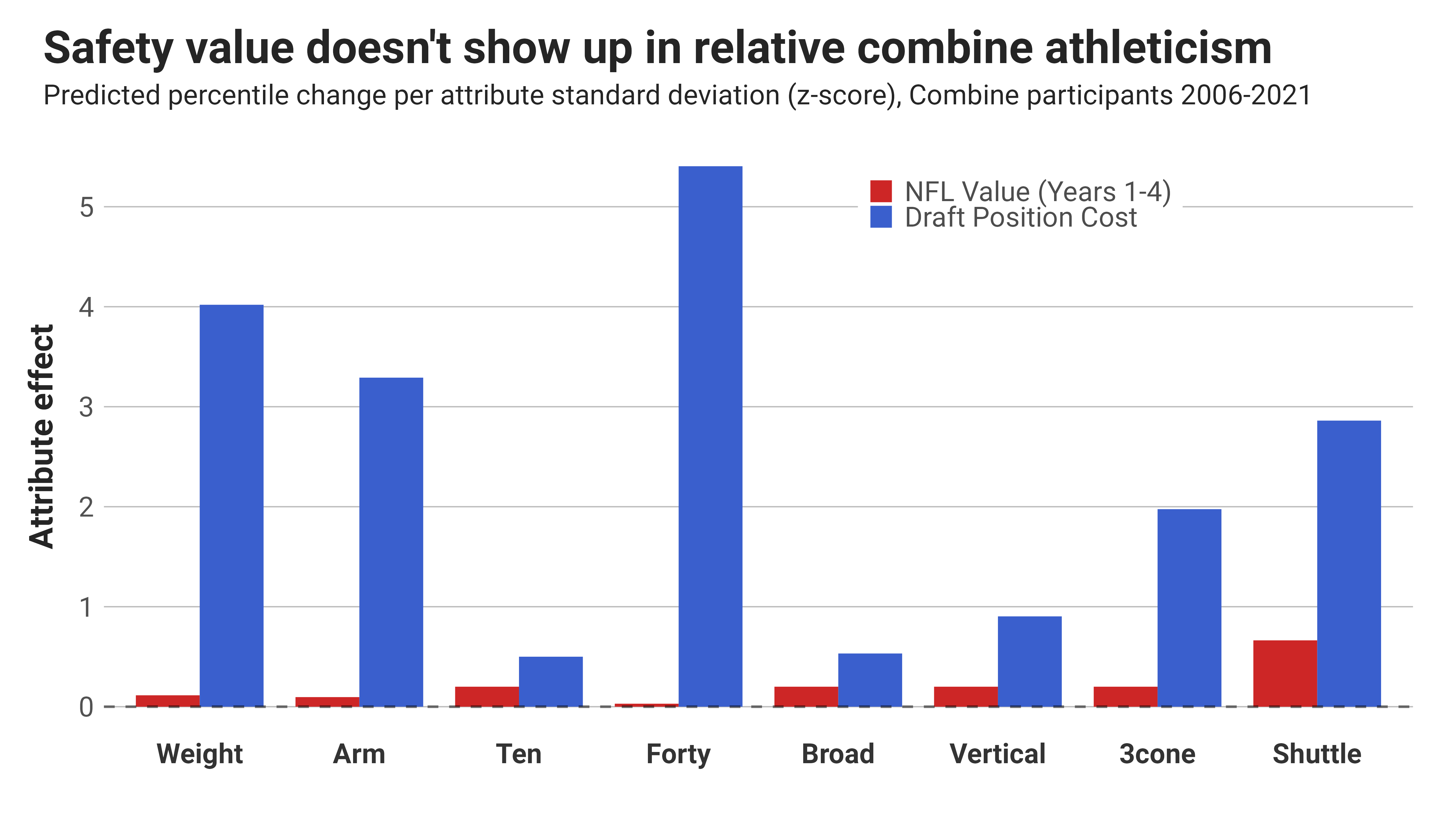
I wasn’t surprised to see little signal for safeties from combine measurements and drills, but digging into the run/pass split illuminates things. If you only look at the effect on run value, size and speed matter, while coverage is more difficult to pin down, beyond the short shuttle’s significance.
Bigger safeties are more likely to be at least a moderate producer in the NFL as run defenders, but won’t necessarily hit the higher-end coverage outcomes needed to be a top producer at the position. The combination of the difficult projecting coverage value into the NFL and the position’s availability in free agency makes in risky to spend a high pick on a safety prospect.
CORNERBACK
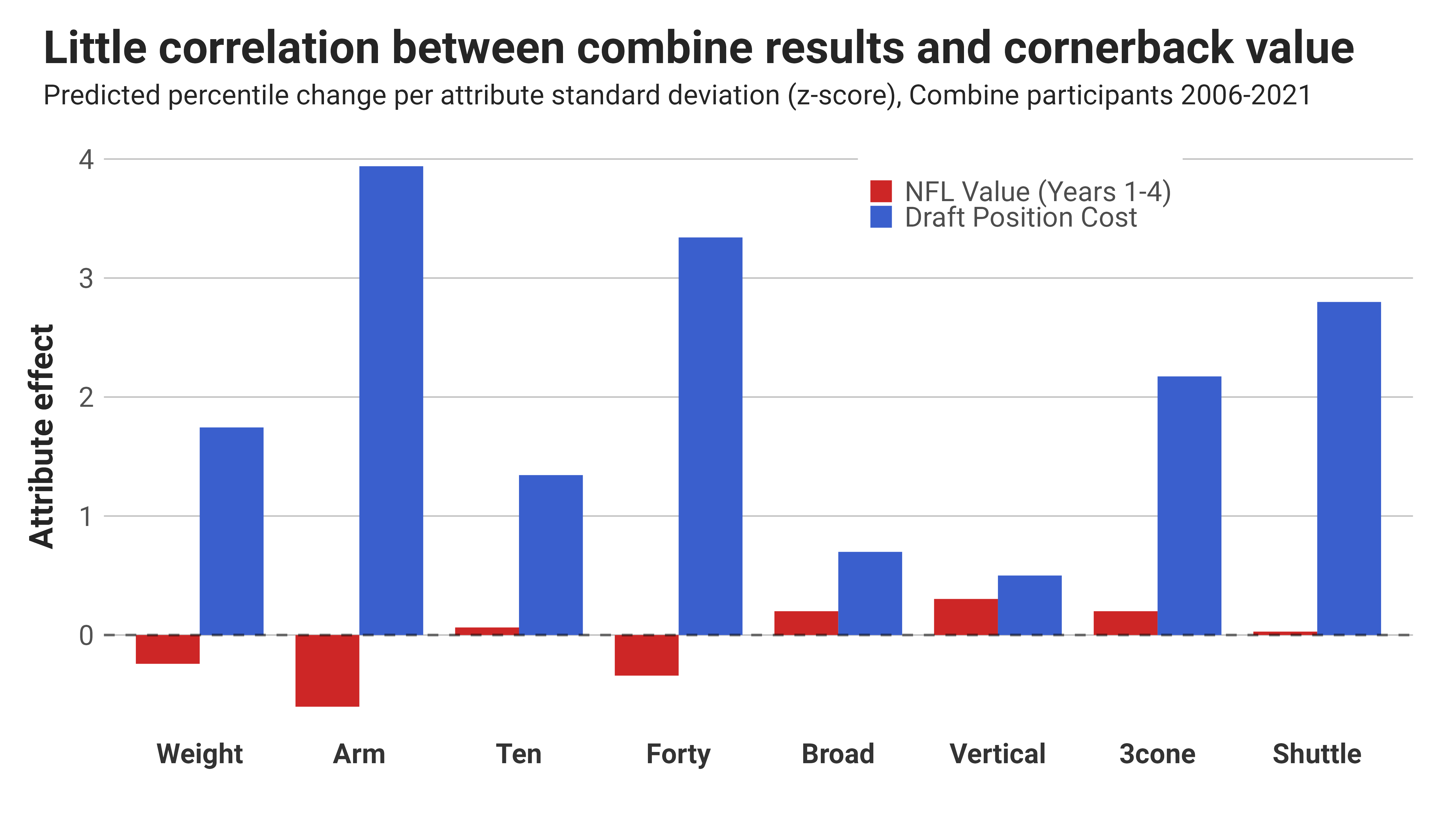
There isn’t a lot to get from the combine for cornerback, and it looks like the measurements and drills are mostly overrated. It’s not that athleticism doesn’t matter at the position, but that so many cornerbacks are elite athletes - often the best athletes on the team - that the differences in performance go beyond what can be measured. Cornerback value is almost completely about coverage, where instincts, study and scheme fit make the biggest differences.
I’m not including a historical top-20 table at the position as most of the measurements and drills have slightly negative correlations to NFL value.