


You can find all the previous weekly editions of the Bayesian Quarterback Rankings here, and the backlog for Adjusted Quarterback Efficiency is here.
QUICK METHODOLOGY PRIMER
If you want the full explanation of Bayesian updating, please refer to this analysis I wrote in the past (which I believe isn’t behind the PFF paywall).
Basically, Bayesian updating begins with an expectation (prior beliefs), then updates the expectation when we get new evidence (posterior beliefs). If the evidence is better than of expectation, the updated expectation is better, and vice-versa. The key is that the evidence only shifts our expectations, it doesn’t define them. The more evidence we get, the more confident that we can be that the evidence is a better representation of actual “truth” than our original expectation. For this analysis, the original expectation is based on historical averages by draft position.
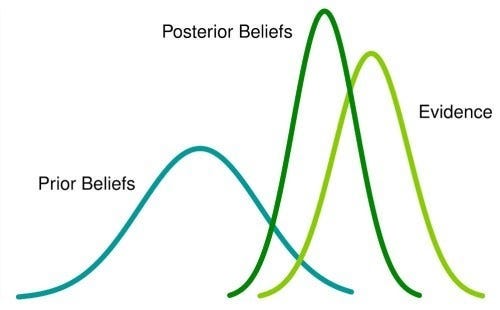
You can see why this would be useful in football analysis, where we’re long on domain knowledge but often short on sample size. In Bayesian statistics, even the smallest sample can be used to update our prior, or initial, forecast. Our prior starts as a strong anchor for our forecast, then waning in influence as our sample of evidence grows larger. This also gives us a range of outcomes, which narrow as we get more evidence. This aligns with common knowledge that quarterbacks with less experience and play on the field have a larger range of who they will eventually prove to be.
The formula for Bayesian updating (using the normal-normal distribution) requires estimates for “true” range of outcomes (I used the distribution of franchise quarterback efficiency, minimum 1,000 career dropbacks) and standard deviation per piece of evidence (I used the standard deviation of value-added on each quarterback play). The difference in more recent versions of this analysis is substituting my adjusted quarterback efficiency metric for basic EPA in the play-by-play data for “evidence”.
The posterior estimates include a “true” estimate, which is the mean/median of the projected range of outcomes, with a standard deviation assumption that shrinks as quarterbacks get more reps. In the table below, you’ll just find the mean values, but remember that sample size is key, so there are wider distributions, and more quickly updating posteriors, for younger and inexperienced quarterbacks. As an example, here are the distributions for two quarterbacks battling for the Atlanta Falcons’ starting role, who look similar by average by mean estimate, but have vastly different sample sizes: Tua Tagovailoa and Michael Penix Jr.
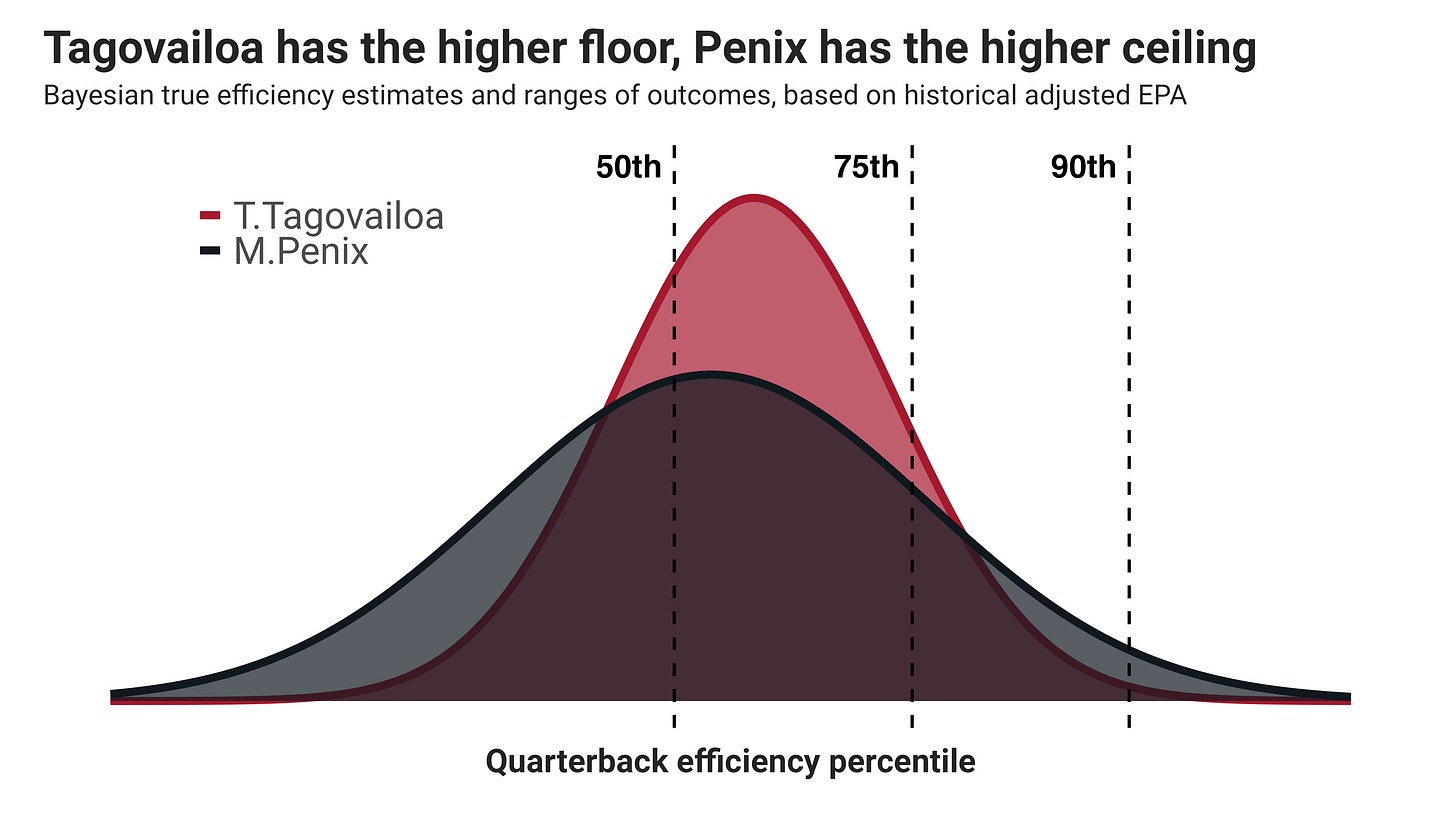
It’s unlikely at this point that Tagovailoa will produce like an elite quarterback, but we should be more confident in assuming the bottom won’t fall out for the Falcons’ pass game this season with him at the helm than with the relatively inexperienced Penix. Unfortunately for the Falcons, Penix hasn’t been good enough in his limited action (443 plays or quarterback involvements) to give him much chance of elite play, but that figure is higher than for Tagovailoa.
2026 PROJECTED ADJUSTED EFFICIENCY
These results are the ranking for the go-forward projections of adjusted quarterback efficiency this season. I also included the adjusted EPA per play rankings for each quarterback over the last five seasons (minimum 300 dropbacks) so you can see the evidence going into the projections.
Older data is decayed over time, so the 2025 and 2024 EPA per play data matters more than those from prior years. That said, older data can’t be fully discounted, or else you miss bounce-back performers of great quarterbacks returning to form, like Aaron Rodgers returning to form after a few poor statistical seasons and winning his third and fourth MVPs in 2020 and 2021.
For this preseason analysis, I’m excluding potential starting quarterbacks who don’t have any NFL play involvements, i.e. rookies. If Fernando Mendoza and other rookies are slated to start in Week 1, I’ll add them to my analysis immediately prior to the season.
“Percentile” is the mean (“best guess”) projection as a percentile of historical franchise quarterback results (min 1K career dropbacks).
I’ve added a column with the quarterback rankings in Mike Sando’s QB Tiers article that he publishes every offseason. He surveys NFL insiders, including coaches, general managers and scouts to get their impressions on NFL quarterbacks, then arranges them in tiers and ranks them further by average tiering. I like to use Sando’s work as a check to see which quarterbacks I’m higher or lower on than NFL consensus.
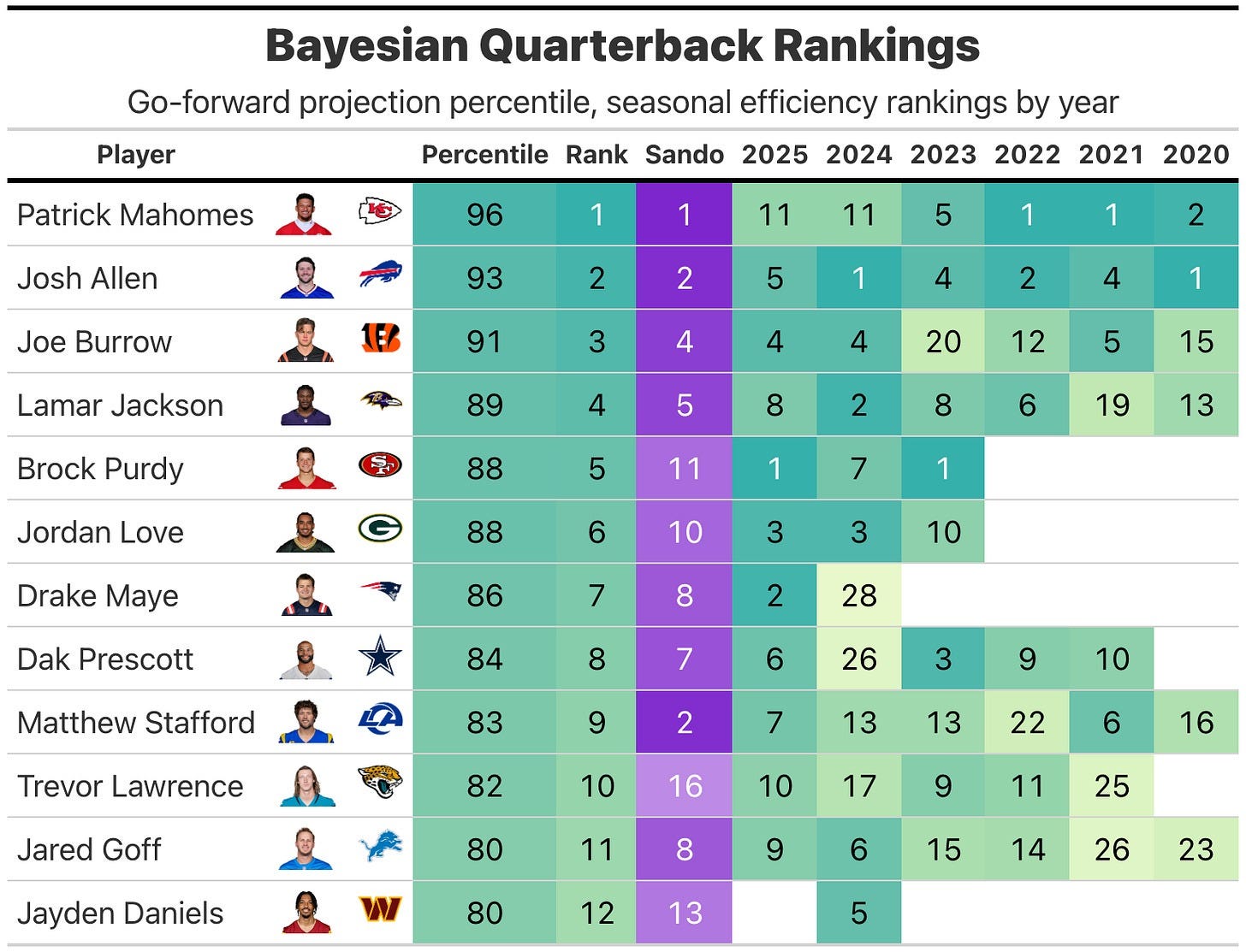
A lot of the shine has come off of Patrick Mahomes’ sterling reputation over the last two seasons, although his adjusted efficiency rankings in 2024 and 2025 were still in the top-11. Partially this is due to the Kansas City Chiefs missing the playoffs for the first time in more than a decade, part is related to questions around his physical abilities coming off of a season-ending knee injury. NFL insiders agree with my ranking Mahomes No. 1, though important context is that his go-forward mean efficiency projection has fallen to the 96th percentile from the 100th entering the 2025 season.
I’m actually a bit surprised that Josh Allen hasn’t caught up further to Mahomes, or separated more from Joe Burrow and the rest of the pack. Allen has been a top-5 quarterback by adjusted efficiency in each of the past six seasons, a feat no other can claim. What isn’t included in the table are Allen’s poor figures in his first two seasons, when he ranked 24th and 22nd, respectively, in EPA per play (min 300 plays). That still weighs on his overall projection, with decreasing effect each subsequent season.
Three quarterbacks to highlight as outliers from the NFL consensus are Brock Purdy, Jordan Love and Trevor Lawrence. It’s not a mystery why Purdy falls into that category; he’s outperformed in EPA efficiency versus perception since his first NFL snap.
