


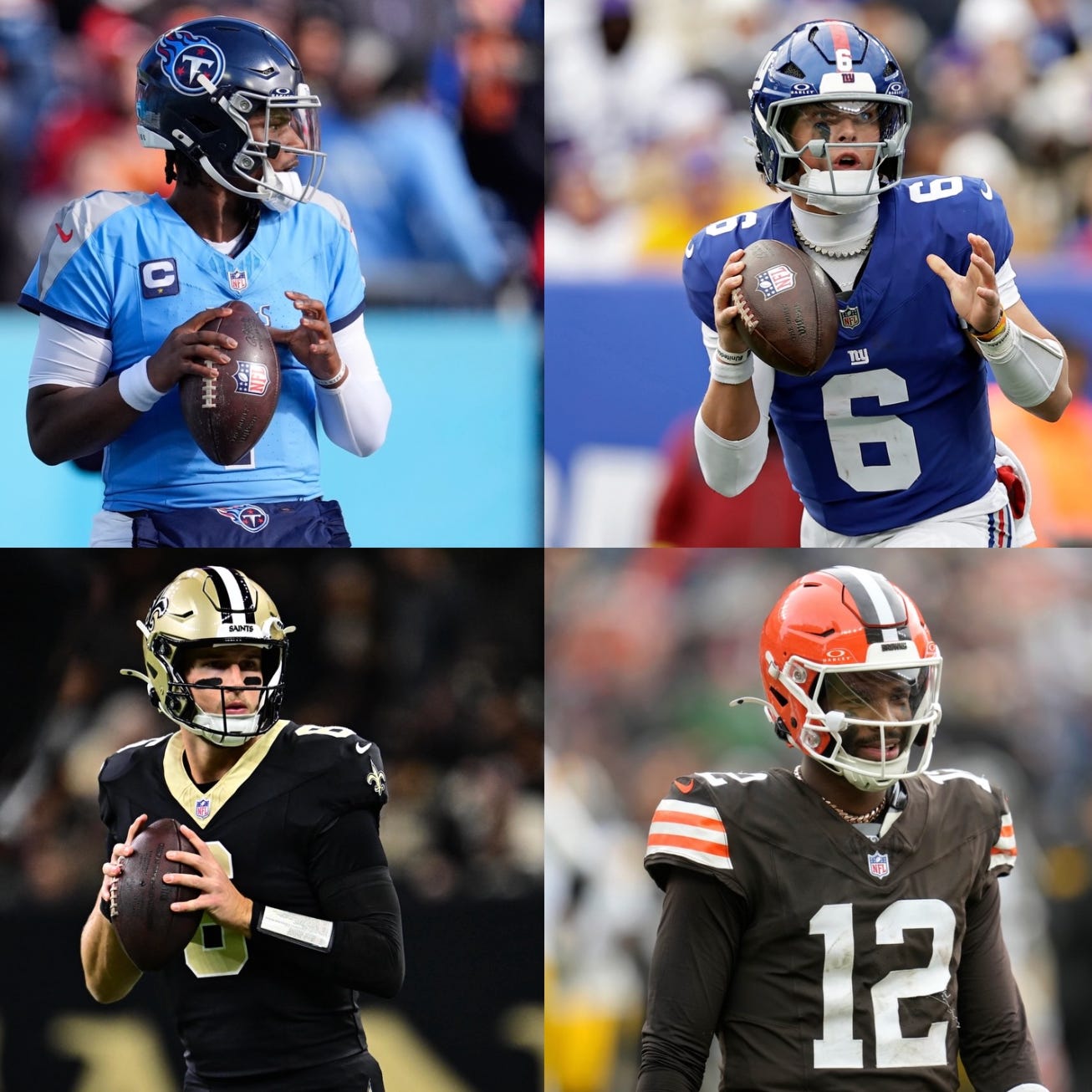
If you’re doing NFL analysis the right way, there are times for higher-level and less intuitive analysis (see my Bayesian QB rankings) and times for plotting and sorting historical metrics to see what they’re directionally telling us. This analysis falls into the latter bucket.
While we have really strong quarterback metrics like EPA and PFF grading going back almost 20 years, the lack of sample for quarterbacks who played meaningful snaps in their rookie seasons is still relatively sparse. If we had dozens of quarterbacks enter the NFL and produce a lot of statistical evidence every year, determining who will end up being elite, good or poor would be a much easier task. The same goes for draft analysis: It’s an imperfect, low-sample analysis with the game and player qualities changing over time (i.e. non-stationarity).
Rather than try and overfit an analysis to develop the “perfect” model to predict quarterback performance, below I’ll plot metrics and show combined percentiles to give us an idea of how much rookie performance matters and how the 2025 class compares to previous peers. The answer to the first question of predictiveness appears to be: quite a lot. Rookie performance isn’t everything, and the context in which rookies play highly affects their metrics - even those like PFF grades that attempt to separate players from surroundings. Even so, you can’t ignore how strong the historical correlation has been between rookie play and career success.
PLOTTING THE PAST
We have PFF grading going back to 2006, and the plot below shows rookie quarterbacks’ offense grades on the X axis and EPA per play on the Y axis. I chose a 300-play involvement (dropbacks + designed QB runs) threshold to restrict lower-sample rookies whose rate-stats will be less sample, and therefore less predictive.
It’s a bit difficult to make out the 2025 class on the plot, so I highlighted the three who exceed the 300-play threshold (Cam Ward, Jaxson Dart and Tyler Shough) by making their labels (last name) red and also circling them in red. I’ll also discuss a few 2025 rookie quarterbacks who didn’t make the 300-play threshold: Spoiler alert - Shedeur Sanders, Dillon Gabriel and Brady Cook all performed poorly by both grading and EPA.
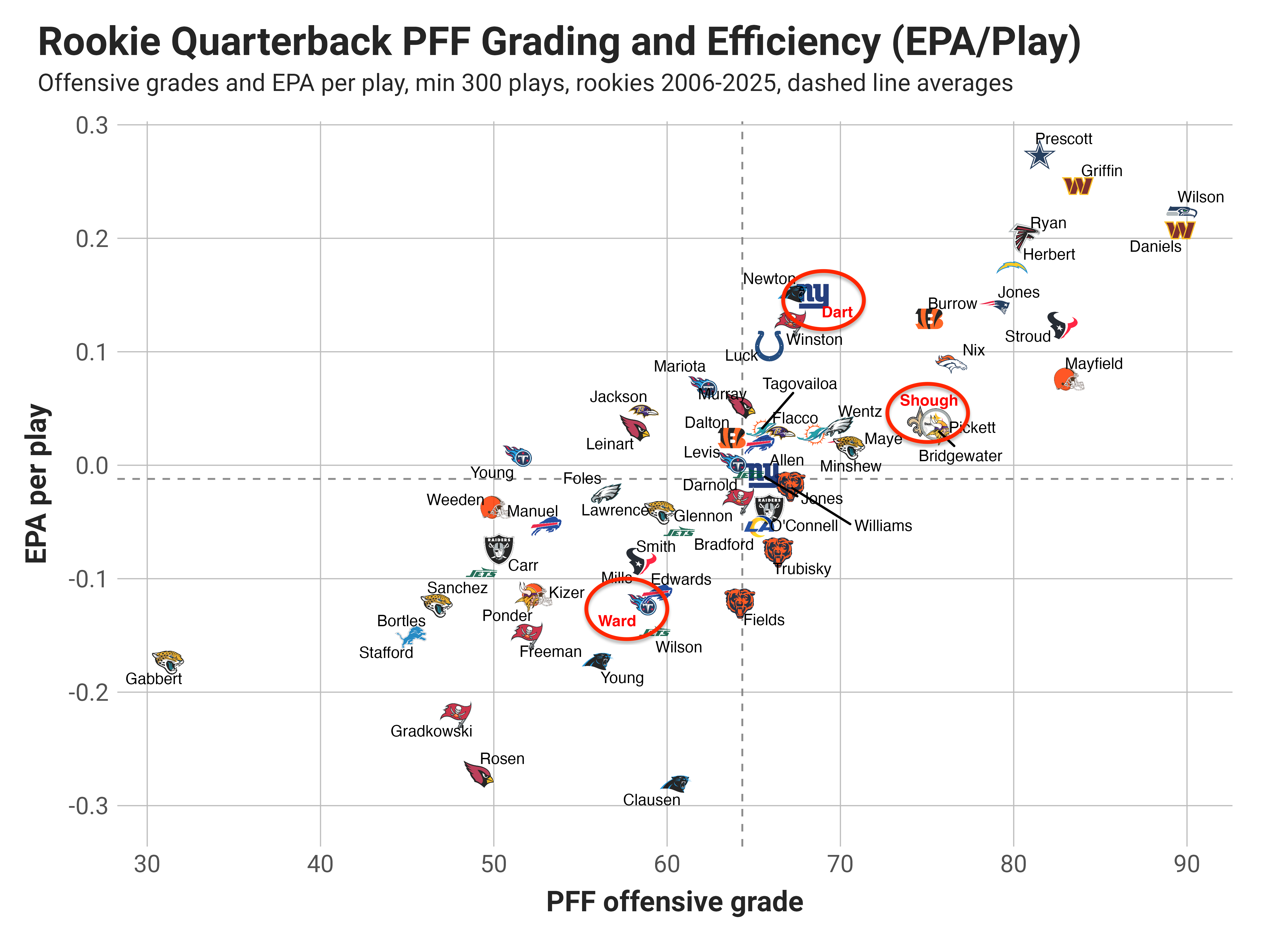
It’s a bit noisy to make out exactly where each of the 57 quarterbacks land on the plot, but the general takeaway is that Dart and Shough fall into the top-right quadrant of above-average PFF grading and EPA/play, whereas Ward falls into the bottom-left. Glancing through the names, you get the distinct impression that being good in both metrics tells us something about future performance, and not measuring up has the opposite association.
It’s important to note the averages for rookies indicated by the dashed gray lines, showing us that rookies typically perform well below the average NFL quarterback, with average grading around 65 (would have been fifth lowest in 2025) and EPA per play less than zero (typical quarterback/passing EPA is higher than zero, with dropbacks averaged +0.04 EPA). Playing quarterback in the NFL is hard for rookies, but you can still learn a lot by comparing rookies to their historical peers.
BREAKDOWN BY COMBINED PERCENTILES
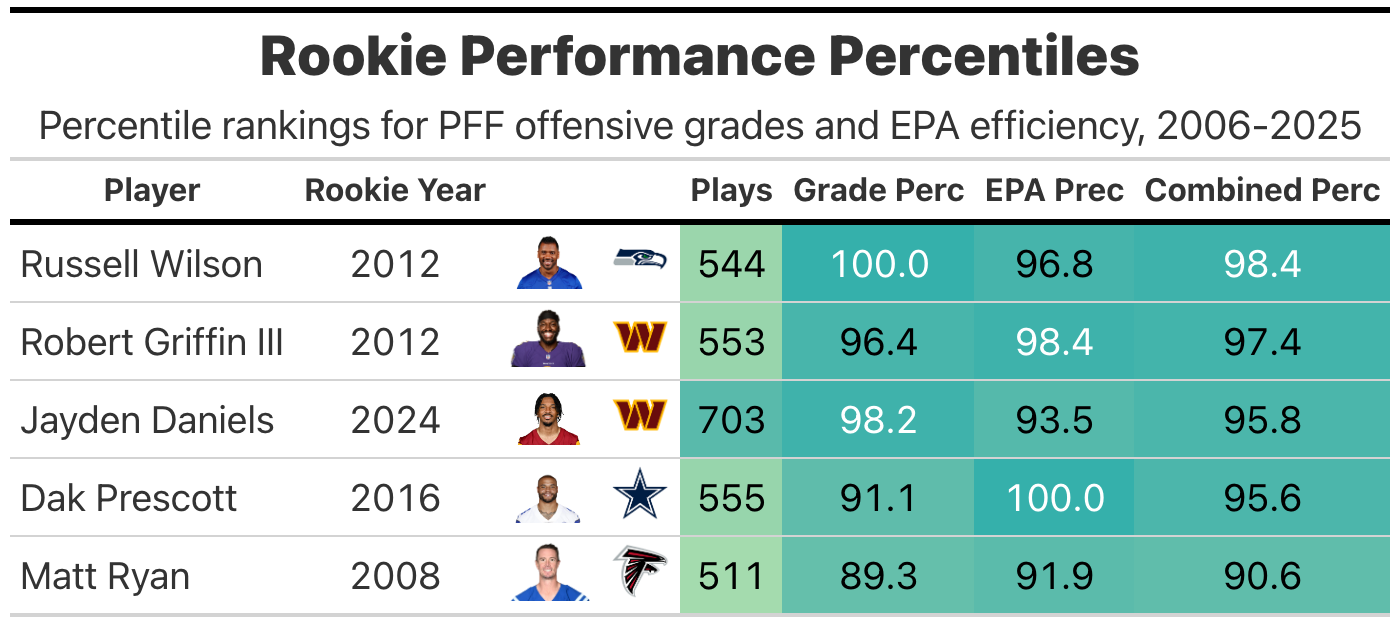
It’s easier to digest and interpret historical results by breaking them down into cohorts. Above are the five quarterbacks who had a combined average percentile above 90th for PFF grading and EPA per play.
It’s a small, but strong group. Jayden Daniels is still a question mark at this point, and Robert Griffin III is either a “miss” or gigantic “what-if” after suffering injuries early in his career. For what it’s worth, I believe Griffin had enough chances when healthy later in his career to prove he was good that “miss” is likely the right designation.
The other three names are really strong, including quarterbacks who played at elite levels for most of their primes. I know sentiment has shifted recently, but Russell Wilson hits all the metrics to make the Hall of Fame, and Matt Ryan isn’t far away. The lack of playoff success for Dak Prescott weighs on his assessment, but he’s already racked up six top-10 seasons in EPA efficiency in his career, four of those in the top-5.
