


I’m going to walk through the process of getting to my Week 1 power rankings for the new season. These rankings are based on the point differentials we expect for every team playing on a neutral field against a league-average opponent. These numbers represent my best guesses for how strong teams are relative to each other and independent of their schedule.
You can find the archive of power rankings from prior seasons here
All the detailed information for year-end 2023-2025 power rankings, plus the initial 2026 rankings, are on the subscriber Google sheet (along with other site metrics).
REVIEWING 2025 PERFORMANCE
Looking back at the fundamentals of how teams played last season, I’ve plotted the projected scoring rates (per play) on offense and defense for every team. This is largely derived from my game-level adjusted scores, which decay older results and give roughly 1.2x the weighting to offensive performance versus defensive, as the former is more “sticky” going forward.
I changed the relative weightings between offense and defense this season, moving from 1.5x (60/40) to 1.2x (55/45). When I tested the model on prior-season results this offseason, I found that the defensive contribution has become more important relative to offense, as it appears that the differentiation and dispersion of offensive performance across the NFL has narrowed.
The gaps in quarterback play, in particular, are smaller and have become less predictable for individual players. Don’t get me wrong: an elite quarterback is still the most important factor in determining team success. It’s just that we’ve seen more previously sub-par quarterbacks jump in performance mid-career (see Sam Darnold), and previously S-tier quarterbacks struggle for multiple seasons (see Patrick Mahomes). I’ll emphasize again: this isn’t a big adjustment, but a necessary one.
The plot includes no adjustments for injuries at key positions or anything outside of what happened on the actual play on the field.
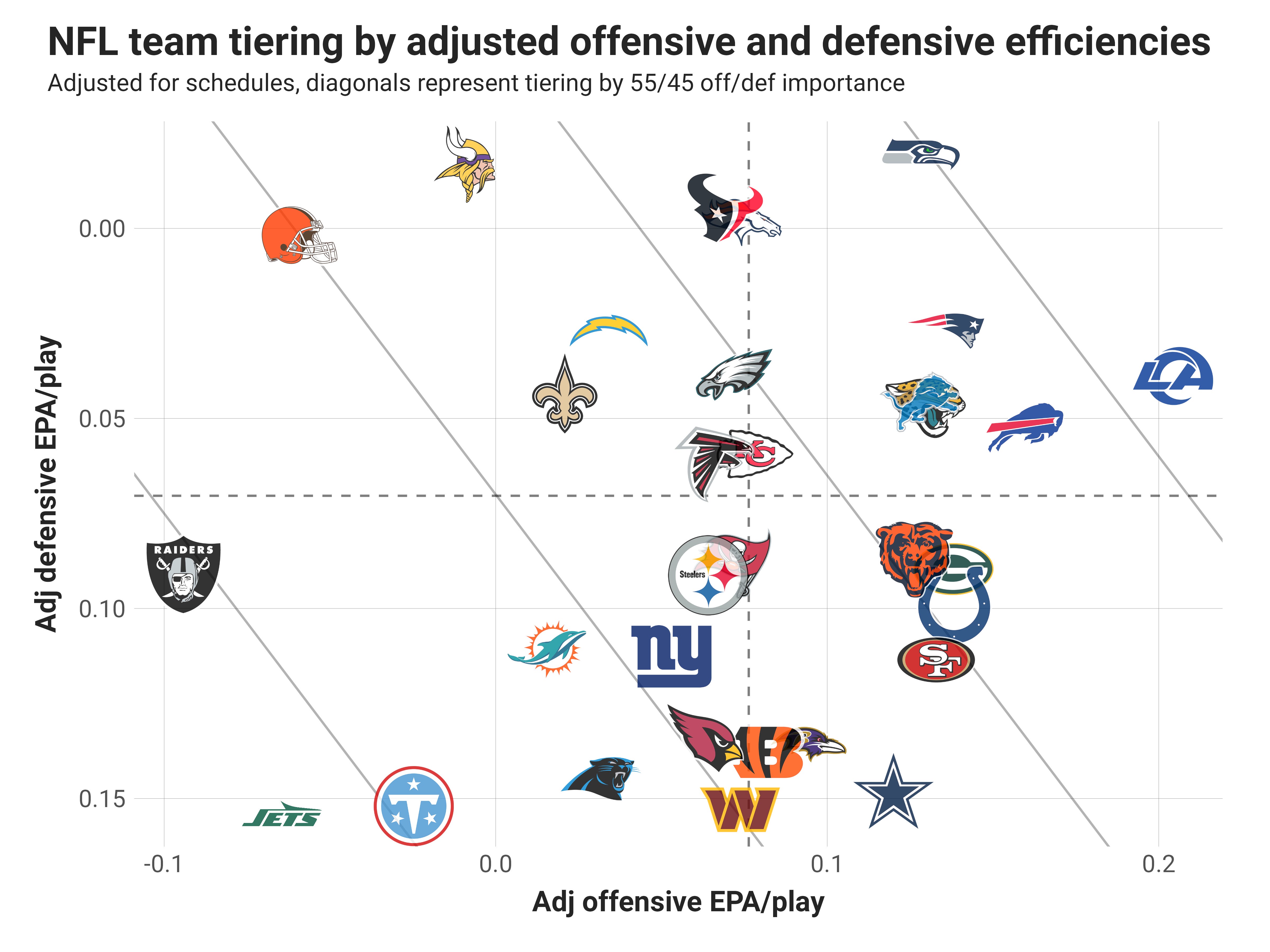
My power rankings had the Los Angeles Rams as the best team in the NFL for most of the second half of the 2025 season. The market - as is often the case - ended up being more correct, moving the Seattle Seahawks into pole position with a few weeks remaining in the regular season and riding them to the Super Bowl. My numbers still have the Rams with the best overall team efficiencies to end the year, ranking first offensively and above average on defense. The Seahawks were the best defense and fourth on offense.
With my models updated focus on defensive play, the gap is closer between the two team in overall strength (use the diagonal lines for comparison), but the Rams are clearly No. 1 and the Seahawks No. 2.
The Super Bowl-losing New England Patriots are in a virtual tie with the Buffalo Bills for third in 2025 performance, followed by the Detroit Lions and Jacksonville Jaguars (?). The Jags are one of my favored teams going into this year, although they look weaker by my calculation for offseason personnel improvement (see below).
NFC South division champion Carolina Panthers fans hated my lower rankings last season, and you can see that they’re in the second-to-bottom tier in performance, although not drastically off from the large cohort of squads that cluster around the middle of the distribution.
ADJUSTMENTS FOR THE NEW NFL SEASON
IMPROVEMENT INDEX
The next step in projecting 2026 is incorporating player-level changes for each team. For that, I’m leveraging my Improvement Index for this offseason, which estimates on a points-basis how much each team’s current roster has improved versus what it was at the end of last season.
The power rankings also adjust for quarterback play if 2026 starters missed a lot of action in 2025 and should return healthy, but that’s a separate process. The return of Aaron Donald doesn’t fit perfectly into the model, with performance data missing for recent seasons. I made an ad hoc adjustment using similar numbers to elite players who have moved teams in the past.
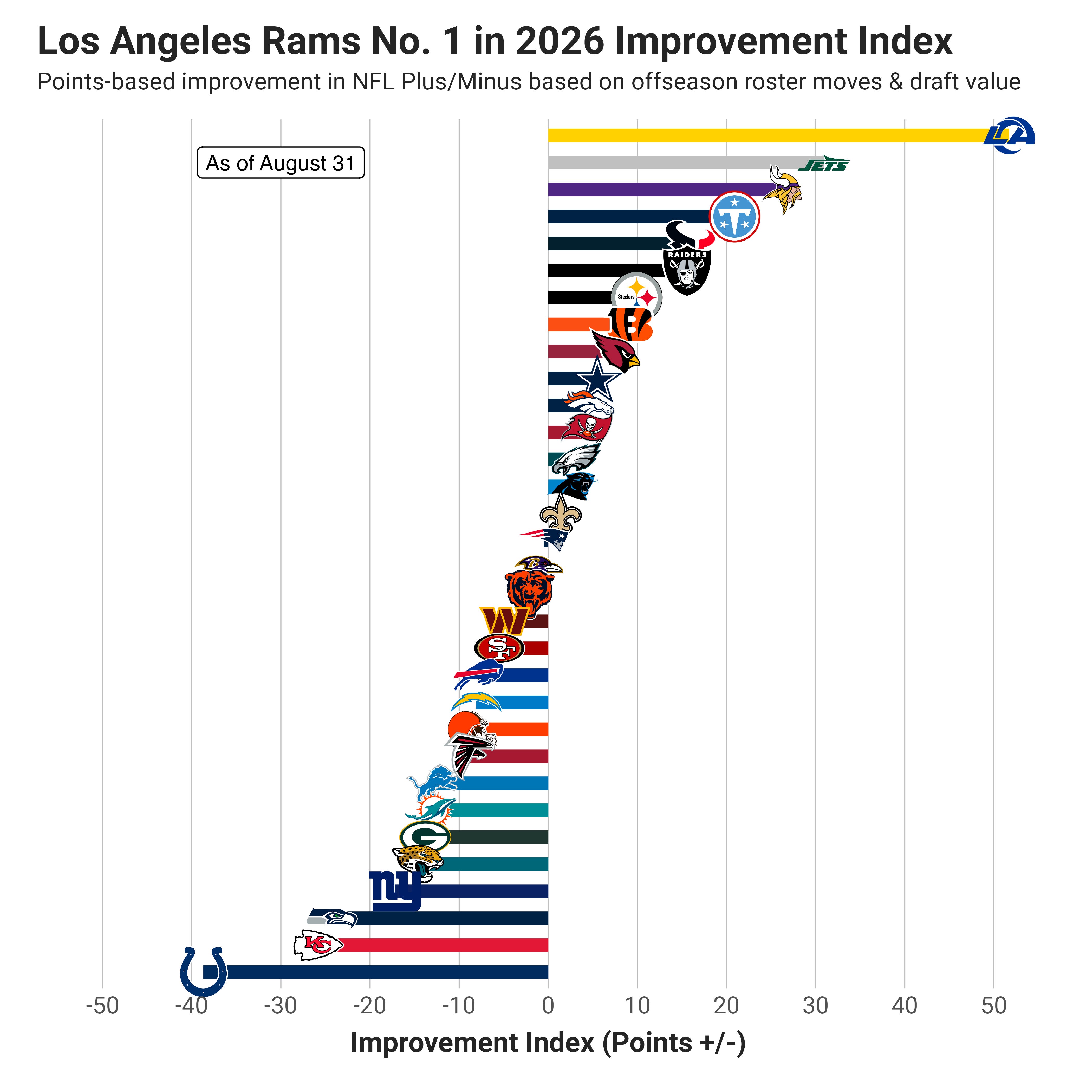
I already had the Los Angeles Rams as the best performers in 2025, and my 2026 projections add in the fact that they had the most impactful offseason. You don’t need to look much further than the acquisition of Myles Garrett and the return from retirement of Aaron Donald to explain the numbers. They’re arguably the two best defensive players in recent NFL history, though neither is in the middle of their primes at 30 and 35 years old, respectively.
As previous-year bad teams with lots of cap space tend to do, the New York Jets ranked high with big player signings, and the Minnesota Vikings jump on the projected improvement in quarterback with Kyler Murray.
The Indianapolis Colts at at the bottom of the field, without factoring in that Daniel Jones in returning from a torn Achilles. The Kansas City Chiefs and Seattle Seahawks are also lower, though their total-point losses equal less than a single game difference in projected records.
QUARTERBACK LUCK (OR OF LACK THEREOF)
I quantify and adjust for many of those factors in my Adjusted Quarterback Efficiency metric (AQE), illustrated below.
